Department of Behavioral Science, University of Kentucky College of Medicine, College of Medicine Office Building, Lexington, KY 40536-0086, USA.
Department of Behavioral Science, University of Kentucky College of Medicine, College of Medicine Office Building, Lexington, KY 40536-0086, USA; Department of Psychology, University of Kentucky College of Arts and Sciences, 106-B Kastle Hall, Lexington, KY 40506-0044, USA; Department of Psychiatry, University of Kentucky College of Medicine, 3470 Blazer Pkwy, Lexington, KY 40509-1810, USA.
Addict Behav. 2019 Jan;88:129-136. doi: 10.1016/j.addbeh.2018.08.023. Epub 2018 Aug 23.
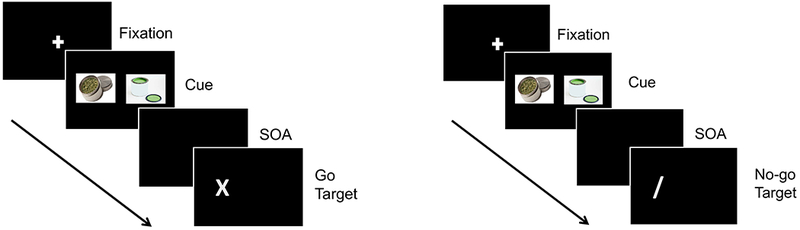
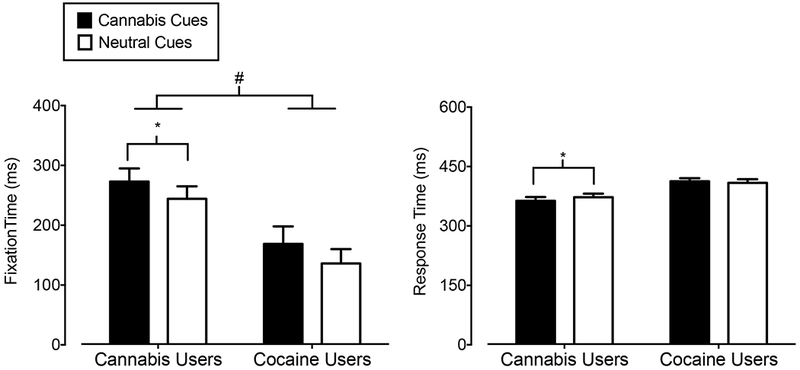
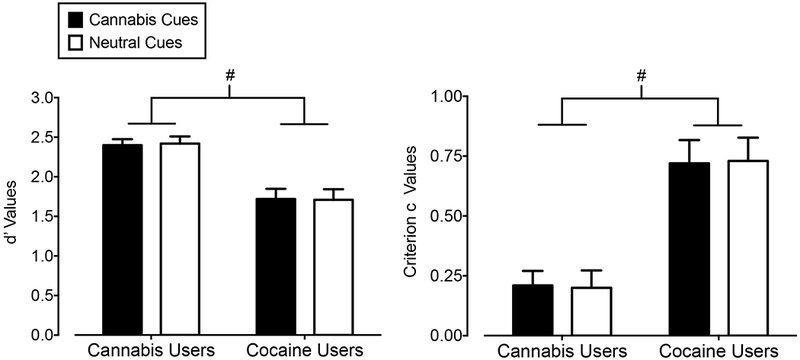
Attentional bias to drug cues has been associated with the problematic use of drugs, including cannabis. The cognitive mechanisms underlying this bias are not fully understood. The purpose of this study was to determine whether cannabis-cue attentional bias is associated with disruptions in attentional processing. To this end, a novel cannabis-cue visual probe task that incorporated eye tracking technology and attention-based metrics derived from signal detection theory was administered to seventeen individuals who reported daily/near-daily cannabis use. Seventeen individuals with cocaine use disorder were also enrolled as a clinical-control group. Cannabis and neutral images were briefly presented side-by-side on a computer screen, followed by the appearance of a "go" or "no-go" target upon offset of both images to permit assessment of attention-based performance. Cannabis users exhibited attentional bias to cannabis cues, as measured by fixation time and response time, but not cue-dependent disruptions on subsequent attentional performance. Cocaine users did not display an attentional bias to cannabis cues but did display poorer attentional performance relative to cannabis users. These results indicate that attentional bias to cannabis cues is selective to cannabis use history and not associated with impaired attentional processing.
对药物线索的注意力偏差与药物的问题使用有关,包括大麻。这种偏差的认知机制尚不完全清楚。本研究的目的是确定大麻线索注意力偏差是否与注意力加工障碍有关。为此,对 17 名报告每日/几乎每日使用大麻的个体进行了一项新的大麻线索视觉探测任务,该任务结合了眼动追踪技术和基于信号检测理论的注意力指标。还招募了 17 名可卡因使用障碍个体作为临床对照组。大麻和中性图像在计算机屏幕上并排短暂呈现,然后在两个图像消失后出现“是”或“否”目标,以评估基于注意力的表现。大麻使用者表现出对大麻线索的注意力偏差,表现为注视时间和反应时间,但随后的注意力表现没有线索依赖性的干扰。可卡因使用者对大麻线索没有表现出注意力偏差,但相对于大麻使用者,他们的注意力表现较差。这些结果表明,对大麻线索的注意力偏差是对大麻使用史的选择性的,而与注意力加工障碍无关。