Vujanovic Anka A, Wardle Margaret C, Liu Shijing, Dias Nadeeka R, Lane Scott D
a Center for Neurobehavioral Research on Addiction , Department of Psychiatry and Behavioral Sciences, University of Texas Health Science Center at Houston , Houston , Texas , USA.
J Addict Dis. 2016;35(2):144-53. doi: 10.1080/10550887.2015.1116354. Epub 2015 Nov 13.
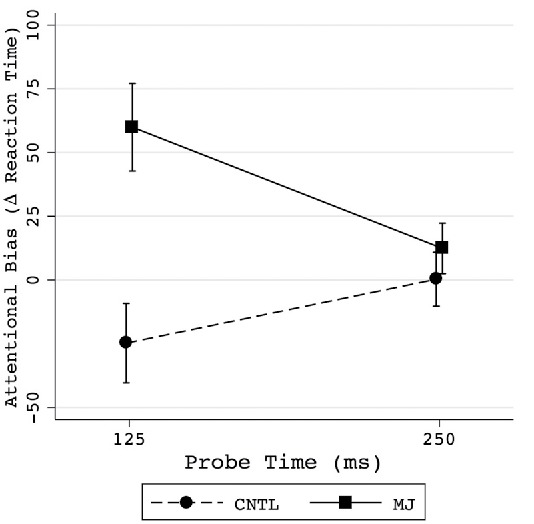
There has been modest examination of attentional bias in individuals with cannabis use disorders. Clinical implications of this work are directly relevant to better informing extant evidence-based treatment for substance use disorders (e.g., relapse prevention) and/or developing novel interventions. The overarching aim of this investigation was to examine a novel attentional bias task in adults with cannabis use disorders. Participants were comprised of 25 adults (8 women: M age = 31, SD = 6.8; range = 22-45) with cannabis use disorders (n = 12) and controls (n = 13) without any current (past month) psychopathology. Relative to controls, adults with cannabis use disorders had greater attentional bias scores. These differences were present only at the 125-ms probe time, where the cannabis use disorders group showed greater attentional bias to cannabis cues than the control group (adjusted p = .001, cannabis use disorders mean = 59.9, control mean = -24.8, Cohen's d-effect size for 125 ms = 1.03). The cannabis use disorders group also reported significantly greater perceived stress and post-task stress scores than the control group, but stress was not related to attentional bias. This study informs understanding of the influence of cannabis cues on visual detection and reaction time under different cue-target onset times, as attentional bias was most prevalent under time pressure to detect the probe.
针对患有大麻使用障碍的个体的注意偏向,目前仅有适度的研究。这项工作的临床意义与更好地为现有的基于证据的物质使用障碍治疗(例如预防复发)提供信息和/或开发新的干预措施直接相关。本研究的总体目标是在患有大麻使用障碍的成年人中检验一种新的注意偏向任务。参与者包括25名成年人(8名女性:平均年龄 = 31岁,标准差 = 6.8;范围 = 22 - 45岁),其中患有大麻使用障碍的有12人,对照组(13人)目前(过去一个月)没有任何精神病理学问题。与对照组相比,患有大麻使用障碍的成年人的注意偏向得分更高。这些差异仅出现在125毫秒的探测时间点,此时大麻使用障碍组对大麻线索的注意偏向比对照组更大(校正p = 0.001,大麻使用障碍组平均值 = 59.9,对照组平均值 = -24.8,125毫秒时的科恩d效应大小 = 1.03)。大麻使用障碍组报告的感知压力和任务后压力得分也显著高于对照组,但压力与注意偏向无关。这项研究有助于理解在不同线索 - 目标起始时间下,大麻线索对视觉检测和反应时间的影响,因为在检测探测刺激的时间压力下,注意偏向最为普遍。