Zakumumpa Henry, Rujumba Joseph, Kwiringira Japheth, Kiplagat Jepchirchir, Namulema Edith, Muganzi Alex
School of Public Health, Makerere University, Kampala, Uganda.
School of Medicine, Makerere University, Kampala, Uganda.
BMC Health Serv Res. 2018 Sep 5;18(1):690. doi: 10.1186/s12913-018-3500-4.
Although there is mounting evidence and policy guidance urging the integration of HIV services into general health systems in countries with a high HIV burden, vertical (stand-alone) HIV clinics are still common in Uganda. We sought to describe the specific contexts underpinning the endurance of vertical HIV clinics in Uganda.
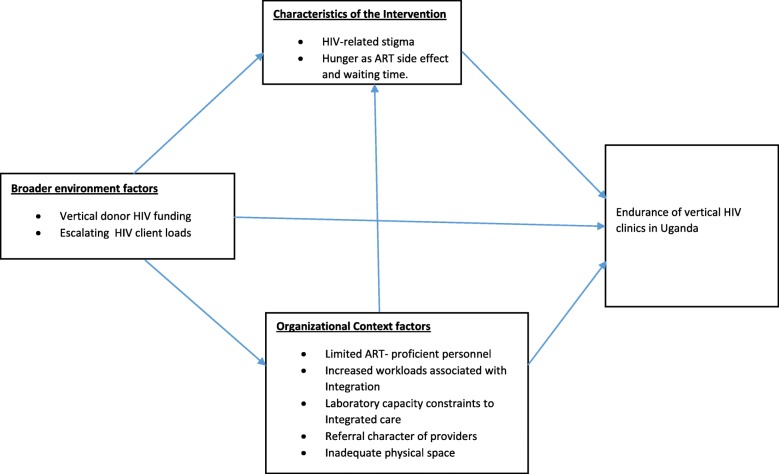
A qualitative research design was adopted. Semi-structured interviews were conducted with the heads of HIV clinics, clinicians and facility in-charges (n = 78), coupled with eight focus group discussions (64 participants) with patients from 16 health facilities purposively selected, from a nationally-representative sample of 195 health facilities across Uganda, because they run stand-alone HIV clinics. Data were analyzed by thematic approach as guided by the theory proposed by Shediac-Rizkallah & Bone (1998) which identifies; Intervention characteristics, organizational context, and broader environment factors as potentially influential on health programme sustainability.
Intervention characteristics: Provider stigma was reported to have been widespread in the integrated care experience of participating health facilities which necessitated the establishment of stand-alone HIV clinics. HIV disease management was described as highly specialized which necessitated a dedicated workforce and vertical HIV infrastructure such as counselling rooms. Organizational context: Participating health facilities reported health-system capacity constraints in implementing integrated systems of care due to a shortage of ART-proficient personnel and physical space, a lack of laboratory capacity to concurrently conduct HIV and non-HIV tests and increased workloads associated with implementing integrated care. Broader environment factors: Escalating HIV client loads and external HIV funding architectures were perceived to have perpetuated verticalized HIV programming over the past decade.
Our study offers in-depth, contextualized insights into the factors contributing to the endurance of vertical HIV clinics in Uganda. Our analysis suggests that there is a complex interaction in supply-side constraints (shortage of ART-proficient personnel, increased workloads, laboratory capacity deficiencies) and demand-side factors (escalating demand for HIV services, psychosocial barriers to HIV care) as well as the specialized nature of HIV disease management which pose challenges to the integrated-health services agenda.
尽管有越来越多的证据和政策指导敦促在艾滋病毒负担较高的国家将艾滋病毒服务纳入一般卫生系统,但在乌干达,垂直(独立)艾滋病毒诊所仍然很常见。我们试图描述支撑乌干达垂直艾滋病毒诊所持续存在的具体背景。
采用定性研究设计。对艾滋病毒诊所负责人、临床医生和机构负责人(n = 78)进行了半结构化访谈,并与来自乌干达195个卫生机构的全国代表性样本中有意挑选的16个卫生机构的患者进行了八次焦点小组讨论(64名参与者),因为这些机构设有独立的艾滋病毒诊所。根据Shediac-Rizkallah和Bone(1998)提出的理论,采用主题分析法对数据进行分析,该理论确定干预特征、组织背景和更广泛的环境因素可能对卫生项目的可持续性产生影响。
干预特征:据报告,在参与的卫生机构的综合护理经验中,提供者的耻辱感普遍存在,这使得有必要设立独立的艾滋病毒诊所。艾滋病毒疾病管理被描述为高度专业化,这需要一支专门的工作人员队伍和垂直的艾滋病毒基础设施,如咨询室。组织背景:参与的卫生机构报告称,由于缺乏抗逆转录病毒治疗专业人员和物理空间、缺乏同时进行艾滋病毒和非艾滋病毒检测的实验室能力以及与实施综合护理相关的工作量增加,在实施综合护理系统方面存在卫生系统能力限制。更广泛的环境因素:在过去十年中,不断增加的艾滋病毒客户数量和外部艾滋病毒资金架构被认为使垂直化的艾滋病毒项目得以持续。
我们的研究对导致乌干达垂直艾滋病毒诊所持续存在的因素提供了深入的、背景化的见解。我们的分析表明,在供应方限制(抗逆转录病毒治疗专业人员短缺、工作量增加、实验室能力不足)和需求方因素(对艾滋病毒服务的需求不断增加、艾滋病毒护理的心理社会障碍)以及艾滋病毒疾病管理的特殊性之间存在复杂的相互作用,这些对综合卫生服务议程构成了挑战。