Haque Md Ezazul, Kim In-Su, Jakaria Md, Akther Mahbuba, Choi Dong-Kug
Department of Applied Life Science, Graduate School, Konkuk University, Chungju, South Korea.
Department of Integrated Bioscience and Biotechnology, College of Biomedical and Health Science, Research Institute of Inflammatory Disease, Konkuk University, Chungju, South Korea.
Front Cell Neurosci. 2018 Aug 21;12:258. doi: 10.3389/fncel.2018.00258. eCollection 2018.
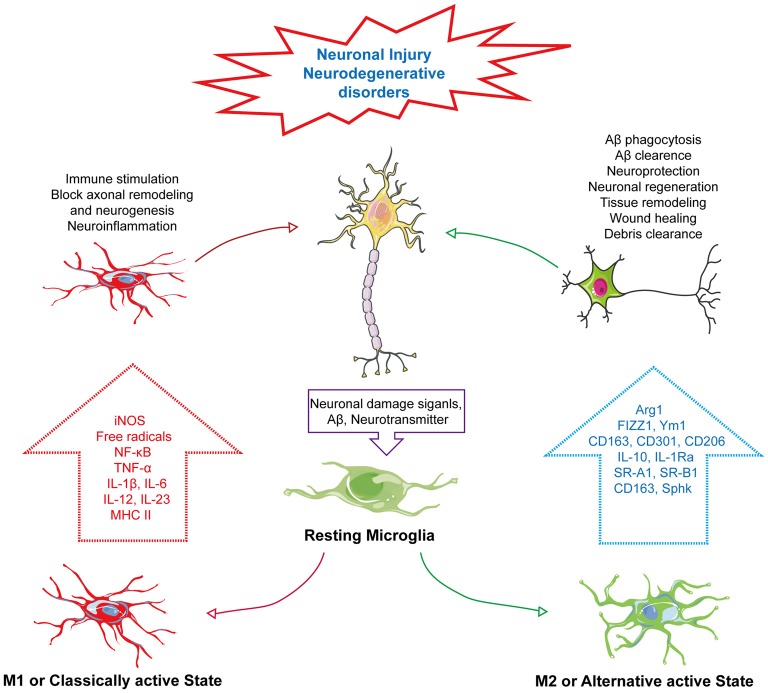
Alzheimer's disease (AD) is a progressive neurodegenerative disorder associated with impairment of cognition, memory deficits and behavioral abnormalities. Accumulation of amyloid beta (Aβ) is a characteristic hallmark of AD. Microglia express several GPCRs, which, upon activation by modulators, mediate microglial activation and polarization phenotype. This GPCR-mediated microglial activation has both protective and detrimental effects. Microglial GPCRs are involved in amyloid precursor protein (APP) cleavage and Aβ generation. In addition, microglial GPCRs are featured in the regulation of Aβ degradation and clearance through microglial phagocytosis and chemotaxis. Moreover, in response to Aβ binding on microglial Aβ receptors, they can trigger multiple inflammatory pathways. However, there is still a lack of insight into the mechanistic link between GPCR-mediated microglial activation and its pathological consequences in AD. Currently, the available drugs for the treatment of AD are mostly symptomatic and dominated by acetylcholinesterase inhibitors (AchEI). The selection of a specific microglial GPCR that is highly expressed in the AD brain and capable of modulating AD progression through Aβ generation, degradation and clearance will be a potential source of therapeutic intervention. Here, we have highlighted the expression and distribution of various GPCRs connected to microglial activation in the AD brain and their potential to serve as therapeutic targets of AD.
阿尔茨海默病(AD)是一种进行性神经退行性疾病,与认知障碍、记忆缺陷和行为异常有关。β-淀粉样蛋白(Aβ)的积累是AD的一个特征性标志。小胶质细胞表达多种G蛋白偶联受体(GPCR),这些受体在被调节剂激活后,介导小胶质细胞的激活和极化表型。这种GPCR介导的小胶质细胞激活具有保护和有害两种作用。小胶质细胞GPCR参与淀粉样前体蛋白(APP)的切割和Aβ的产生。此外,小胶质细胞GPCR在通过小胶质细胞吞噬作用和趋化作用调节Aβ降解和清除方面具有特点。而且,响应于Aβ与小胶质细胞Aβ受体的结合,它们可以触发多种炎症途径。然而,对于GPCR介导的小胶质细胞激活与其在AD中的病理后果之间的机制联系仍缺乏深入了解。目前,治疗AD的可用药物大多是对症治疗,主要是乙酰胆碱酯酶抑制剂(AchEI)。选择在AD大脑中高表达且能够通过Aβ的产生、降解和清除来调节AD进展的特定小胶质细胞GPCR,将是一个潜在的治疗干预来源。在这里,我们强调了与AD大脑中小胶质细胞激活相关的各种GPCR的表达和分布及其作为AD治疗靶点的潜力。