Mandini Simona, Conconi Francesco, Mori Elisa, Myers Jonathan, Grazzi Giovanni, Mazzoni Gianni
Center of Biomedical Studies Applied to Sport, University of Ferrara, Ferrara, Italy.
Public Health Department, AUSL Ferrara, Ferrara, Italy.
PeerJ. 2018 Aug 30;6:e5471. doi: 10.7717/peerj.5471. eCollection 2018.
The aim of the study was to assess the effects of walking on the blood pressure in sedentary adults with differing degrees of systolic blood pressure (SBP).
A total of 529 subjects with SBP above 120 mmHg were enrolled. Blood pressure, body weight, body mass index, waist circumference and walking speed were determined at enrolment and after six months. Walking sessions were supervised by exercise physiologists.
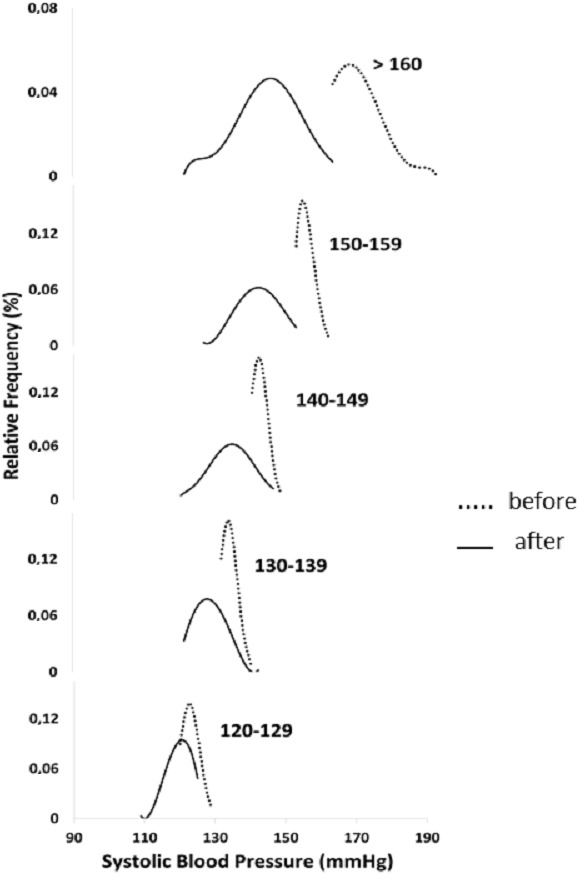
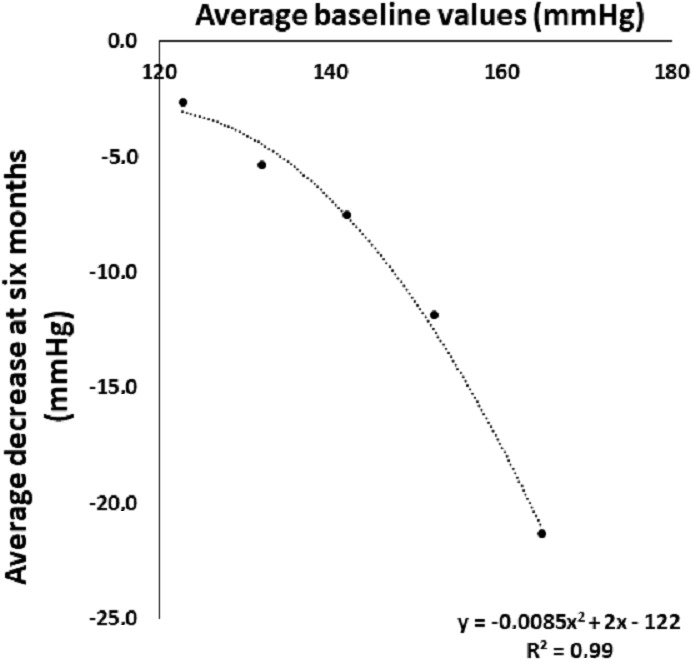
The weekly walking time of the subjects completing the project was uniform and reached 300 minutes by the second month. 56% of participants completed the 6 months intervention (182 women 59.6 ± 9.0 years, and 114 men, 65.4 ± 8.6 years) 27 had a baseline SBP >160 mm Hg, 35 between 150-159, 70 between 140-149, 89 between 130-139 and 75 between 120-129 mmHg. Following six months of supervised walking, SBP was significantly reduced in all subgroups ( < 0.001), with the greatest reduction (-21.3 mmHg) occurring in subjects with baseline SBP >160 and the smallest reduction (-2.6 mmHg) occurring in subjects with baseline SBP of 120-129 mmHg. Diastolic blood pressure, body weight, body mass index and waist circumference were also significantly reduced following the walking intervention ( < 0.001). These reductions were nearly identical within the various groups.
In a large group of sedentary adults with varying degrees of SBP, 6 months of supervised walking elicited a marked reduction in systolic blood pressure with the largest reductions in pressure occurring in individuals with higher baseline SBP.
本研究旨在评估步行对不同收缩压(SBP)水平的久坐不动成年人血压的影响。
共招募了529名收缩压高于120 mmHg的受试者。在入组时和六个月后测定血压、体重、体重指数、腰围和步行速度。步行训练由运动生理学家监督。
完成该项目的受试者每周步行时间一致,到第二个月时达到300分钟。56%的参与者完成了6个月的干预(182名女性,年龄59.6±9.0岁,114名男性,年龄65.4±8.6岁)。27人基线收缩压>160 mmHg,35人在150 - 159之间,70人在140 - 149之间,89人在130 - 139之间,75人在120 - 129 mmHg之间。经过六个月的监督步行后,所有亚组的收缩压均显著降低(P<0.001),基线收缩压>160的受试者降低幅度最大(-21.3 mmHg),基线收缩压为120 - 129 mmHg的受试者降低幅度最小(-2.6 mmHg)。步行干预后舒张压、体重、体重指数和腰围也显著降低(P<0.001)。这些降低在各个组内几乎相同。
在一大组不同收缩压水平的久坐不动成年人中,6个月的监督步行使收缩压显著降低,基线收缩压较高的个体血压降低幅度最大。