Qadir Raza, Sculthorpe Nicholas F, Todd Taylor, Brown Elise C
Oakland University William Beaumont School of Medicine, 586 Pioneer Dr, Rochester, MI, 48309, USA.
Institute of Clinical Exercise and Health Science, University of the West of Scotland, Lanarkshire, UK.
Sports Med Open. 2021 May 29;7(1):38. doi: 10.1186/s40798-021-00321-x.
Resistance training (RT) is an effective intervention for glycemic control and cardiometabolic health in individuals with type 2 diabetes (T2D). However, the use of RT in individuals at risk for T2D to prevent or delay the onset of T2D, and RT program characteristics that are most effective are still unknown. The purpose of this review is to determine the effects of RT on cardiometabolic risk factors in those at risk for T2D and to examine RT program characteristics associated with intervention effectiveness.
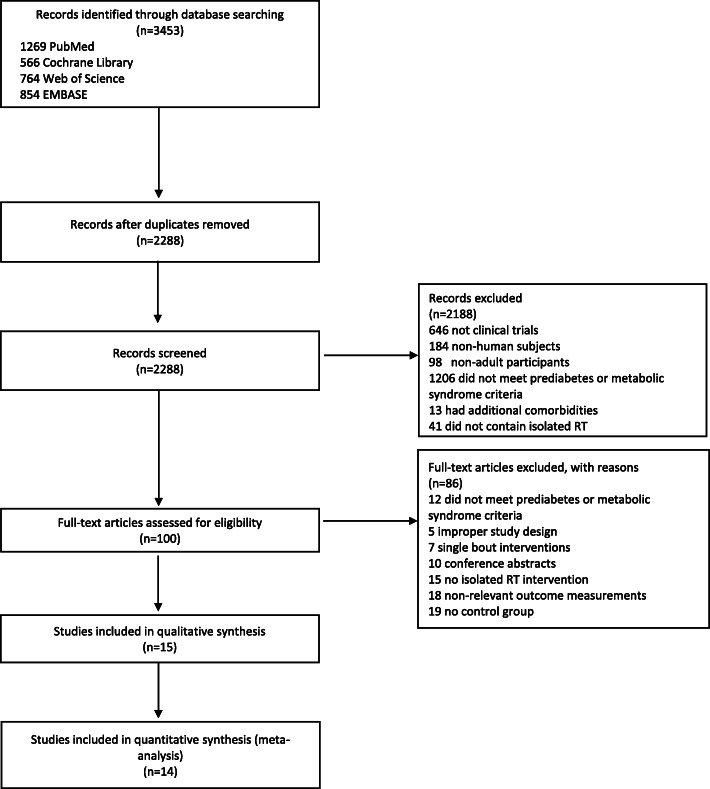
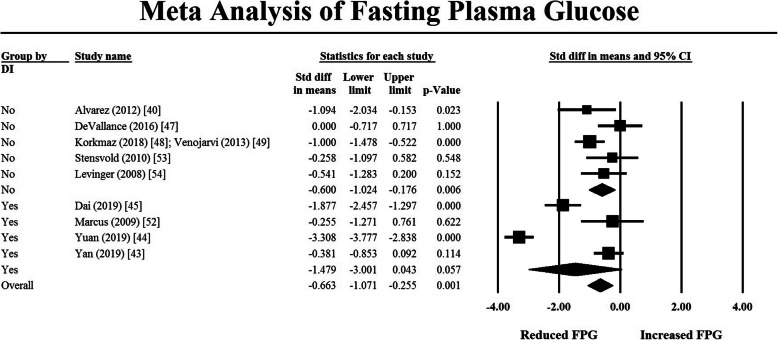
PubMed, Cochrane, Web of Science, and Embase databases were systematically searched for published controlled trials that compared cardiometabolic outcomes in adults with cardiometabolic risk for those that underwent an RT intervention with those that did not. A systematic review and meta-analysis was conducted to determine the effect of RT on glycosylated hemoglobin (HbA1c), fasting plasma glucose (FPG), body fat percentage (BF%), total cholesterol (TC), high-density lipoprotein (HDL), low-density lipoprotein (LDL), and triglycerides (TG). Additional analyses examined effects of intervention duration and dietary intervention on FPG and TG.
Fourteen trials with 668 participants were included. For RT compared to controls, the standardized mean difference (SMD) was -1.064 for HbA1c (95% confidence interval [CI] -1.802 to -0.327; p=0.005), -0.99 for FPG (95% CI -1.798 to -0.183; p=0.016), -0.933 for TC (95% CI -1.66 to -0.206; p=0.012), -0.840 for BF% (95% CI -1.429 to -0.251; p=0.005), -0.693 for HDL (95% CI -1.230 to -0.156; p=0.011), -1.03 for LDL (95% CI -2.03 to -0.050; p=0.039), and -0.705 for TG (95% CI -1.132 to -0.279; p=0.001).
RT is beneficial for improving glycemic control, BF%, and blood lipids in those at risk for diabetes. The addition of a dietary component did not result in larger reductions in FPG and TG than RT alone.
CRD42019122217.
抗阻训练(RT)是对2型糖尿病(T2D)患者进行血糖控制和改善心脏代谢健康的有效干预措施。然而,对于有T2D风险的个体使用RT来预防或延缓T2D的发病情况,以及最有效的RT方案特征仍不清楚。本综述的目的是确定RT对有T2D风险个体的心脏代谢危险因素的影响,并研究与干预效果相关的RT方案特征。
系统检索了PubMed、Cochrane、科学引文索引和Embase数据库,以查找已发表的对照试验,这些试验比较了有心脏代谢风险的成年人中接受RT干预者与未接受干预者的心脏代谢结局。进行了系统评价和荟萃分析,以确定RT对糖化血红蛋白(HbA1c)、空腹血糖(FPG)、体脂百分比(BF%)、总胆固醇(TC)、高密度脂蛋白(HDL)、低密度脂蛋白(LDL)和甘油三酯(TG)的影响。额外的分析研究了干预持续时间和饮食干预对FPG和TG的影响。
纳入了14项试验,共668名参与者。与对照组相比,RT组的HbA1c标准化均数差(SMD)为-1.064(95%置信区间[CI]-1.802至-0.327;p=0.005),FPG为-0.99(95%CI-1.798至-0.183;p=0.016),TC为-0.933(95%CI-1.66至-0.206;p=0.012),BF%为-0.840(95%CI-1.429至-0.251;p=0.005),HDL为-0.693(95%CI-1.230至-0.156;p=0.011),LDL为-1.03(95%CI-2.03至-0.050;p=0.039),TG为-0.705(95%CI-1.132至-0.279;p=0.001)。
RT有利于改善糖尿病风险个体的血糖控制、BF%和血脂。添加饮食成分并未比单独进行RT导致FPG和TG有更大程度的降低。
CRD42019122217。