Department of Biological Applications and Technology, School of Health Sciences, University of Ioannina, Ioannina, Greece.
Monterey Bay Aquarium, Monterey, CA, United States of America.
PLoS One. 2018 Sep 6;13(9):e0203124. doi: 10.1371/journal.pone.0203124. eCollection 2018.
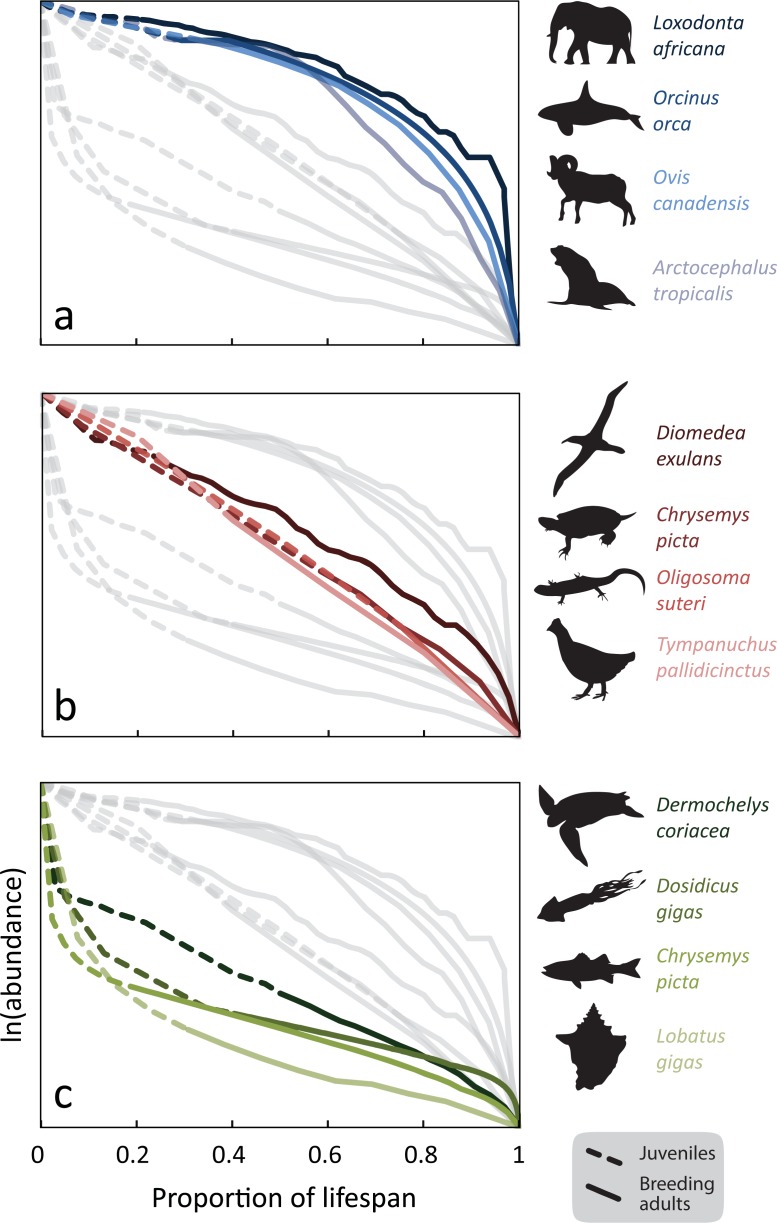
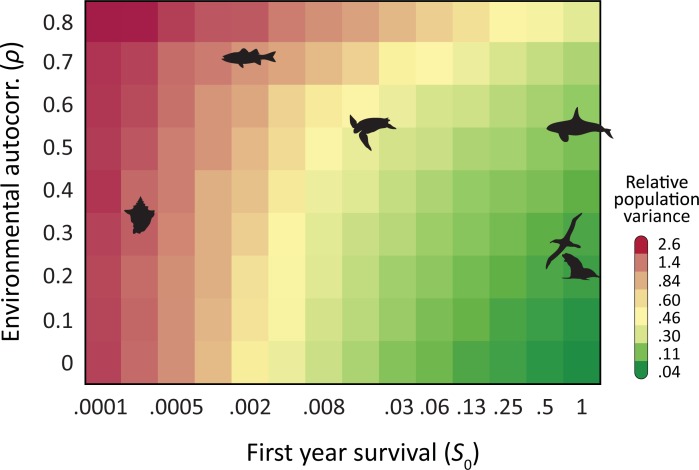
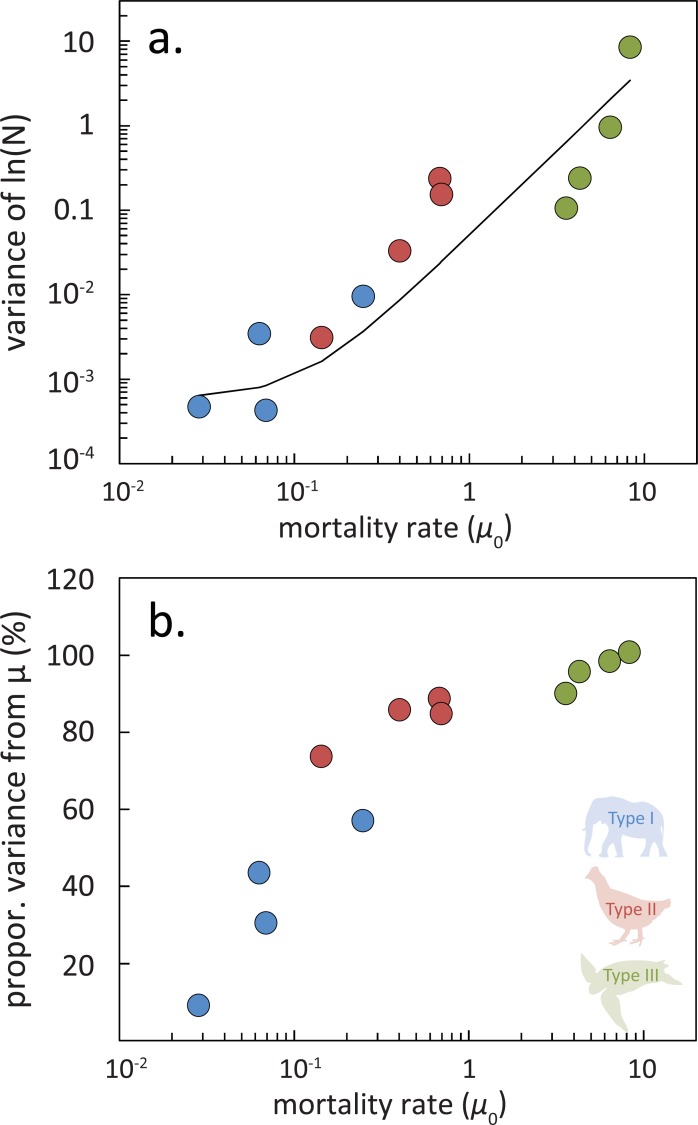
Human activities are exposing organisms not only to direct threats (e.g. habitat loss) but also to indirect environmental pressures such as climate change, which involves not just directional global warming but also increasing climatic variability. Such changes will impact whole communities of organisms and the possible effects on population dynamics have raised concerns about increased extinction rates. Conservation-minded approaches to extinction risk vary from range shifts predicted by climate envelope models with no population dynamics to population viability analyses that ignore environmental variability altogether. Our modelling study shows that these extremes are modelling responses to a spectrum of environmental sensitivity that organisms may exhibit. We show how the survival curve plays a major role in how environmental variability leads to population fluctuations. While it is often supposed that low-fecundity organisms (those with high parental investment) will be the most vulnerable to climate change, it is those with high fecundity (low parental investment) that are likely to be more sensitive to such changes. We also find that abundance variations in high fecundity populations is driven primarily by fluctuations in the survival of early life stages, the more so if those environmental changes are autocorrelated in time. We show which types of conservation actions are most appropriate for a number of real populations. While the most effective conservation actions for organisms of low fecundity is to avoid killing them, for populations with high fecundity (and low parental investment), our study suggests conservation should focus more on protecting early life stages from hostile environments.
人类活动不仅使生物直接面临威胁(例如栖息地丧失),还使它们间接承受环境压力,例如气候变化,气候变化不仅包括全球变暖的方向性变化,还包括气候变异性增加。这些变化将影响到整个生物群落,而其对种群动态的潜在影响引发了人们对灭绝率上升的担忧。考虑到灭绝风险的保护方法多种多样,从气候 envelope 模型预测的无种群动态的范围转移,到完全忽略环境变异性的种群生存力分析。我们的模型研究表明,这些极端情况是对生物体可能表现出的一系列环境敏感性的模型响应。我们展示了生存曲线如何在环境变异性导致种群波动方面发挥主要作用。尽管通常认为低生育率生物(那些具有高亲代投资的生物)最容易受到气候变化的影响,但那些具有高生育率(低亲代投资)的生物可能更容易受到此类变化的影响。我们还发现,高生育率种群的丰度变化主要是由早期生命阶段的生存波动驱动的,如果这些环境变化在时间上具有自相关性,则更是如此。我们展示了针对许多实际种群的最适当的保护行动类型。对于低生育率生物来说,最有效的保护行动是避免杀死它们,而对于高生育率(低亲代投资)的种群,我们的研究表明,保护应更侧重于保护早期生命阶段免受恶劣环境的影响。