Albina E, Piriou L, Hutet E, Cariolet R, L'Hospitalier R
Centre National d'Etudes Vétérinaires et Alimentaires, Unité de Virologie et Immunologie Porcines, Ploufragan, France.
Vet Immunol Immunopathol. 1998 Feb 16;61(1):49-66. doi: 10.1016/s0165-2427(97)00134-7.
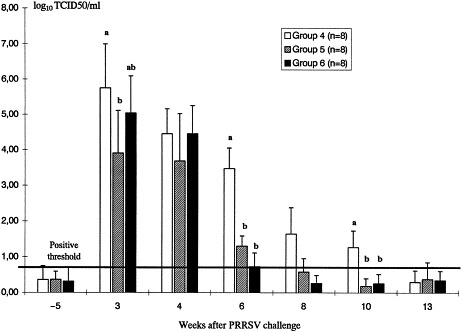
In three successive experiments, the immune functions of pigs persistently infected with the porcine reproductive and respiratory syndrome virus (PRRSV) have been evaluated. Non-specific immune responses were analyzed over a period of 12 weeks post-infection (PI). In addition, the capacity of PRRSV-infected pigs to develop an efficient immune response against pseudorabies virus (PRV) glycoproteins and to resist to a subsequent virulent challenge was investigated. Our results demonstrate that PRRSV produced minor effects on the immune system of pigs. The skin delayed type hypersensitivity (DTH) in response to phytohemagglutinine injection was slightly diminished one week after challenge, but was restored thereafter. However, three weeks after the infection, the total white blood cell count, and the number of CD2+, CD8+ and IgM+ cells were enhanced. The increase in numbers of CD8+ cells persisted for three consecutive weeks. Serum immunoglobulins in infected pigs also increased by week 3 PI and up to 8 weeks PI. These results show that PRRSV may have stimulating effects on the pig immune system during the phase of long-lasting infection. After immunization with PRV glycoproteins, the production of anti-PRV antibodies and skin DTH response against PRV glycoproteins were not affected. On the contrary, following a virulent PRV challenge, PRRSV-infected pigs developed a better secondary antibody response and their resistance to the infection was as effective as in control pigs. Taken together, our data do not support a systemic immunosuppressive effect of PRRSV, during the persistent phase of infection. Other mechanisms may therefore apply to explain the emergence of secondary infections in endemically infected herds.
在三项连续的实验中,对持续感染猪繁殖与呼吸综合征病毒(PRRSV)的猪的免疫功能进行了评估。在感染后12周的时间内分析了非特异性免疫反应。此外,还研究了感染PRRSV的猪针对伪狂犬病病毒(PRV)糖蛋白产生有效免疫反应以及抵抗随后强毒攻击的能力。我们的结果表明,PRRSV对猪的免疫系统产生的影响较小。在接种植物血凝素后,皮肤迟发型超敏反应(DTH)在攻击后一周略有减弱,但此后恢复。然而,感染三周后,白细胞总数以及CD2 +、CD8 +和IgM +细胞数量增加。CD8 +细胞数量的增加持续了连续三周。感染猪的血清免疫球蛋白在感染后第3周也增加,直至感染后8周。这些结果表明,PRRSV在长期感染阶段可能对猪免疫系统有刺激作用。用PRV糖蛋白免疫后,抗PRV抗体的产生以及针对PRV糖蛋白的皮肤DTH反应不受影响。相反,在受到强毒PRV攻击后,感染PRRSV的猪产生了更好的二次抗体反应,并且它们对感染的抵抗力与对照猪一样有效。综上所述,我们的数据不支持PRRSV在感染持续阶段具有全身性免疫抑制作用。因此,可能需要其他机制来解释地方性感染猪群中继发感染的出现。