Department of Experimental Biomedicine and Clinical Neuroscience, Section of Human Anatomy, University of Palermo, 90127 Palermo, Italy.
Euro-Mediterranean Institute of Science and Technology (IEMEST), 90136 Palermo, Italy.
Int J Mol Sci. 2018 Sep 5;19(9):2626. doi: 10.3390/ijms19092626.
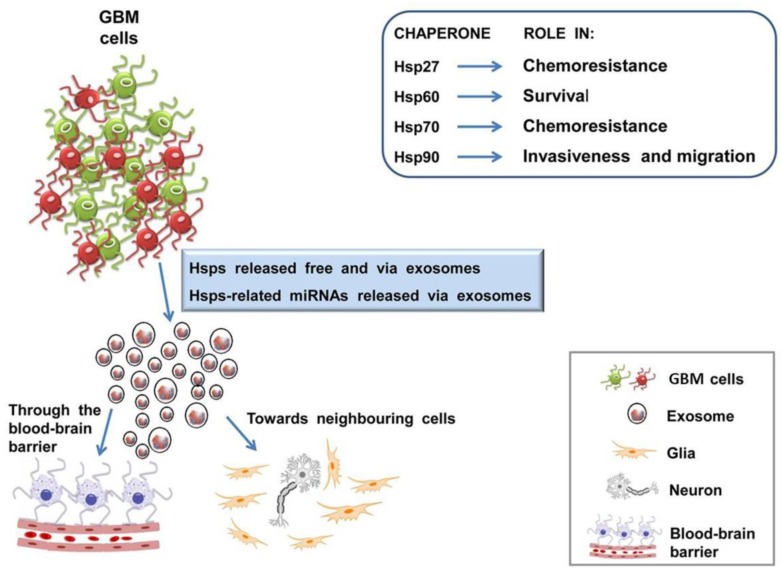
Gliomas have poor prognosis no matter the treatment applied, remaining an unmet clinical need. As background for a substantial change in this situation, this review will focus on the following points: (i) the steady progress in establishing the role of molecular chaperones in carcinogenesis; (ii) the recent advances in the knowledge of miRNAs in regulating gene expression, including genes involved in carcinogenesis and genes encoding chaperones; and (iii) the findings about exosomes and their cargo released by tumor cells. We would like to trigger a discussion about the involvement of exosomal chaperones and miRNAs in gliomagenesis. Chaperones may be either targets for therapy, due to their tumor-promoting activity, or therapeutic agents, due to their antitumor growth activity. Thus, chaperones may well represent a Janus-faced approach against tumors. This review focuses on extracellular chaperones as part of exosomes' cargo, because of their potential as a new tool for the diagnosis and management of gliomas. Moreover, since exosomes transport chaperones and miRNAs (the latter possibly related to chaperone gene expression in the recipient cell), and probably deliver their cargo in the recipient cells, a new area of investigation is now open, which is bound to generate significant advances in the understanding and treatment of gliomas.
无论采用何种治疗方法,神经胶质瘤的预后都很差,这仍然是未满足的临床需求。作为这种情况发生重大变化的背景,本综述将重点关注以下几点:(i)在确立分子伴侣在致癌作用中的作用方面取得的稳步进展;(ii)最近在 miRNA 调控基因表达方面的知识进展,包括参与致癌的基因和编码伴侣蛋白的基因;以及(iii)关于肿瘤细胞释放的外泌体及其货物的发现。我们希望引发关于外泌体伴侣蛋白和 miRNA 在神经胶质瘤发生中的作用的讨论。伴侣蛋白可能是治疗的靶点,因为它们具有促进肿瘤的活性,或者是治疗剂,因为它们具有抑制肿瘤生长的活性。因此,伴侣蛋白很可能代表着一种针对肿瘤的双面方法。本综述重点关注细胞外伴侣蛋白作为外泌体货物的一部分,因为它们具有作为神经胶质瘤诊断和管理的新工具的潜力。此外,由于外泌体运输伴侣蛋白和 miRNA(后者可能与受体细胞中的伴侣蛋白基因表达有关),并且可能将其货物递送到受体细胞中,因此现在开辟了一个新的研究领域,这必将在理解和治疗神经胶质瘤方面取得重大进展。