Tang Bijun, Lummis Sarah C R
Department of Biochemistry, University of Cambridge, Cambridge, UK.
BMC Neurosci. 2018 Sep 6;19(1):53. doi: 10.1186/s12868-018-0454-8.
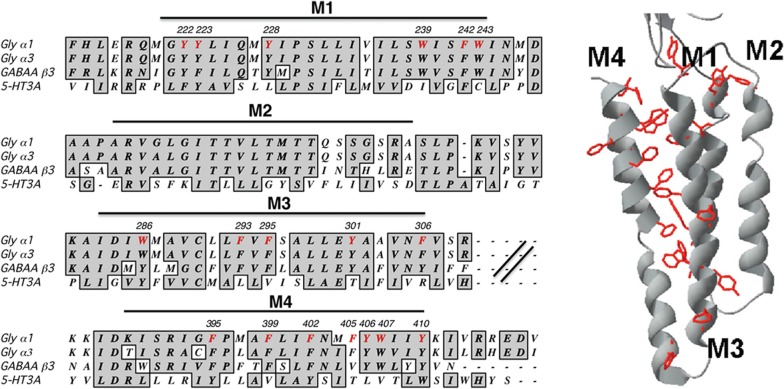
Cys-loop receptors play important roles in fast neuronal signal transmission. Functional receptors are pentamers, with each subunit having an extracellular, transmembrane (TM) and intracellular domain. Each TM domain contains 4 α-helices (M1-M4) joined by loops of varying lengths. Many of the amino acid residues that constitute these α-helices are hydrophobic, and there has been particular interest in aromatic residues, especially those in M4, which have the potential to contribute to the assembly and function of the receptor via a range of interactions with nearby residues.
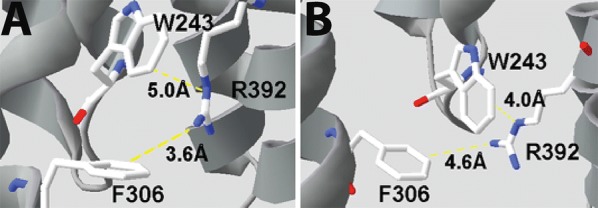
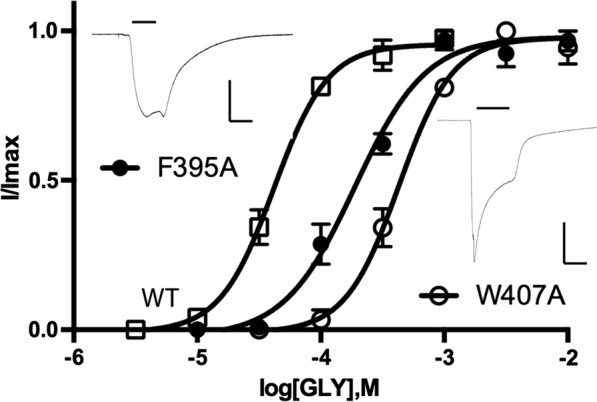
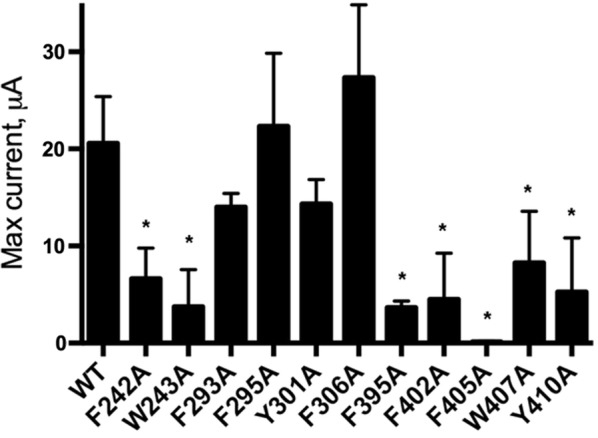
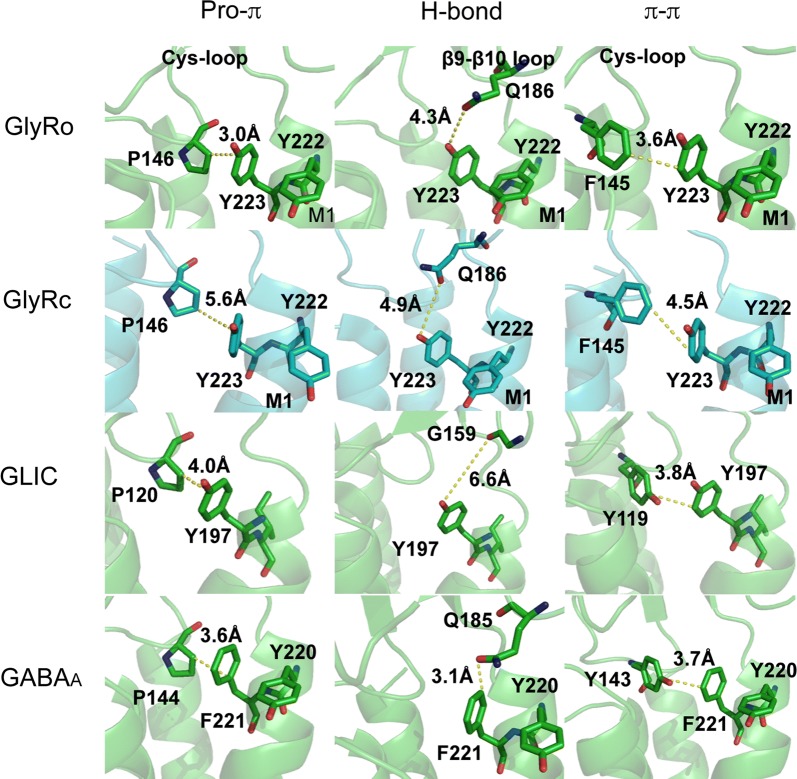
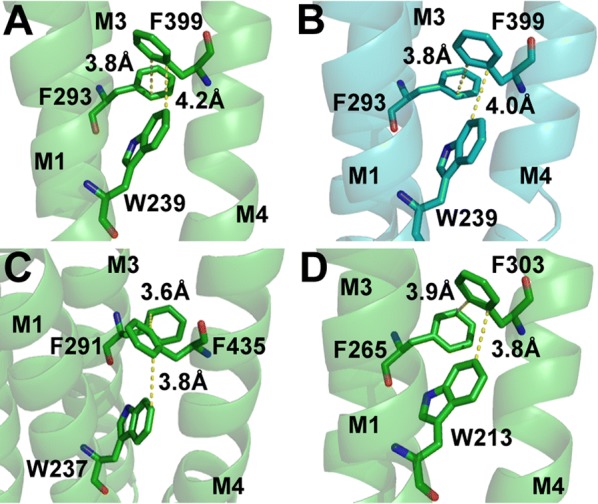
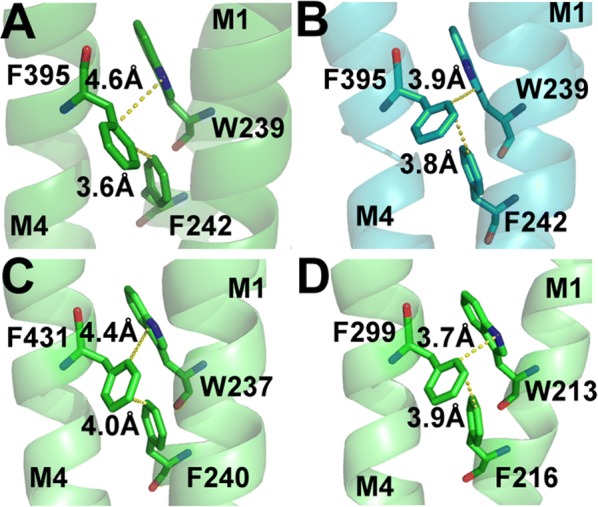
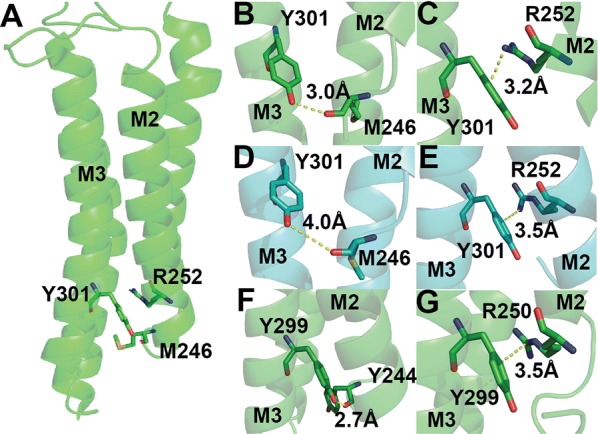
Here we show that many aromatic residues in the M1, M3 and M4 α-helices of the glycine receptor are involved in the function of the receptor. The residues were explored by creating a range of mutant receptors, characterising them using two electrode voltage clamp in Xenopus oocytes, and interpreting changes in receptor parameters using currently available structural information on the open and closed states of the receptor. For 7 residues function was ablated with an Ala substitution: 3 Tyr residues at the extracellular end of M1, 2 Trp residues located towards the centers of M1 and M3, and a Phe and a Tyr residue in M4. For many of these an alternative aromatic residue restored wild-type-like function indicating the importance of the π ring. ECs were increased with Ala substitution of 8 other aromatic residues, with those in M1 and M4 also having reduced currents, indicating a role in receptor assembly. The structure shows many potential interactions with nearby residues, especially between those that form the M1/M3/M4 interface, and we identify those that are supported by the functional data.
The data reveal the importance and interactions of aromatic residues in the GlyR M1, M3 and M4 α-helices, many of which are essential for receptor function.
半胱氨酸环受体在快速神经元信号传递中起重要作用。功能性受体是五聚体,每个亚基都有一个细胞外结构域、跨膜(TM)结构域和细胞内结构域。每个TM结构域包含4个α螺旋(M1-M4),由不同长度的环连接。构成这些α螺旋的许多氨基酸残基是疏水的,人们对芳香族残基特别感兴趣,尤其是M4中的那些残基,它们有可能通过与附近残基的一系列相互作用对受体的组装和功能做出贡献。
我们在此表明,甘氨酸受体的M1、M3和M4α螺旋中的许多芳香族残基参与了受体的功能。通过创建一系列突变受体来探究这些残基,利用非洲爪蟾卵母细胞中的双电极电压钳对它们进行表征,并利用目前关于受体开放和关闭状态的结构信息来解释受体参数的变化。7个残基的功能因丙氨酸替代而丧失:M1细胞外端的3个酪氨酸残基、M1和M3中心附近的2个色氨酸残基以及M4中的1个苯丙氨酸残基和1个酪氨酸残基。对于其中许多残基,一个替代的芳香族残基恢复了类似野生型的功能,表明π环的重要性。另外8个芳香族残基的丙氨酸替代增加了EC,M1和M4中的残基电流也降低,表明其在受体组装中的作用。该结构显示了与附近残基的许多潜在相互作用,特别是在形成M1/M3/M4界面的那些残基之间,并且我们确定了那些得到功能数据支持的相互作用。
数据揭示了甘氨酸受体M1、M3和M4α螺旋中芳香族残基的重要性和相互作用,其中许多对受体功能至关重要。