Instituto de Fisiologia, Facultad de Medicina, Universidad Austral de Chile, Valdivia, Chile.
Institute for Computational Molecular Science and Department of Biology, Temple University, Philadelphia, United States.
Elife. 2022 Jun 10;11:e73645. doi: 10.7554/eLife.73645.
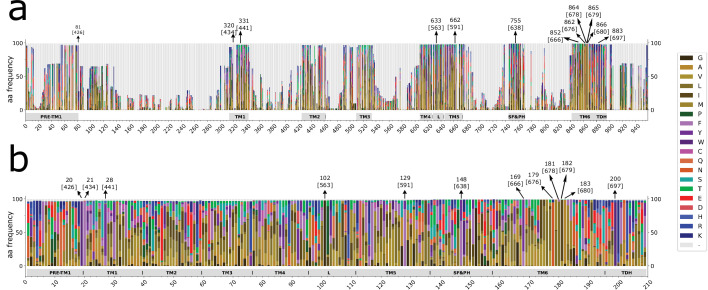
Transient receptor potential (TRP) proteins are a large family of cation-selective channels, surpassed in variety only by voltage-gated potassium channels. Detailed molecular mechanisms governing how membrane voltage, ligand binding, or temperature can induce conformational changes promoting the open state in TRP channels are still a matter of debate. Aiming to unveil distinctive structural features common to the transmembrane domains within the TRP family, we performed phylogenetic reconstruction, sequence statistics, and structural analysis over a large set of TRP channel genes. Here, we report an exceptionally conserved set of residues. This fingerprint is composed of twelve residues localized at equivalent three-dimensional positions in TRP channels from the different subtypes. Moreover, these amino acids are arranged in three groups, connected by a set of aromatics located at the core of the transmembrane structure. We hypothesize that differences in the connectivity between these different groups of residues harbor the apparent differences in coupling strategies used by TRP subgroups.
瞬时受体电位 (TRP) 蛋白是一大类阳离子选择性通道,其种类仅次于电压门控钾通道。目前仍在争论的是,控制膜电压、配体结合或温度如何诱导构象变化以促进 TRP 通道开放状态的详细分子机制。为了揭示 TRP 家族跨膜结构域内共同的独特结构特征,我们对大量 TRP 通道基因进行了系统发育重建、序列统计和结构分析。在这里,我们报告了一组特别保守的残基。这个指纹由十二个残基组成,位于不同亚型的 TRP 通道中等效的三维位置。此外,这些氨基酸分为三组,由一组位于跨膜结构核心的芳香族残基连接。我们假设这些不同残基组之间的连接性差异,蕴含着 TRP 亚群所使用的耦合策略的明显差异。