Mora Maria T, Ferrero Jose M, Gomez Juan F, Sobie Eric A, Trenor Beatriz
Centro de Investigación e Innovación en Bioingeniería, Universitat Politècnica de València, Valencia, Spain.
Department of Pharmacological Sciences, Icahn School of Medicine at Mount Sinai, New York, NY, United States.
Front Physiol. 2018 Aug 23;9:1194. doi: 10.3389/fphys.2018.01194. eCollection 2018.
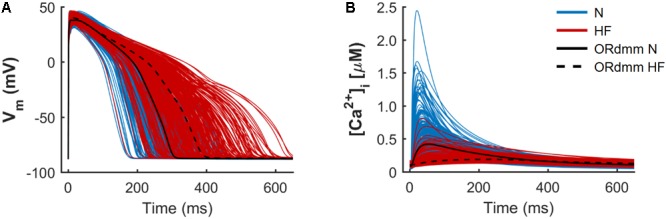
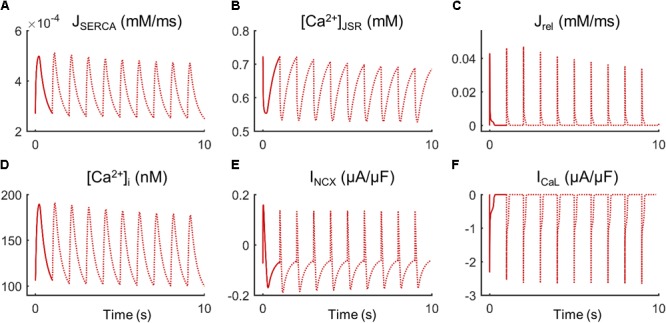
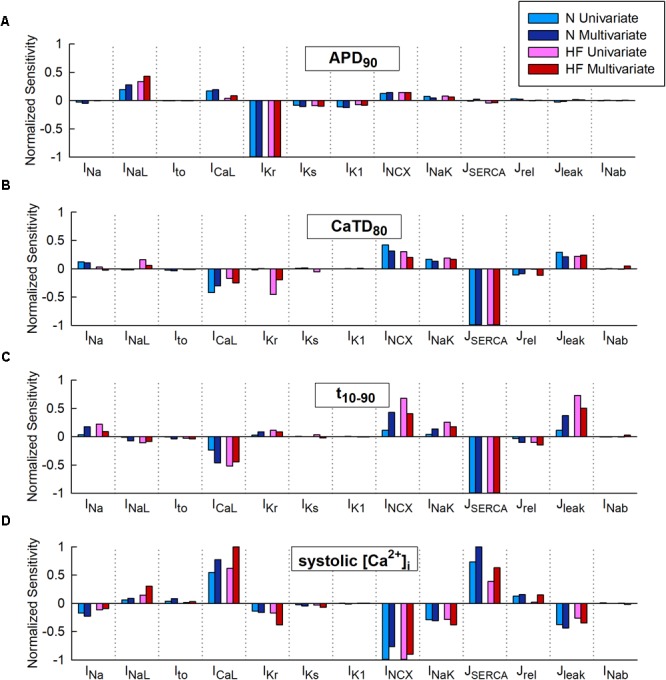
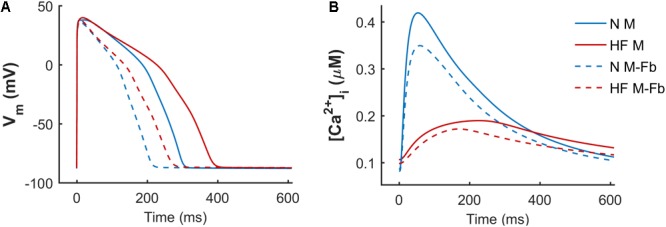
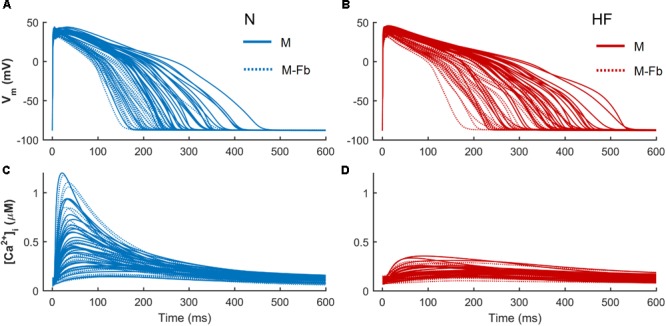
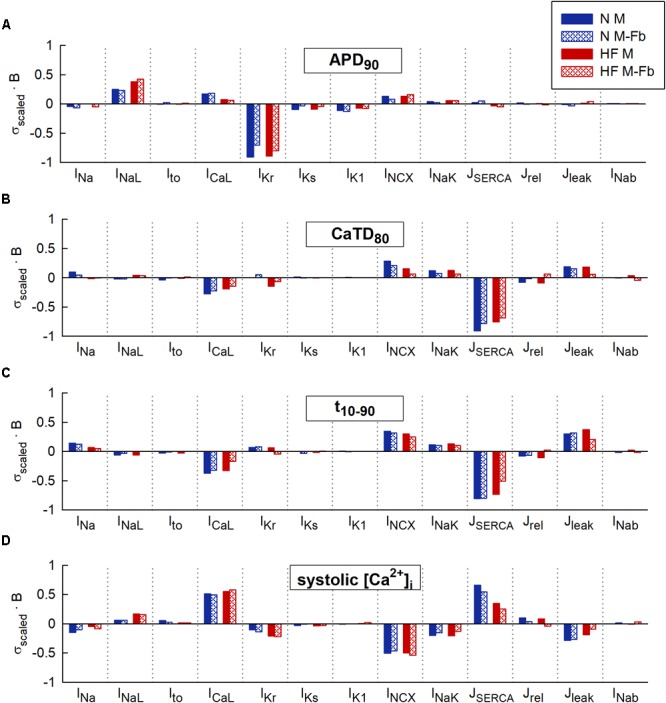
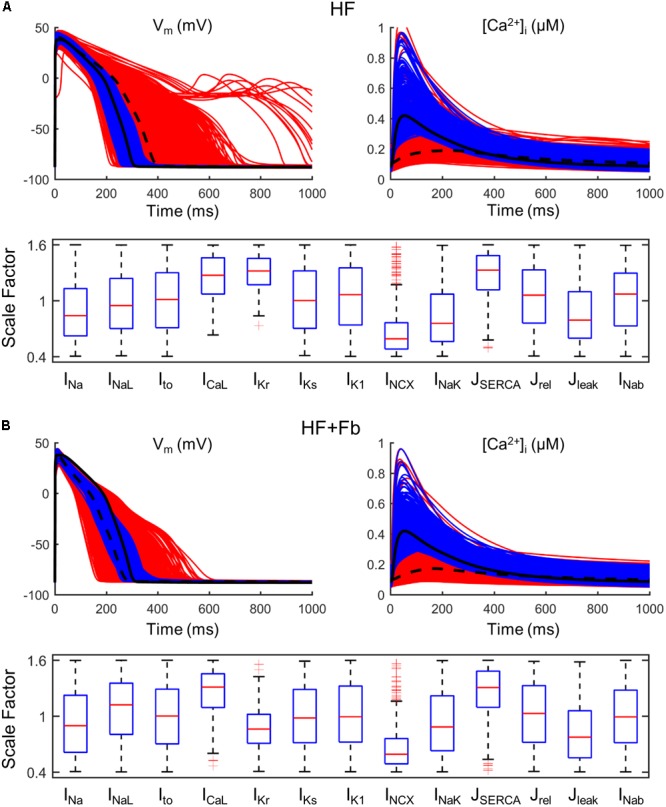
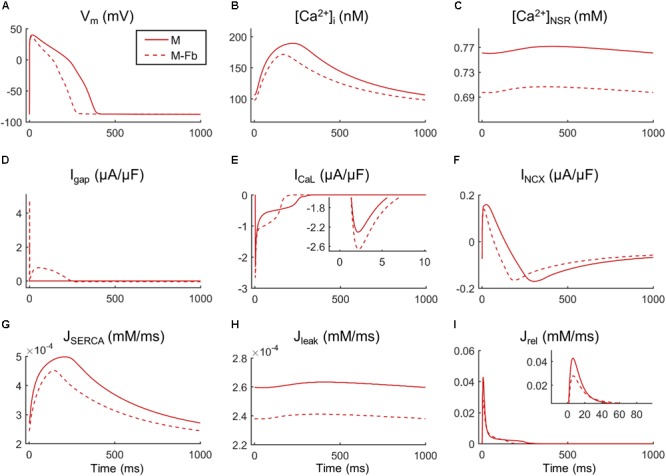
Heart failure (HF) is characterized by altered Ca cycling, resulting in cardiac contractile dysfunction. Failing myocytes undergo electrophysiological remodeling, which is known to be the main cause of abnormal Ca homeostasis. However, structural remodeling, specifically proliferating fibroblasts coupled to myocytes in the failing heart, could also contribute to Ca cycling impairment. The goal of the present study was to systematically analyze the mechanisms by which myocyte-fibroblast coupling could affect Ca dynamics in normal conditions and in HF. Simulations of healthy and failing human myocytes were performed using established mathematical models, and cells were either isolated or coupled to fibroblasts. Univariate and multivariate sensitivity analyses were performed to quantify effects of ion transport pathways on biomarkers computed from intracellular [Ca] waveforms. Variability in ion channels and pumps was imposed and populations of models were analyzed to determine effects on Ca dynamics. Our results suggest that both univariate and multivariate sensitivity analyses are valuable methodologies to shed light into the ionic mechanisms underlying Ca impairment in HF, although differences between the two methodologies are observed at high parameter variability. These can result from either the fact that multivariate analyses take into account ion channels or non-linear effects of ion transport pathways on Ca dynamics. Coupling either healthy or failing myocytes to fibroblasts decreased Ca transients due to an indirect sink effect on action potential (AP) and thus on Ca related currents. Simulations that investigated restoration of normal physiology in failing myocytes showed that Ca cycling can be normalized by increasing SERCA and L-type Ca current activity while decreasing Na-Ca exchange and SR Ca leak. Changes required to normalize APs in failing myocytes depended on whether myocytes were coupled to fibroblasts. In conclusion, univariate and multivariate sensitivity analyses are helpful tools to understand how Ca cycling is impaired in HF and how this can be exacerbated by coupling of myocytes to fibroblasts. The design of pharmacological actions to restore normal activity should take into account the degree of fibrosis in the failing heart.
心力衰竭(HF)的特征是钙循环改变,导致心脏收缩功能障碍。衰竭的心肌细胞会发生电生理重塑,这是已知的钙稳态异常的主要原因。然而,结构重塑,特别是衰竭心脏中与心肌细胞相连的成纤维细胞增殖,也可能导致钙循环受损。本研究的目的是系统分析心肌细胞 - 成纤维细胞耦合在正常条件和HF中影响钙动力学的机制。使用已建立的数学模型对健康和衰竭的人类心肌细胞进行模拟,细胞要么分离,要么与成纤维细胞耦合。进行单变量和多变量敏感性分析,以量化离子转运途径对从细胞内[Ca]波形计算的生物标志物的影响。施加离子通道和泵的变异性,并分析模型群体以确定对钙动力学的影响。我们的结果表明,单变量和多变量敏感性分析都是有价值的方法,有助于揭示HF中钙损伤的离子机制,尽管在高参数变异性下观察到两种方法之间存在差异。这些差异可能源于多变量分析考虑了离子通道或离子转运途径对钙动力学的非线性影响这一事实。将健康或衰竭的心肌细胞与成纤维细胞耦合会降低钙瞬变,这是由于对动作电位(AP)进而对钙相关电流的间接汇效应。研究衰竭心肌细胞正常生理功能恢复的模拟表明,通过增加肌浆网钙ATP酶(SERCA)和L型钙电流活性,同时降低钠钙交换和肌浆网钙泄漏,可以使钙循环正常化。使衰竭心肌细胞的AP正常化所需的变化取决于心肌细胞是否与成纤维细胞耦合。总之,单变量和多变量敏感性分析是有助于理解HF中钙循环如何受损以及心肌细胞与成纤维细胞耦合如何加剧这种损伤的有用工具。恢复正常活性的药理作用设计应考虑衰竭心脏的纤维化程度。