Wallis Lisa J, Szabó Dóra, Erdélyi-Belle Boglárka, Kubinyi Enikö
Department of Ethology, Eötvös Loránd University, Budapest, Hungary.
Front Vet Sci. 2018 Aug 23;5:200. doi: 10.3389/fvets.2018.00200. eCollection 2018.
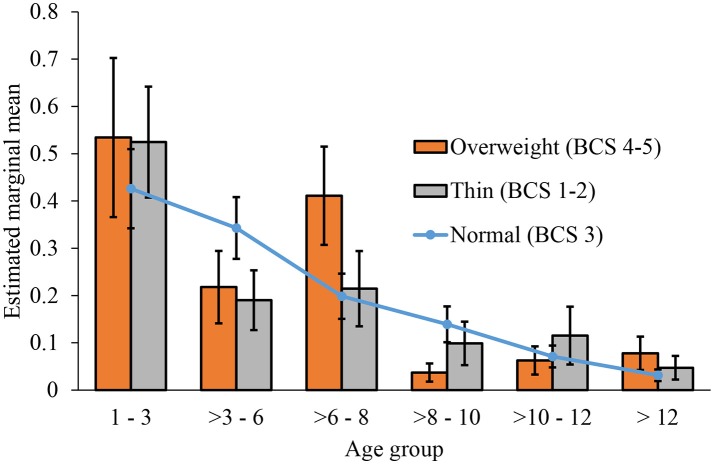
Although dogs' life expectancies are six to twelve times shorter than that of humans, the demographics (e. g., living conditions) of dogs can still change considerably with aging, similarly to humans. Despite the fact that the dog is a particularly good model for human healthspan, and the number of aged dogs in the population is growing in parallel with aged humans, there has been few previous attempts to describe demographic changes statistically. We utilized an on-line questionnaire to examine the link between the age and health of the dog, and owner and dog demographics in a cross-sectional Hungarian sample. Results from univariate analyses revealed that 20 of the 27 demographic variables measured differed significantly between six dog age groups. Our results revealed that pure breed dogs suffered from health problems at a younger age, and may die at an earlier age than mixed breeds. The oldest dog group (>12 years) consisted of fewer pure breeds than mixed breeds and the mixed breeds sample was on average older than the pure breed sample. Old dogs were classified more frequently as unhealthy, less often had a "normal" body condition score, and more often received medication and supplements. They were also more often male, neutered, suffered health problems (such as sensory, joint, and/or tooth problems), received less activity/interaction/training with the owner, and were more likely to have experienced one or more traumatic events. Surprisingly, the youngest age group contained more pure breeds, were more often fed raw meat, and had owners aged under 29 years, reflecting new trends among younger owners. The high prevalence of dogs that had experienced one or more traumatic events in their lifetime (over 40% of the sample), indicates that welfare and health could be improved by informing owners of the greatest risk factors of trauma, and providing interventions to reduce their impact. Experiencing multiple life events such as spending time in a shelter, changing owners, traumatic injury/prolonged disease/surgery, getting lost, and changes in family structure increased the likelihood that owners reported that their dogs currently show behavioral signs that they attribute to the previous trauma.
尽管狗的预期寿命比人类短六至十二倍,但与人类相似,狗的人口统计学特征(如生活条件)仍会随着年龄增长而发生显著变化。尽管狗是研究人类健康寿命的特别好的模型,且老龄狗的数量与老龄人类数量同步增长,但此前很少有人尝试从统计学角度描述人口统计学变化。我们利用一份在线问卷,在匈牙利的一个横断面样本中研究狗的年龄与健康之间的联系,以及主人和狗的人口统计学特征。单变量分析结果显示,在测量的27个人口统计学变量中,有20个在六个狗龄组之间存在显著差异。我们的结果表明,纯种狗比混种狗更早出现健康问题,并可能更早死亡。最老的狗组(>12岁)中纯种狗比混种狗少,且混种狗样本的平均年龄比纯种狗样本大。老龄狗被归类为不健康的频率更高,身体状况评分为“正常”的频率更低,接受药物和补充剂的频率更高。它们也更常为雄性、已绝育,存在健康问题(如感官、关节和/或牙齿问题),与主人的活动/互动/训练较少,且更有可能经历过一次或多次创伤性事件。令人惊讶的是,最年轻的年龄组中纯种狗更多,更常喂食生肉,且主人年龄在29岁以下,这反映了年轻主人中的新趋势。一生中经历过一次或多次创伤性事件的狗的比例很高(超过样本的40%),这表明通过告知主人创伤的最大风险因素并提供干预措施以减少其影响,可以改善狗的福利和健康状况。经历过诸如待在收容所、更换主人、创伤性损伤/长期疾病/手术、走失以及家庭结构变化等多种生活事件,会增加主人报告其狗目前表现出他们认为是由先前创伤导致的行为迹象的可能性。