Sturgill Jamie L
University of Kentucky, Department of Internal Medicine, Division of Pulmonary, Critical Care, & Sleep Medicine, 740 South Limestone St, Lexington, KY 40536, United States.
Adv Biol Regul. 2018 Dec;70:74-81. doi: 10.1016/j.jbior.2018.09.001. Epub 2018 Sep 5.
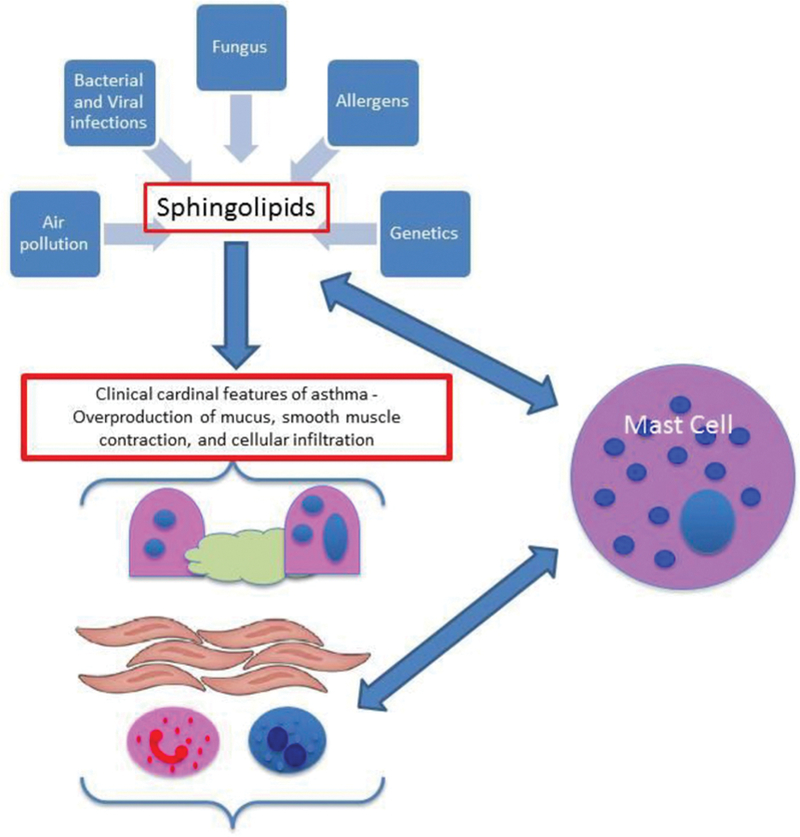
Asthma is defined as a chronic inflammatory condition in the lung and is characterized by episodic shortness of breath with expiratory wheezing and cough. Asthma is a serious public health concern globally with an estimated incidence over 300 million. Asthma is a complex disease in that it manifests as disease of gene and environmental interactions. Sphingolipids are a unique class of lipids involved in a host of biological functions ranging from serving as key cellular membrane lipids to acting as critical signaling molecules. To date sphingolipids have been studied across various human conditions ranging from neurological disorders to cancer to infection to autoimmunity. This review will focus on the role of sphingolipids in asthma development and pathology with particular focus on the role of mast cell sphingolipid biology.
哮喘被定义为肺部的一种慢性炎症性疾病,其特征为发作性呼吸急促伴呼气性哮鸣和咳嗽。哮喘是全球严重的公共卫生问题,估计发病率超过3亿。哮喘是一种复杂的疾病,表现为基因与环境相互作用的疾病。鞘脂是一类独特的脂质,参与许多生物学功能,从作为关键的细胞膜脂质到充当关键的信号分子。迄今为止,鞘脂已在从神经疾病到癌症、感染和自身免疫等各种人类疾病中得到研究。本综述将重点关注鞘脂在哮喘发展和病理中的作用,特别关注肥大细胞鞘脂生物学的作用。