Behler Nora, Leitner Bianka, Mezger Eva, Weidinger Elif, Musil Richard, Blum Bernhard, Kirsch Beatrice, Wulf Linda, Löhrs Lisa, Winter Christine, Padberg Frank, Palm Ulrich
Department of Psychiatry and Psychotherapy, Ludwig-Maximilian University, Klinikum der Universität München, Munich, Germany.
Department of Neurology, Ludwig-Maximilian University, Klinikum der Universität München, Munich, Germany.
Front Behav Neurosci. 2018 Aug 24;12:194. doi: 10.3389/fnbeh.2018.00194. eCollection 2018.
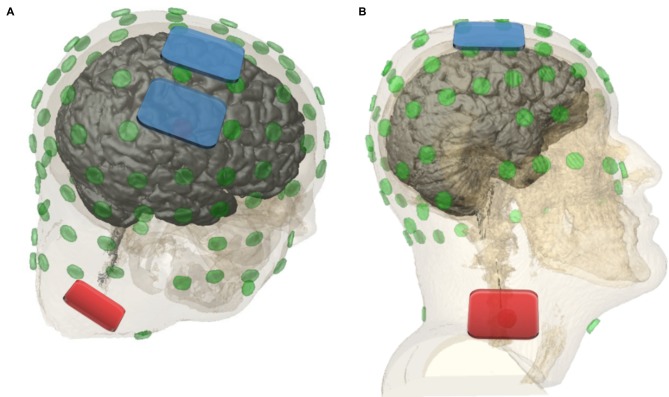
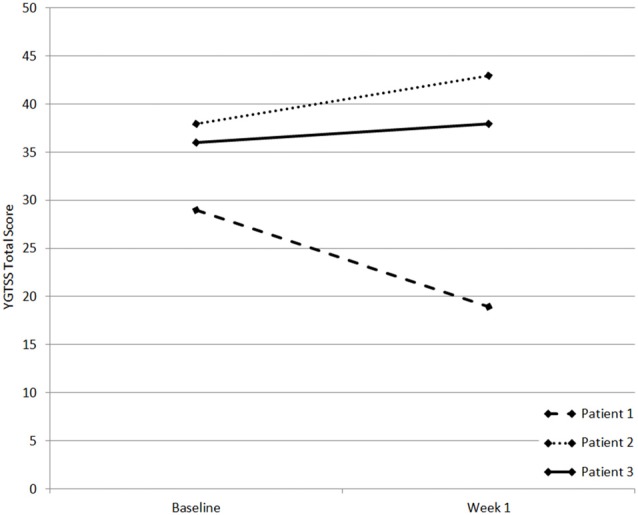
: Current pathophysiological hypotheses of Gilles de la Tourette Syndrome (GTS) refer to temporally abnormal neuronal activation in cortico-striato-thalamo-cortical (CSTC) networks. Modifying cortical activity by non-invasive brain-stimulation appears to be a new treatment option in GTS. : Previous studies suggested therapeutic effects of cathodal transcranial direct current stimulation (tDCS) to pre-supplementary motor areas (SMA), however, treatment modalities concerning electrode placement, current intensity and stimulation-rate have not been systematically explored. Aim of this study was to assess efficacy of an alternative stimulation regime on GTS symptoms in a pilot study. To test a treatment protocol with tDCS twice a day, we administered 10 sessions over 5 days of bilateral cathodal tDCS (30 min, 2 mA) over the pre-SMA in three patients with severe GTS. Tic severity as well as obsessive-compulsive (OC) symptoms and affective scales were rated before and after tDCS treatment. : Only one out of three patients showed a 34.5% reduction in tic severity. The two other patients showed an increase in tic severity. All patients showed a mild increase in positive affect and a reduction in negative affect, OC symptom changes were heterogeneous. Our results do not support earlier findings of extensive therapeutic effects of cathodal tDCS on tics in patients with GTS and show that prediction of stimulation effects on a targeted brain area remains inaccurate. : Future research will have to focus on the determination of most effective stimulation modes regarding site, polarity and frequency of tDCS in GTS patients.
目前,抽动秽语综合征(GTS)的病理生理假说涉及皮质-纹状体-丘脑-皮质(CSTC)网络中神经元激活的时间异常。通过非侵入性脑刺激来改变皮质活动似乎是GTS的一种新的治疗选择。:先前的研究表明,阴极经颅直流电刺激(tDCS)对辅助运动区(SMA)具有治疗作用,然而,关于电极放置、电流强度和刺激频率的治疗方式尚未得到系统研究。本研究的目的是在一项初步研究中评估一种替代刺激方案对GTS症状的疗效。为了测试每天两次tDCS的治疗方案,我们对三名重度GTS患者在5天内进行了10次双侧阴极tDCS(30分钟,2毫安)刺激前SMA的治疗。在tDCS治疗前后对抽动严重程度、强迫(OC)症状和情感量表进行评分。:三名患者中只有一名患者的抽动严重程度降低了34.5%。另外两名患者的抽动严重程度增加。所有患者的积极情绪均有轻度增加,消极情绪有所降低,OC症状变化各异。我们的结果不支持先前关于阴极tDCS对GTS患者抽动具有广泛治疗效果的研究结果,并且表明对靶向脑区刺激效果的预测仍然不准确。:未来的研究将不得不聚焦于确定GTS患者中关于tDCS的部位、极性和频率的最有效刺激模式。