Graduate School of Sport Sciences, Waseda University, Saitama, Japan.
Research Fellow of Japan Society for the Promotion of Science, Tokyo, Japan.
J Strength Cond Res. 2018 Nov;32(11):3258-3266. doi: 10.1519/JSC.0000000000002781.
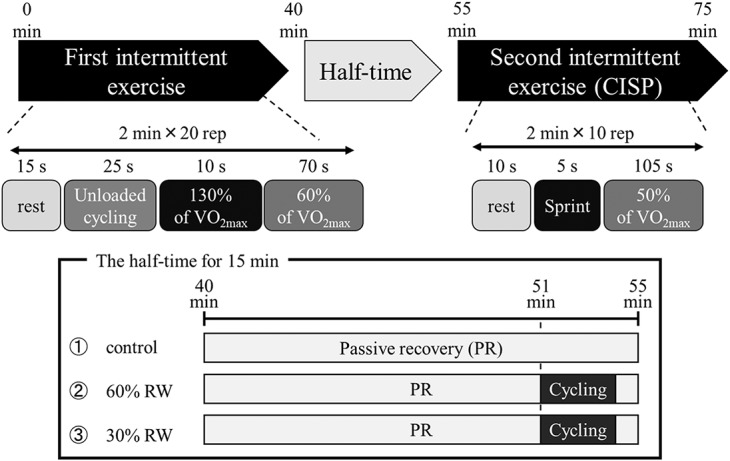
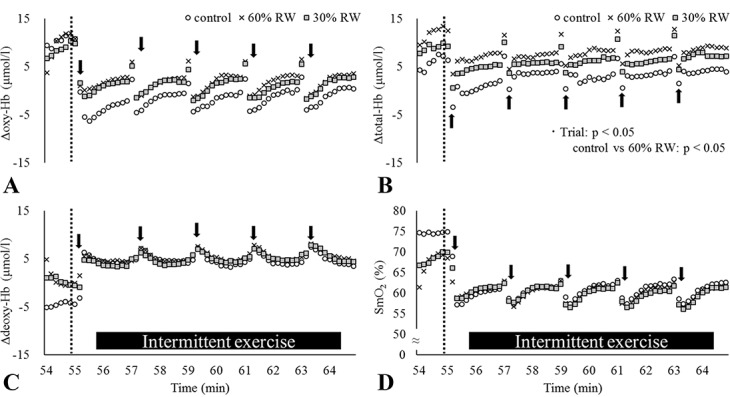
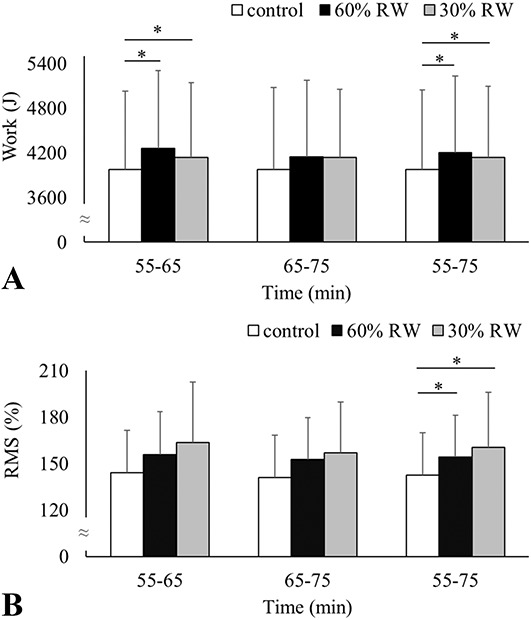
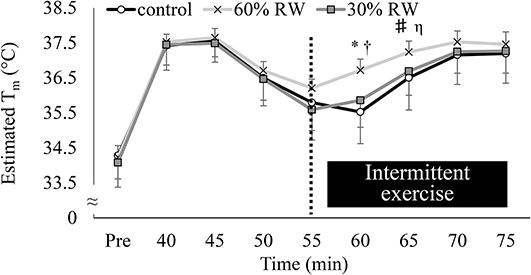
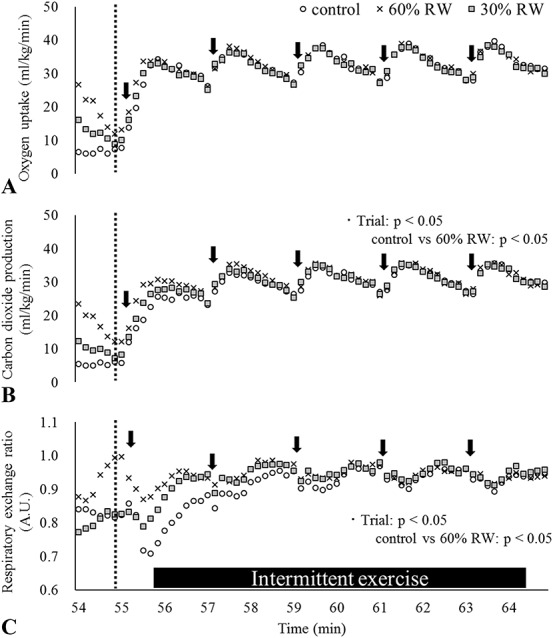
Yanaoka, T, Hamada, Y, Kashiwabara, K, Kurata, K, Yamamoto, R, Miyashita, M, and Hirose, N. Very-short-duration, low-intensity half-time re-warm up increases subsequent intermittent sprint performance. J Strength Cond Res 32(11): 3258-3266, 2018-This study investigated the effect of very-short-duration, low-intensity half-time re-warm up (RW) on subsequent intermittent sprint performance. Using a randomized cross-over design, 11 healthy men performed 3 trials. In the experimental trials, participants performed the first 40-minute intermittent exercise followed by a 15-minute half-time. The interventions at half-time were 15 minutes of seated rest (control), 3 minutes of moderate-intensity RW (cycling at 60% of maximal oxygen uptake [V[Combining Dot Above]O2max]; [60% RW]), and 3 minutes of low-intensity RW (cycling at 30% of V[Combining Dot Above]O2max; [30% RW]). After half-time, participants performed the Cycling Intermittent-Sprint Protocol (CISP), which consisted of 10 seconds of rest, 5 seconds of maximal sprint, and 105 seconds of active recovery at 50% of V[Combining Dot Above]O2max, with the cycles repeated over the 20-minute duration. The mean work and electromyogram amplitude during the sprint in the CISP were higher in both RW trials than in the control trial (p < 0.05). Muscle temperature, estimated from the skin temperature, at 60 minutes was higher in the 60% RW trial than in the control and 30% RW trials (p < 0.05). The mean change in oxygenated hemoglobin concentration during active recovery at 55-65 minutes tended to be higher in both RW trials than in the control trial (60% RW trial: p = 0.06, 30% RW trial: p = 0.06). In conclusion, very-short-duration, low-intensity RW increased intermittent sprint performance after the half-time, in comparison with a traditional passive half-time practice, and was as effective as a moderate-intensity RW when matched for total duration.
柳冈隆,滨田裕,柏原圭司,仓田敬,山本亮,宫下诚,广瀬信。非常短时间、低强度半时复温增加随后的间歇冲刺性能。J 力量 Cond 研 32(11):3258-3266,2018-这项研究调查了非常短时间、低强度半时复温 (RW) 对随后的间歇冲刺性能的影响。使用随机交叉设计,11 名健康男性进行了 3 次试验。在实验性试验中,参与者进行了前 40 分钟的间歇运动,然后进行了 15 分钟的半时。半时的干预措施是 15 分钟的坐姿休息(对照)、3 分钟的中等强度 RW(以 60%最大摄氧量 [V[Combining Dot Above]O2max]的速度骑行;[60% RW])和 3 分钟的低强度 RW(以 30%V[Combining Dot Above]O2max 的速度骑行;[30% RW])。半时后,参与者进行了间歇冲刺协议(CISP),该协议包括 10 秒的休息、5 秒的最大冲刺和 105 秒的主动恢复,速度为 50%V[Combining Dot Above]O2max,20 分钟内重复循环。在 CISP 中,冲刺时的平均工作量和肌电图振幅在 RW 试验中均高于对照试验(p < 0.05)。皮肤温度估算的 60 分钟时的肌肉温度在 60%RW 试验中高于对照和 30%RW 试验(p < 0.05)。在 55-65 分钟主动恢复期间,氧合血红蛋白浓度的平均变化在 RW 试验中均高于对照试验(60%RW 试验:p = 0.06,30%RW 试验:p = 0.06)。总之,与传统的被动半时练习相比,非常短时间、低强度的 RW 在半时后增加了间歇冲刺性能,并且与中等强度的 RW 相比,在总时间匹配时同样有效。