Department of Pathology and Laboratory Medicine, College of Medicine, University of Saskatchewan, Room 2841, Royal University Hospital, 103 Hospital Drive, Saskatoon, S7N 0W8, Canada.
Department of Biochemistry, College of Medicine, University of Saskatchewan, Saskatoon, SK, S7N 5E5, Canada.
BMC Biotechnol. 2018 Sep 10;18(1):55. doi: 10.1186/s12896-018-0466-6.
Advances in antibody engineering provide strategies to construct recombinant antibody-like molecules with modified pharmacokinetic properties. Multermerization is one strategy that has been used to produce antibody-like molecules with two or more antigen binding sites. Multimerization enhances the functional affinity (avidity) and can be used to optimize size and pharmacokinetic properties. Most multimerization strategies involve genetically fusing or non-covalently linking antibody fragments using oligomerization domains. Recent studies have defined guidelines for producing antibody-like molecules with optimal tumor targeting properties, which require intermediates size (70-120 kDa) and bi- or tri-valency.
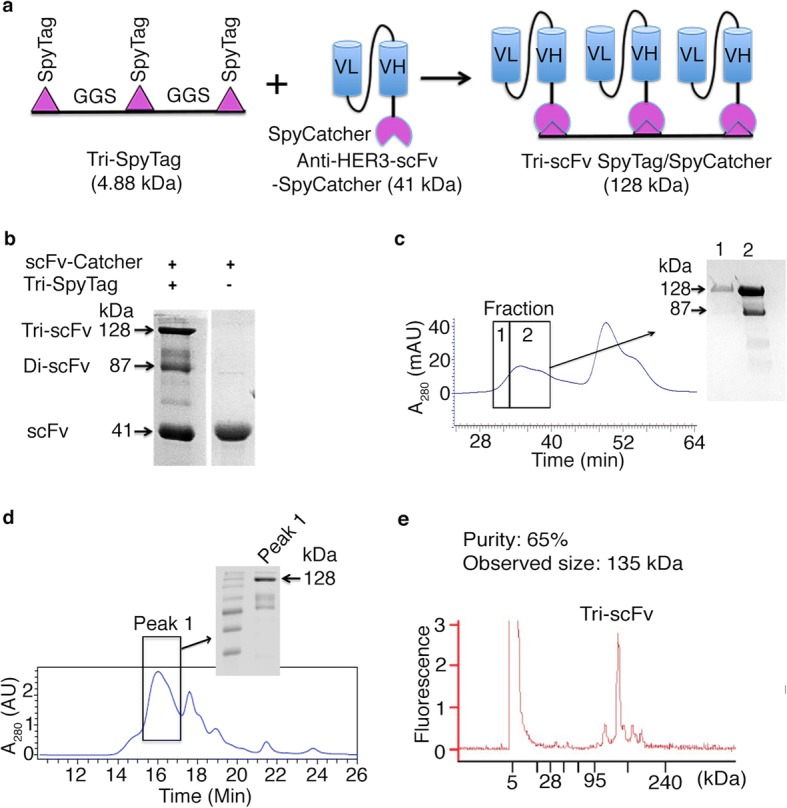
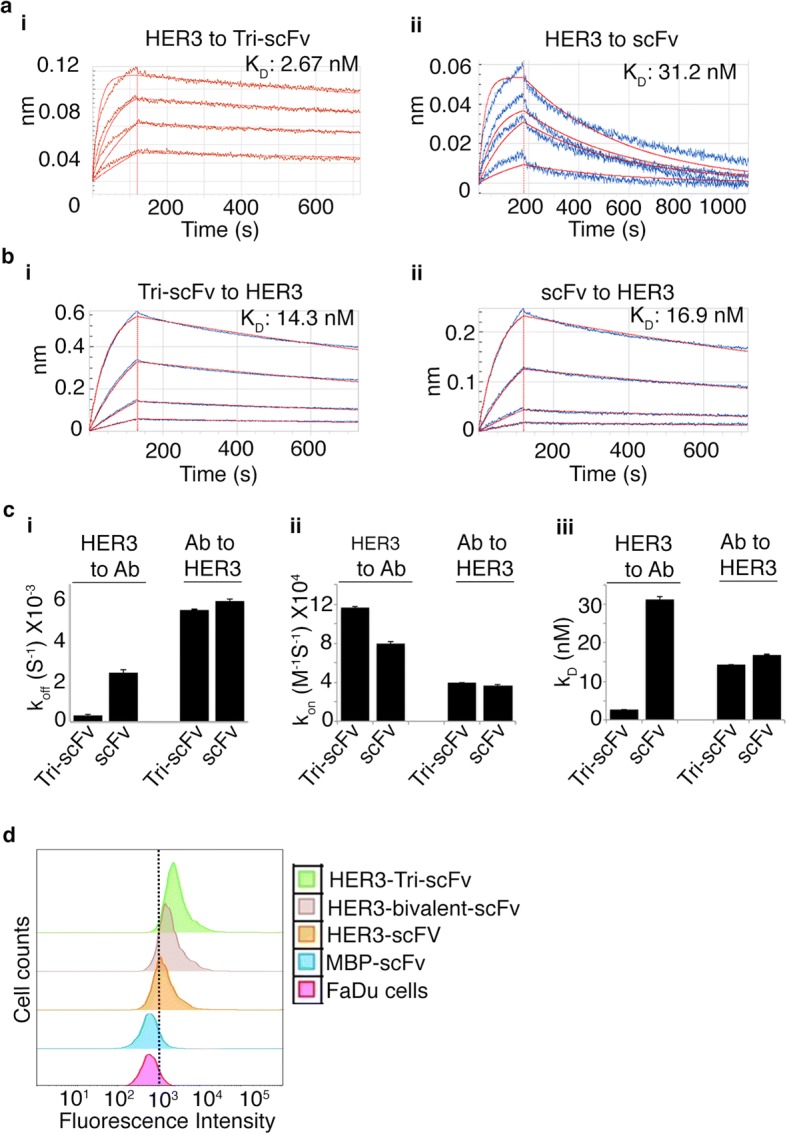
We described a highly modular antibody-engineering platform for rapidly constructing synthetic, trivalent single chain variable fragments (Tri-scFv) using the SpyCatcher/SpyTag protein ligase system. We used this platform to construct an anti-human epidermal growth factor receptor 3 (HER3) Tri-scFv. We generated the anti-HER3 Tri-scFv by genetically fusing a SpyCatcher to the C-terminus of an anti-HER3 scFv and ligating it to a synthetic Tri-SpyTag peptide. The anti-HER3 Tri-scFv bound recombinant HER3 with an apparent K of 2.67 nM, which is approximately 12 times lower than the K of monomeric anti-HER3 scFv (31.2 nM). Anti-HER3 Tri-scFv also bound endogenous cell surface expressed HER3 stronger than the monomer anti-HER3 scFv.
We used the SpyTag/SpyCatcher protein ligase system to ligate anti-HER3 scFv fused to a SpyCatcher at its C-termini to a Tri-SpyTag to construct Tr-scFv. This system allowed the construction of a Tri-scFv with all the scFv antigen-binding sites pointed outwards. The anti-HER3 Tri-scFv bound recombinant and endogenously expressed HER3 with higher functional affinity (avidity) than the monomeric anti-HER3 scFv. The Tri-scFv had the size, valency, and functional affinity that are desired for therapeutic and imaging applications. Use of the SpyTag/SpyCatcher protein ligase system allows Tri-scFvs to be rapidly constructed in a simple, modular manner, which can be easily applied to scFvs or other antibody fragments targeting other antigens.
抗体工程的进步提供了构建具有改良药代动力学特性的重组抗体样分子的策略。多聚化是一种用于产生具有两个或多个抗原结合位点的抗体样分子的策略。多聚化增强了功能亲和力(亲合力),并可用于优化大小和药代动力学特性。大多数多聚化策略涉及使用寡聚化结构域基因融合或非共价连接抗体片段。最近的研究定义了产生具有最佳肿瘤靶向特性的抗体样分子的指南,这些分子需要中等大小(70-120 kDa)和二价或三价。
我们描述了一种高度模块化的抗体工程平台,用于使用 SpyCatcher/SpyTag 蛋白连接酶系统快速构建合成的三价单链可变片段(Tri-scFv)。我们使用该平台构建了针对人表皮生长因子受体 3(HER3)的 Tri-scFv。我们通过将 SpyCatcher 基因融合到抗 HER3 scFv 的 C 末端,并将其连接到合成的 Tri-SpyTag 肽上来生成抗 HER3 Tri-scFv。抗 HER3 Tri-scFv 与重组 HER3 的结合表观 K 值为 2.67 nM,约比单体抗 HER3 scFv(31.2 nM)低 12 倍。抗 HER3 Tri-scFv 与细胞表面表达的内源性 HER3 的结合也比单体抗 HER3 scFv 强。
我们使用 SpyTag/SpyCatcher 蛋白连接酶系统将融合在 C 末端的 SpyCatcher 的抗 HER3 scFv 与 Tri-SpyTag 连接,构建了 Tri-scFv。该系统允许构建所有 scFv 抗原结合位点都指向外侧的 Tri-scFv。抗 HER3 Tri-scFv 与重组和内源性表达的 HER3 的结合亲和力(亲合力)高于单体抗 HER3 scFv。Tri-scFv 的大小、价数和功能亲和力都适合治疗和成像应用。SpyTag/SpyCatcher 蛋白连接酶系统的使用允许以简单、模块化的方式快速构建 Tri-scFv,可轻松应用于针对其他抗原的 scFv 或其他抗体片段。