Department of Hematopathology, The University of Texas MD Anderson Cancer Center, Houston, TX.
Department of Hematology, the Second Hospital of Dalian Medical University, Dalian, China.
Blood. 2018 Oct 25;132(17):1805-1817. doi: 10.1182/blood-2018-03-841015. Epub 2018 Sep 12.
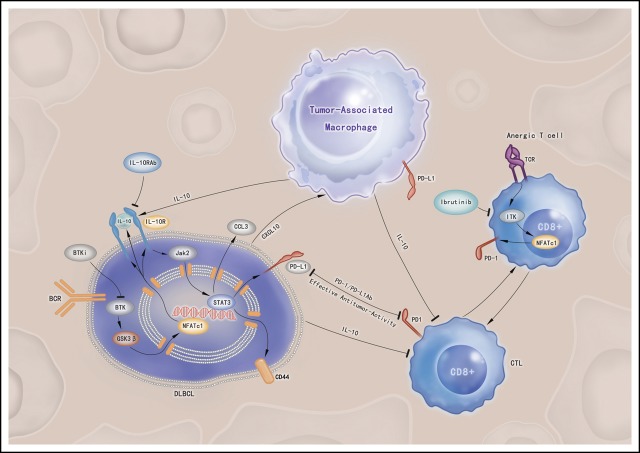
Knowledge of programmed death ligand 1 (PD-L1) expression and its regulation in B-cell lymphoma cells is limited. Investigating mechanisms that control PD-L1 expression in B-cell lymphoma cells might identify biomarkers that predict the efficacy of immunotherapy with anti-programmed death-1/PD-L1 antibodies. In addition, identification of mechanisms that regulate PD-L1 may identify molecules that can be targeted to improve the clinical efficacy of immune checkpoint inhibitors. In this study, we used proteomic approaches and patient-derived B-cell lymphoma cell lines to investigate mechanisms that regulate PD-L1 expression. We found that PD-L1 expression, particularly in nongerminal center B cell-derived diffuse large B-cell lymphoma (DLBCL), is controlled and regulated by several interactive signaling pathways, including the B-cell receptor (BCR) and JAK2/STAT3 signaling pathways. We found that that BCR-mediated NFATc1 activation upregulates IL-10 chemokine expression in PD-L1 B-cell lymphoma cells. Released IL-10 activates the JAK2/STAT3 pathway, leading to STAT3-induced PD-L1 expression. IL-10 antagonist antibody abrogates IL-10/STAT3 signaling and PD-L1 protein expression. We also found that BCR pathway inhibition by BTK inhibitors (ibrutinib, acalabrutinib, and BGB-3111) blocks NFATc1 and STAT3 activation, thereby inhibiting IL-10 and PD-L1 expression. Finally, we validated the PD-L1 signaling network in 2 primary DLBCL cohorts consisting of 428 and 350 cases and showed significant correlations among IL-10, STAT3, and PD-L1. Thus, our findings reveal a complex signaling network regulating PD-L1 expression in B-cell lymphoma cells and suggest that PD-L1 expression can be modulated by small molecule inhibitors to potentiate immunotherapies.
PD-L1(程序性死亡配体 1)表达及其在 B 细胞淋巴瘤细胞中的调控机制知之甚少。研究控制 B 细胞淋巴瘤细胞中 PD-L1 表达的机制,可能会发现预测抗 PD-1/PD-L1 抗体免疫治疗疗效的生物标志物。此外,鉴定调控 PD-L1 的机制可能会发现可靶向的分子,以提高免疫检查点抑制剂的临床疗效。在这项研究中,我们使用蛋白质组学方法和患者来源的 B 细胞淋巴瘤细胞系来研究调控 PD-L1 表达的机制。我们发现,PD-L1 的表达,特别是在非生发中心 B 细胞衍生的弥漫性大 B 细胞淋巴瘤(DLBCL)中,受到包括 B 细胞受体(BCR)和 JAK2/STAT3 信号通路在内的几种相互作用的信号通路的控制和调节。我们发现 BCR 介导的 NFATc1 激活上调了 PD-L1 B 细胞淋巴瘤细胞中 IL-10 趋化因子的表达。释放的 IL-10 激活 JAK2/STAT3 通路,导致 STAT3 诱导的 PD-L1 表达。IL-10 拮抗剂抗体可阻断 IL-10/STAT3 信号和 PD-L1 蛋白表达。我们还发现 BTK 抑制剂(依鲁替尼、阿卡替尼和 BGB-3111)抑制 BCR 通路可阻断 NFATc1 和 STAT3 的激活,从而抑制 IL-10 和 PD-L1 的表达。最后,我们在由 428 例和 350 例病例组成的 2 个原发性 DLBCL 队列中验证了 PD-L1 信号网络,并显示 IL-10、STAT3 和 PD-L1 之间存在显著相关性。因此,我们的研究结果揭示了一个调控 B 细胞淋巴瘤细胞中 PD-L1 表达的复杂信号网络,并表明 PD-L1 表达可以通过小分子抑制剂来调节,以增强免疫治疗。