Hu Li-Yang, Xu Xiao-Lu, Rao Hui-Lan, Chen Jie, Lai Ren-Chun, Huang Hui-Qiang, Jiang Wen-Qi, Lin Tong-Yu, Xia Zhong-Jun, Cai Qing-Qing
State Key Laboratory of Oncology in South China, Collaborative Innovation Center of Cancer Medicine, Sun Yat-sen University Cancer Center, Guangzhou, 510060, Guangdong, P. R. China.
Department of Medical Oncology, Sun Yat-sen University Cancer Center, Guangzhou, 510060, Guangdong, P. R. China.
Chin J Cancer. 2017 Dec 16;36(1):94. doi: 10.1186/s40880-017-0262-z.
The programmed cell death-1 (PD-1)/programmed cell death-ligand 1 (PD-L1) pathway inhibits the activation of T cells and plays a crucial role in the negative regulation of cellular and humoral immune responses. Diffuse large B-cell lymphoma (DLBCL) is the most common lymphoid malignancy in adults. In the present study, we aimed to detect the expression of PD-L1 in DLBCL and to analyze its relationship with prognosis.
We reviewed medical records of 204 newly diagnosed DLBCL patients in Sun Yat-sen University Cancer Center between October 2005 and August 2012. The expression of PD-L1 in tumor tissues from these 204 patients was detected using immunohistochemical (IHC) assay. The expression of anaplastic lymphoma kinase (ALK), CD5, CD30, and C-Myc in tumor specimens from 109 patients was detected using IHC, and Epstein-Barr virus (EBV)-encoded RNAs (EBERs) were detected using fluorescence in situ hybridization. The Spearman method was used for correlation analysis. The Kaplan-Meier method with log-rank test was used for univariate analysis. Cox proportional hazards model was used for multivariate analysis.
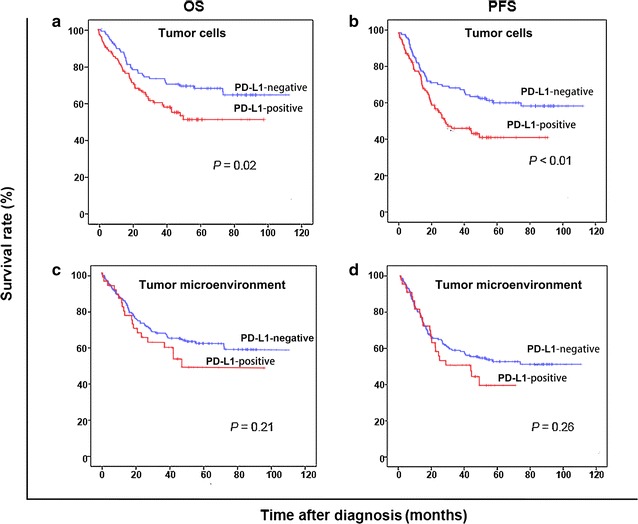
Of the 204 patients, 100 (49.0%) were PD-L1-positive in tumor cells and 44 (21.6%) were PD-L1-positive in tumor microenvironment. PD-L1 expression in tumor cells and tumor microenvironment were more common in the non-germinal center B-cell-like (GCB) subtype than in the GCB subtype (P = 0.02 and P = 0.04). Patients with PD-L1 expression in tumor microenvironment were more likely to be resistant to first-line chemotherapy when compared with the patients without PD-L1 expression in tumor microenvironment (P = 0.03). PD-L1 expression in tumor microenvironment was negatively correlated with C-Myc expression (r = - 0.20, P = 0.04). No correlations were detected between PD-L1 expression and the expression of ALK, CD5, and CD30 as well as EBERs. The 5-year overall survival (OS) rates were 50.0% and 67.3% in patients with and without PD-L1 expression in tumor cells (P = 0.02). PD-L1 expression in tumor cells was an independent risk predictor for OS (P < 0.01).
PD-L1 expression is more common in the non-GCB subtype than in the GCB subtype. PD-L1 expression in tumor microenvironment has a negative correlation with C-Myc. PD-L1 positivity predicts short survival in DLBCL patients. For patients with PD-L1 expression, more strategy such as anti-PD-L1 antibody treatment should be recommended.
程序性细胞死亡蛋白1(PD-1)/程序性细胞死亡配体1(PD-L1)通路可抑制T细胞的激活,并在细胞免疫和体液免疫反应的负调控中起关键作用。弥漫性大B细胞淋巴瘤(DLBCL)是成人中最常见的淋巴系统恶性肿瘤。在本研究中,我们旨在检测DLBCL中PD-L1的表达,并分析其与预后的关系。
我们回顾了2005年10月至2012年8月在中山大学肿瘤防治中心新诊断的204例DLBCL患者的病历。采用免疫组织化学(IHC)检测这204例患者肿瘤组织中PD-L1的表达。采用IHC检测109例患者肿瘤标本中间变性淋巴瘤激酶(ALK)、CD5、CD30和C-Myc的表达,采用荧光原位杂交检测爱泼斯坦-巴尔病毒(EBV)编码RNA(EBERs)。采用Spearman法进行相关性分析。采用Kaplan-Meier法和对数秩检验进行单因素分析。采用Cox比例风险模型进行多因素分析。
204例患者中,100例(49.0%)肿瘤细胞中PD-L1呈阳性,44例(21.6%)肿瘤微环境中PD-L1呈阳性。肿瘤细胞和肿瘤微环境中PD-L1的表达在非生发中心B细胞样(GCB)亚型中比在GCB亚型中更常见(P = 0.02和P = 0.04)。与肿瘤微环境中无PD-L1表达的患者相比,肿瘤微环境中有PD-L1表达的患者对一线化疗更可能耐药(P = 0.03)。肿瘤微环境中PD-L1的表达与C-Myc的表达呈负相关(r = -0.20,P = 0.04)。未检测到PD-L1表达与ALK、CD5、CD30的表达以及EBERs之间存在相关性。肿瘤细胞中有和无PD-L1表达的患者5年总生存率(OS)分别为50.0%和67.3%(P = 0.02)。肿瘤细胞中PD-L1的表达是OS的独立风险预测因子(P < 0.01)。
PD-L1的表达在非GCB亚型中比在GCB亚型中更常见。肿瘤微环境中PD-L1的表达与C-Myc呈负相关。PD-L1阳性预示DLBCL患者生存期短。对于有PD-L1表达的患者,应推荐更多策略,如抗PD-L1抗体治疗。