Division of Genetics and Genomics and The Manton Center for Orphan Disease Research, Boston Children's Hospital, Boston, Massachusetts, USA.
Center for Medical Ethics and Health Policy, Baylor College of Medicine, Houston, Texas, USA.
Genet Med. 2019 Mar;21(3):622-630. doi: 10.1038/s41436-018-0105-6. Epub 2018 Sep 13.
Newborn genomic sequencing (nGS) has great potential to improve pediatric care. Parental interest and concerns about genomics are relatively unexplored. Understanding why parents decline research consent for nGS may reveal implementation barriers.
We evaluated parental interest in a randomized trial of nGS in well-baby and intensive care unit nursery settings. Interested families attended an informational enrollment session (ES) with a genetic counselor prior to consenting. Reason(s) for declining participation and sociodemographic associations were analyzed.
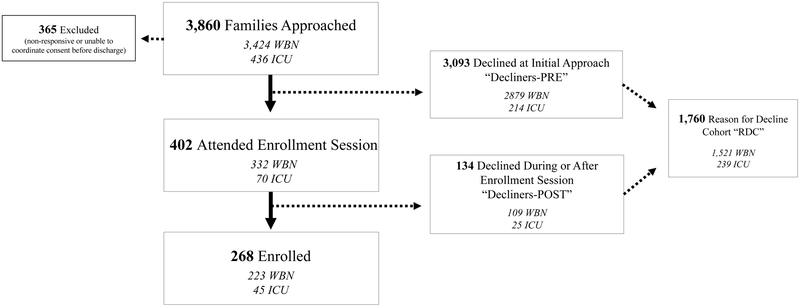
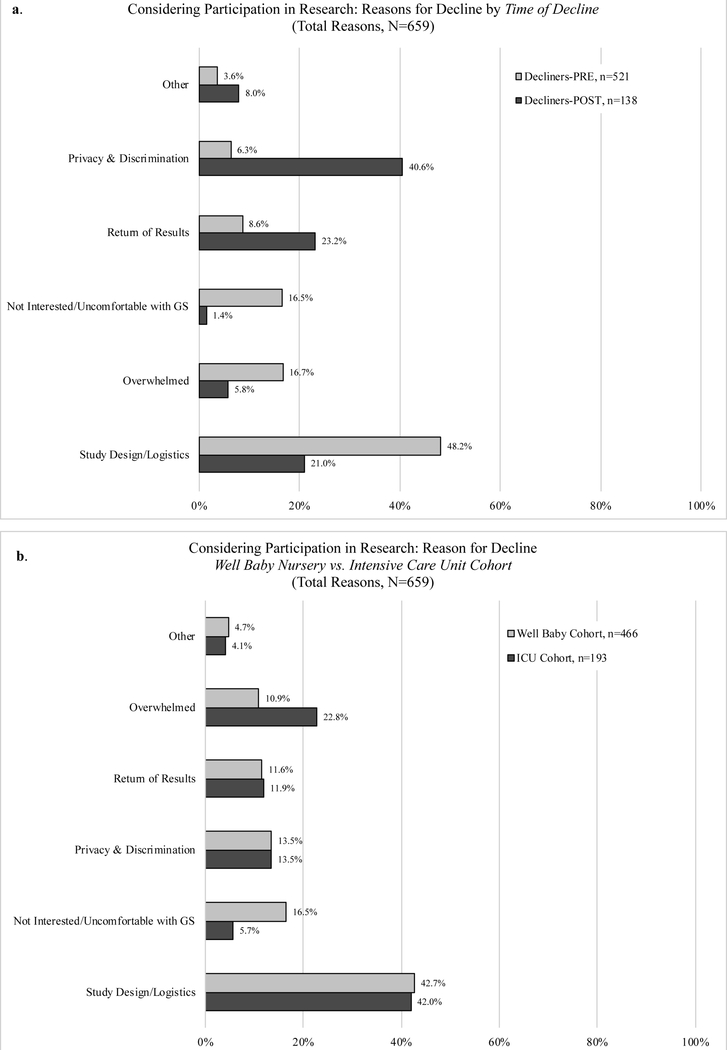
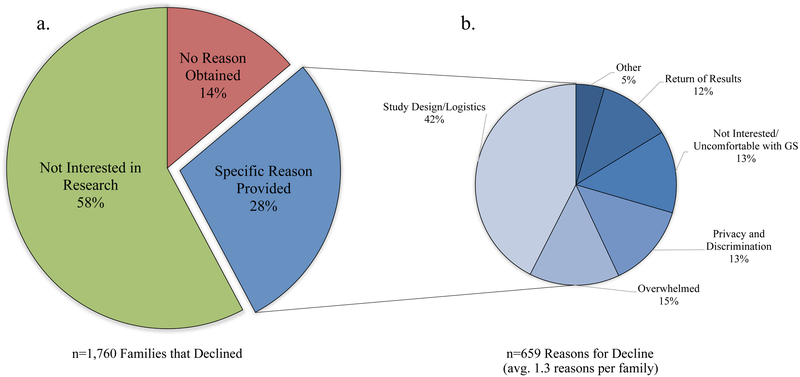
Of 3860 eligible approached families, 10% attended ES, 67% of whom enrolled. Of 1760 families queried for decline reasons, 58% were uninterested in research. Among 499 families considering research, principal reasons for decline prior to ES included burdensome study logistics (48%), feeling overwhelmed postpartum (17%), and lack of interest/discomfort with genetic testing (17%). Decliners after ES more often cited concerns about privacy/insurability (41%) and uncertain/unfavorable results (23%).
Low interest in research and study logistics were major initial barriers to postpartum enrollment and are likely generic to many postpartum research efforts. Concerns over privacy and result implications were most commonly cited in decliners after ES. Understanding parental concerns around research nGS may inform future integration of nGS into newborn screening, predictive testing, and pediatric diagnostics.
新生儿基因组测序(nGS)具有改善儿科护理的巨大潜力。父母对基因组学的兴趣和担忧相对较少被探索。了解父母为何拒绝参与 nGS 研究可能揭示实施障碍。
我们评估了父母对新生儿在常规婴儿和重症监护室环境中进行 nGS 的随机试验的兴趣。有兴趣的家庭在同意之前,先与遗传咨询师一起参加信息登记会议(ES)。分析了拒绝参与的原因和社会人口统计学关联。
在 3860 名符合条件的被访家庭中,有 10%参加了 ES,其中 67%的家庭同意参与。在被问及拒绝原因的 1760 个家庭中,58%的家庭对研究不感兴趣。在 499 个考虑研究的家庭中,拒绝参与 ES 的主要原因包括研究后勤工作繁琐(48%)、产后感到不知所措(17%),以及对遗传检测缺乏兴趣/不舒适(17%)。参加 ES 后拒绝参与的家庭更多地提到对隐私/可保性的担忧(41%)和不确定/不利的结果(23%)。
对研究和研究后勤工作的低兴趣是产后登记的主要初始障碍,可能对许多产后研究工作都具有普遍性。ES 后对隐私和结果影响的担忧是最常被引用的拒绝理由。了解父母对研究 nGS 的关注可能有助于未来将 nGS 纳入新生儿筛查、预测性测试和儿科诊断。