University of Rochester School of Nursing, Rochester, New York.
Department of Biostatistics, University of Rochester Medical Center, Rochester, New York.
Ann Allergy Asthma Immunol. 2019 Jan;122(1):58-64. doi: 10.1016/j.anai.2018.09.448. Epub 2018 Sep 11.
Adequate assessment of control is critical to asthma management. The Asthma Control Questionnaire (ACQ) and the National Asthma Education and Prevention Program (NAEPP) criteria are commonly used measures of asthma control.
To examine the associations between the ACQ and NAEPP criteria and compare the validity in association with lung function, asthma exacerbation, and quality of life.
The ACQ and the NAEPP criteria were administered to 373 adolescents with asthma aged 12 to 20 years. The 2 measures correlated with forced expiratory volume in 1 second (FEV), asthma exacerbation (oral corticosteroid use, hospitalization, and emergency department [ED] use) in the past 12 months, and quality of life.
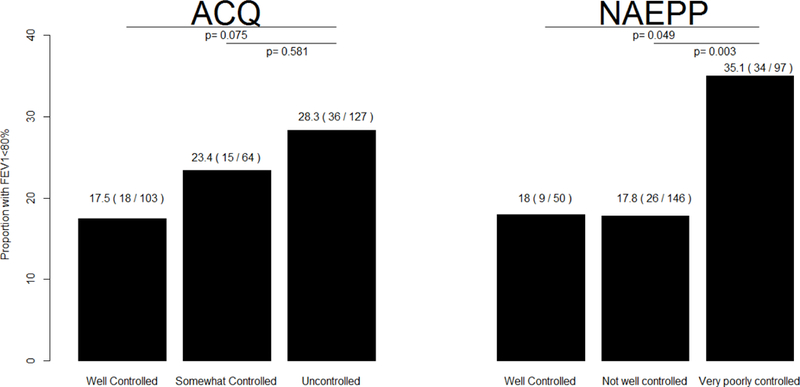
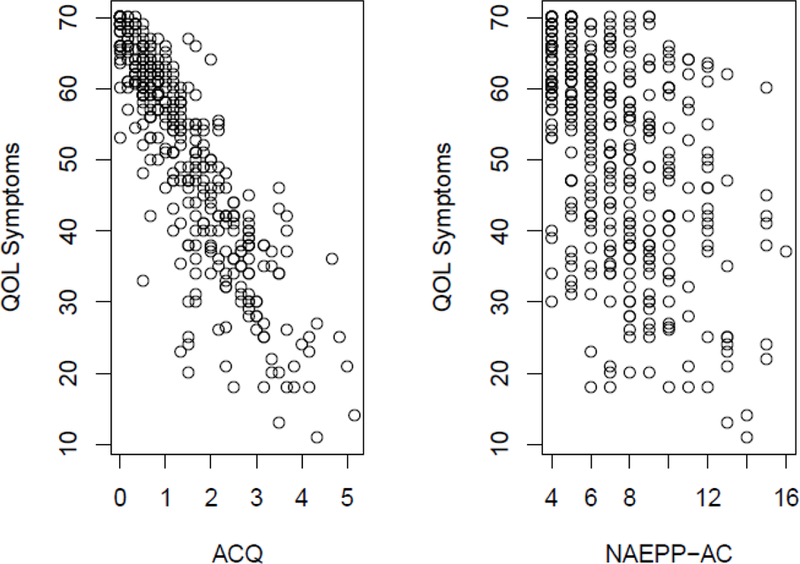
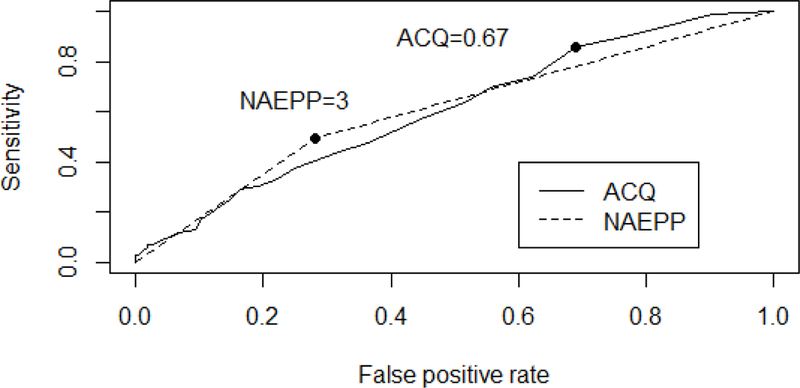
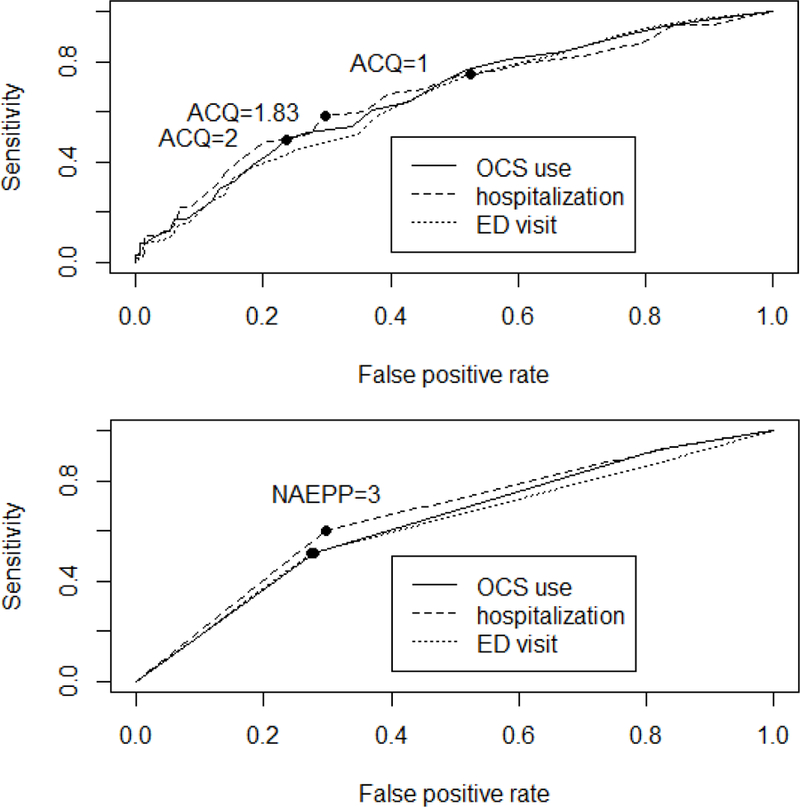
Agreement between the ACQ and NAEPP criteria was moderate (κ = 0.40-0.61). Neither of the 2 measures was a reliable predictor of FEV less than 80% because of the high rate of false-positive results for the ACQ (68%) and low sensitivity for the NAEPP (49%). The NAEPP identified more cases of uncontrolled asthma (84.6%) than the ACQ (64.6%). The ACQ was a significant predictor of recent oral corticosteroid use, hospitalization, and ED visits (area under the curve = 0.66, 0.66, and 0.64, respectively; P < .001), as was NAEPP (area under the curve = 0.63, 0.66, and 0.61, respectively; P < .001). Both measures were significantly associated with quality of life, and the associations were particularly strong for the ACQ (r = -0.87 for symptom subscale, r = -0.76 for activity subscale, and r = -0.78 for emotional function subscale).
Neither the ACQ nor the NAEPP appears to reliably predict lung function, whereas both measures reasonably associate with acute asthma exacerbation. The ACQ may be the superior measure in gauging the psychosocial effect of asthma control given its particularly strong associations with quality of life.
ClinicalTrials.gov Identifier: NCT02293499.
充分评估控制情况对哮喘管理至关重要。哮喘控制问卷(ACQ)和美国国家哮喘教育和预防计划(NAEPP)标准是常用的哮喘控制衡量指标。
探讨 ACQ 和 NAEPP 标准与肺功能、哮喘加重和生活质量之间的关联,并比较其有效性。
对 373 名年龄在 12 至 20 岁的青少年哮喘患者进行 ACQ 和 NAEPP 标准评估。这两种方法与过去 12 个月内的用力呼气量(FEV)、哮喘加重(口服皮质类固醇使用、住院和急诊室[ED]使用)和生活质量相关。
ACQ 和 NAEPP 标准之间的一致性为中度(κ=0.40-0.61)。由于 ACQ 的假阳性结果率较高(68%)和 NAEPP 的敏感性较低(49%),这两种方法都不能可靠地预测 FEV 低于 80%。与 ACQ(64.6%)相比,NAEPP 标准识别出更多的未控制哮喘病例(84.6%)。ACQ 是近期口服皮质类固醇使用、住院和 ED 就诊的显著预测因素(曲线下面积分别为 0.66、0.66 和 0.64;P<0.001),NAEPP 也是如此(曲线下面积分别为 0.63、0.66 和 0.61;P<0.001)。两种方法均与生活质量显著相关,而 ACQ 与生活质量的相关性特别强(症状子量表为 r=-0.87,活动子量表为 r=-0.76,情绪功能子量表为 r=-0.78)。
ACQ 和 NAEPP 均不能可靠地预测肺功能,而这两种方法都与急性哮喘加重有合理的关联。鉴于 ACQ 与生活质量的关联特别强,它可能是评估哮喘控制的社会心理影响的更好指标。
ClinicalTrials.gov 标识符:NCT02293499。