Food Science and Human Nutrition Department, University of Florida, Gainesville, FL 32611, USA.
Department of Nutrition, University of Tennessee, Knoxville, TN 37996, USA.
Nutrients. 2018 Sep 13;10(9):1296. doi: 10.3390/nu10091296.
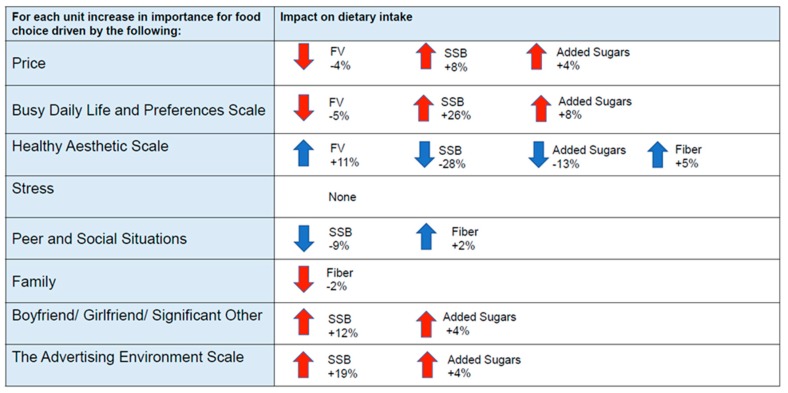
This study assessed food choice priorities (FCP) and associations with consumption of fruits and vegetables (FV), fiber, added sugars from non-beverage sources, and sugar-sweetened beverages (SSB) among college students. Freshmen from eight U.S. universities ( = 1149) completed the Food Choice Priorities Survey, designed for college students to provide a way to determine the factors of greatest importance regarding food choices, and the NCI Dietary Screener Questionnaire. Changes in FCP and dietary intake from fall 2015 to spring 2016 were assessed. Multiple regression models examined associations between FCP and log-transformed dietary intake, controlling for sex, age, race, and BMI. Participant characteristics and FCP associations were also assessed. FCP importance changed across the freshmen year and significantly predicted dietary intake. The most important FCP were price, busy daily life and preferences, and healthy aesthetic. Students who endorsed healthy aesthetic factors (health, effect on physical appearance, freshness/quality/in season) as important for food choice, consumed more FV and fiber and less added sugar and SSB. Busy daily life and preferences (taste, convenience, routine, ability to feel full) predicted lower FV, higher added sugar, and higher SSB consumption. Price predicted lower FV, higher SSB, and more added sugar while the advertising environment was positively associated with SSB intake. FCP and demographic factors explained between 2%⁻17% of the variance in dietary intake across models. The strongest relationship was between healthy aesthetic factors and SSB (B = -0.37, < 0.01). Self-rated importance of factors influencing food choice are related to dietary intake among students. Interventions that shift identified FCP may positively impact students' diet quality especially considering that some FCP increase in importance across the first year of college.
本研究评估了大学生的食物选择优先级(FCP)与水果和蔬菜(FV)、纤维、非饮料来源的添加糖以及含糖饮料(SSB)消费之间的关系。来自美国八所大学的新生(n=1149)完成了食物选择优先级调查,该调查专为大学生设计,旨在确定与食物选择相关的最重要因素,并使用 NCI 饮食筛查问卷进行评估。从 2015 年秋季到 2016 年春季,评估了 FCP 和饮食摄入的变化。多回归模型控制性别、年龄、种族和 BMI,检验了 FCP 与 log 转化后饮食摄入之间的关系。还评估了参与者特征和 FCP 之间的关联。FCP 的重要性在新生学年发生了变化,并显著预测了饮食摄入。最重要的 FCP 是价格、忙碌的日常生活和偏好以及健康美观。选择食物时将健康美观因素(健康、对身体外观的影响、新鲜度/质量/当季)作为重要因素的学生,摄入更多的 FV 和纤维,而摄入较少的添加糖和 SSB。忙碌的日常生活和偏好(口味、方便、常规、饱腹感)预测 FV 摄入量较低、添加糖和 SSB 摄入量较高。价格预测 FV 摄入量较低、SSB 摄入量较高、添加糖摄入量较高,而广告环境与 SSB 摄入量呈正相关。FCP 和人口统计学因素在各个模型中解释了 2%-17%的饮食摄入差异。最强的关系是健康美观因素与 SSB 之间的关系(B=-0.37,<0.01)。影响食物选择的因素的自我评估重要性与学生的饮食摄入有关。改变已确定的 FCP 可能会对学生的饮食质量产生积极影响,特别是考虑到一些 FCP 在大学第一年的重要性会增加。