Department of Psychology, University of Campania Luigi Vanvitelli, CE 81100 Caserta, Italy.
Department of Psychology, Alma Mater Studiorum University of Bologna, BO 40126 Bologna, Italy.
Int J Environ Res Public Health. 2018 Sep 13;15(9):1996. doi: 10.3390/ijerph15091996.
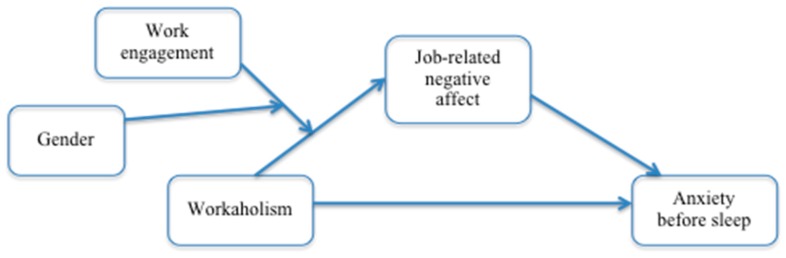
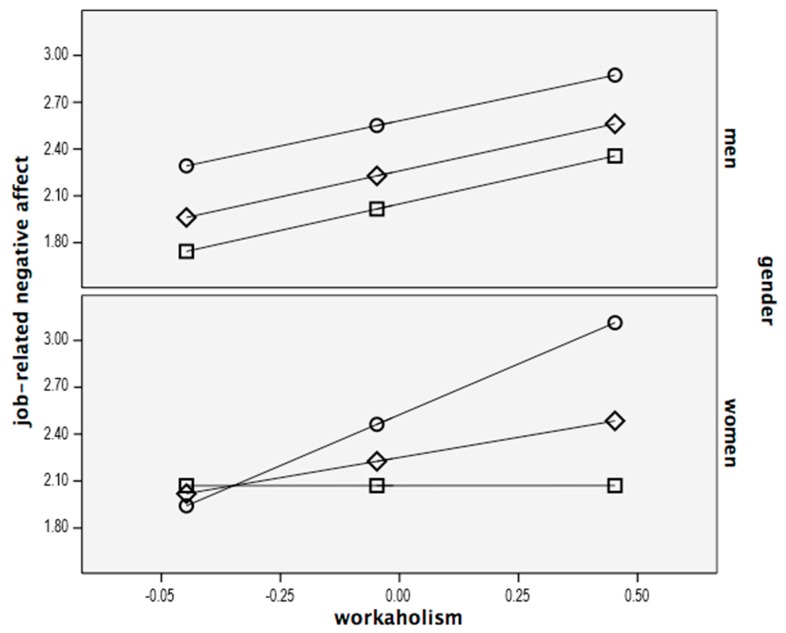
Although the interplay between workaholism and work engagement could explain several open questions regarding the Heavy Work Investment (HWI) phenomenon, few studies have addressed this issue. Thus, with the purpose of filling this literature gap, the present study aimed at examining a model where job-related negative affect mediates the relationship between the interplay of workaholism and work engagement, and anxiety before sleep. Since gender could have a role in the way the interplay would impact on the theorized model, we also hypothesized a moderated role of gender on the specific connection concerning the interplay between workaholism and work engagement, in relation to job-related negative affect. Conditional process analysis was conducted on a sample of 146 participants, balanced for gender. Results supported the mediating model and indicated the presence of a moderated role of gender, such that engaged workaholic women reported significantly less job-related negative affect than disengaged workaholic women. On the contrary, the interplay between workaholism and work engagement did not seem significant for men. Results are discussed in light of the limitations and future directions of the research in this field, as well as the ensuing practical implications.
尽管工作狂和工作投入之间的相互作用可以解释关于重度工作投入(HWI)现象的几个悬而未决的问题,但很少有研究涉及这个问题。因此,为了填补这一文献空白,本研究旨在检验一个模型,其中与工作相关的负面情绪在工作狂和工作投入之间的相互作用与睡眠前焦虑之间的关系中起中介作用。由于性别可能会影响相互作用对理论模型的影响方式,我们还假设性别在工作狂和工作投入之间的相互作用与与工作相关的负面情绪有关的特定联系方面具有调节作用。在性别平衡的 146 名参与者样本中进行了条件过程分析。结果支持了中介模型,并表明性别具有调节作用,即投入型工作狂女性报告的与工作相关的负面情绪明显少于非投入型工作狂女性。相反,工作狂和工作投入之间的相互作用似乎对男性没有意义。研究结果根据该领域研究的局限性和未来方向以及随之而来的实际意义进行了讨论。