Laboratory Medicine and Pathology, University of Alberta, Edmonton, AB, Canada.
Blood Systems Research Institute, San Francisco, CA.
Blood Adv. 2018 Sep 25;2(18):2296-2306. doi: 10.1182/bloodadvances.2018021931.
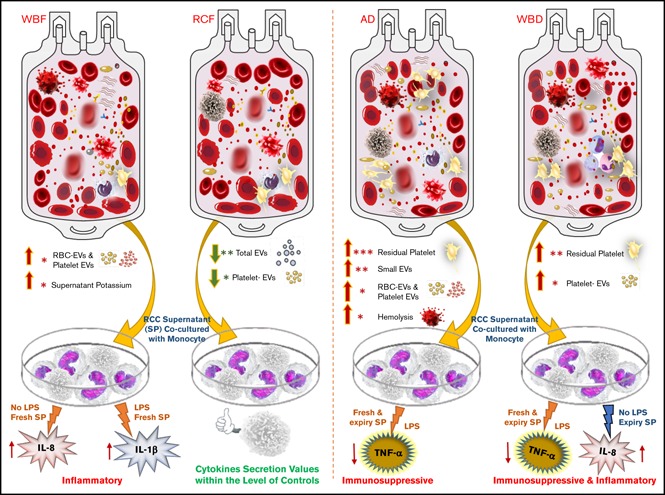
Transfusion of red cell concentrates (RCCs) is associated with increased risk of adverse outcomes that may be affected by different blood manufacturing methods and the presence of extracellular vesicles (EVs). We investigated the effect of different manufacturing methods on hemolysis, residual cells, cell-derived EVs, and immunomodulatory effects on monocyte activity. Thirty-two RCC units produced using whole blood filtration (WBF), red cell filtration (RCF), apheresis-derived (AD), and whole blood-derived (WBD) methods were examined (n = 8 per method). Residual platelet and white blood cells (WBCs) and the concentration, cell of origin, and characterization of EVs in RCC supernatants were assessed in fresh and stored supernatants. Immunomodulatory activity of RCC supernatants was assessed by quantifying monocyte cytokine production capacity in an in vitro transfusion model. RCF units yielded the lowest number of platelet and WBC-derived EVs, whereas the highest number of platelet EVs was in AD (day 5) and in WBD (day 42). The number of small EVs (<200 nm) was greater than large EVs (≥200 nm) in all tested supernatants, and the highest level of small EVs were in AD units. Immunomodulatory activity was mixed, with evidence of both inflammatory and immunosuppressive effects. Monocytes produced more inflammatory interleukin-8 after exposure to fresh WBF or expired WBD supernatants. Exposure to supernatants from AD and WBD RCC suppressed monocyte lipopolysaccharide-induced cytokine production. Manufacturing methods significantly affect RCC unit EV characteristics and are associated with an immunomodulatory effect of RCC supernatants, which may affect the quality and safety of RCCs.
输注浓缩红细胞(RCC)与不良结局风险增加相关,这种风险可能受到不同血液制备方法和细胞外囊泡(EVs)的存在的影响。我们研究了不同的制备方法对溶血、残留细胞、细胞衍生的 EVs 以及对单核细胞活性的免疫调节作用的影响。使用全血过滤(WBF)、红细胞过滤(RCF)、单采衍生(AD)和全血衍生(WBD)方法制备了 32 个 RCC 单位(每种方法 8 个单位),并对其进行了研究。评估了新鲜和储存上清液中 RCC 上清液中残留血小板和白细胞(WBC)的浓度、细胞来源以及 EVs 的特征。通过在体外输血模型中定量单核细胞细胞因子产生能力来评估 RCC 上清液的免疫调节活性。RCF 单位产生的血小板和 WBC 衍生 EVs 数量最少,而 AD(第 5 天)和 WBD(第 42 天)的血小板 EVs 数量最多。所有测试的上清液中,小 EVs(<200nm)的数量均大于大 EVs(≥200nm),且 AD 单位中的小 EVs 水平最高。免疫调节活性存在混合性,表现出炎症和免疫抑制作用。新鲜 WBF 或过期 WBD 上清液暴露后,单核细胞产生更多的炎症性白细胞介素-8。AD 和 WBD RCC 上清液抑制了单核细胞脂多糖诱导的细胞因子产生。制备方法显著影响 RCC 单位 EV 的特征,并与 RCC 上清液的免疫调节作用相关,这可能会影响 RCC 的质量和安全性。