Inbrain Lab, Department de Física, FFCLRP, Universidade de São Paulo, São Carlos, SP, Brazil.
Departamento de Clínica Médica, FMRP, Universidade de São Paulo, São Carlos, SP, Brazil.
Neuroimage Clin. 2018;20:705-714. doi: 10.1016/j.nicl.2018.08.030. Epub 2018 Aug 31.
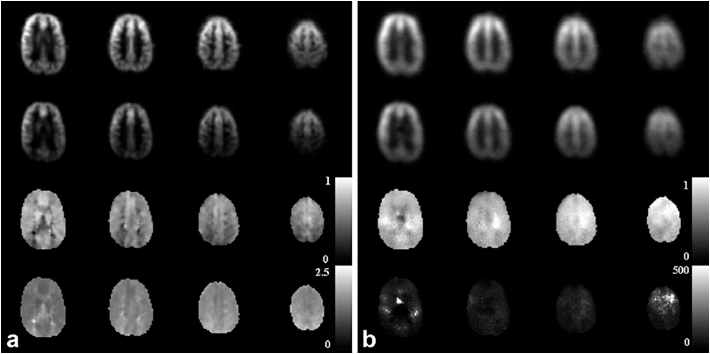
Intravoxel Incoherent Motion (IVIM) is a recently rediscovered noninvasive magnetic resonance imaging (MRI) method based on diffusion-weighted imaging. It enables the separation of the intravoxel signal into diffusion due to Brownian motion and perfusion-related contributions and provides important information on microperfusion in the tissue and therefore it is a promising tool for applications in neurological and neurovascular diseases. This review focuses on the basic principles and outputs of IVIM and details it major applications in the brain, such as stroke, tumor, and cerebral small vessel disease. A bi-exponential model that considers two different compartments, namely capillaries, and medium-sized vessels, has been frequently used for the description of the IVIM signal and may be important in those clinical applications cited before. Moreover, the combination of IVIM and arterial spin labeling MRI enables the estimation of water permeability across the blood-brain barrier (BBB), suggesting a potential imaging biomarker for disrupted-BBB diseases.
体素内不相干运动(IVIM)是一种最近重新发现的基于扩散加权成像的无创磁共振成像(MRI)方法。它能够将体素内信号分离为由于布朗运动引起的扩散和与灌注相关的贡献,并提供有关组织中微灌注的重要信息,因此它是一种有前途的在神经和神经血管疾病中的应用工具。这篇综述重点介绍了 IVIM 的基本原理和输出结果,并详细介绍了它在大脑中的主要应用,如中风、肿瘤和脑小血管疾病。双指数模型考虑了两个不同的隔间,即毛细血管和中等大小的血管,经常用于描述 IVIM 信号,并且在之前提到的那些临床应用中可能很重要。此外,IVIM 与动脉自旋标记 MRI 的结合可以估计血脑屏障(BBB)的水通透性,这表明它是一种用于诊断 BBB 疾病的潜在成像生物标志物。