Physicians Committee for Responsible Medicine, 5100 Wisconsin Ave, N.W. Ste.400, Washington, DC 20016, USA.
School of Medicine, University of Utah, Salt Lake City, UT 84132, USA.
Nutrients. 2019 Mar 13;11(3):615. doi: 10.3390/nu11030615.
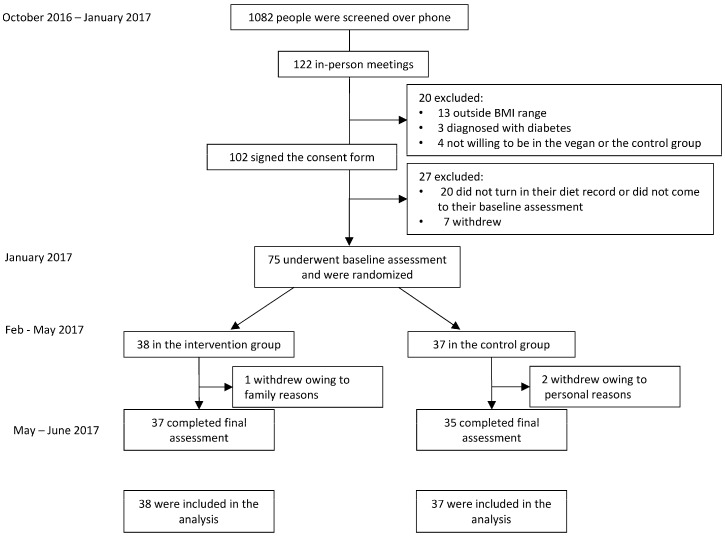
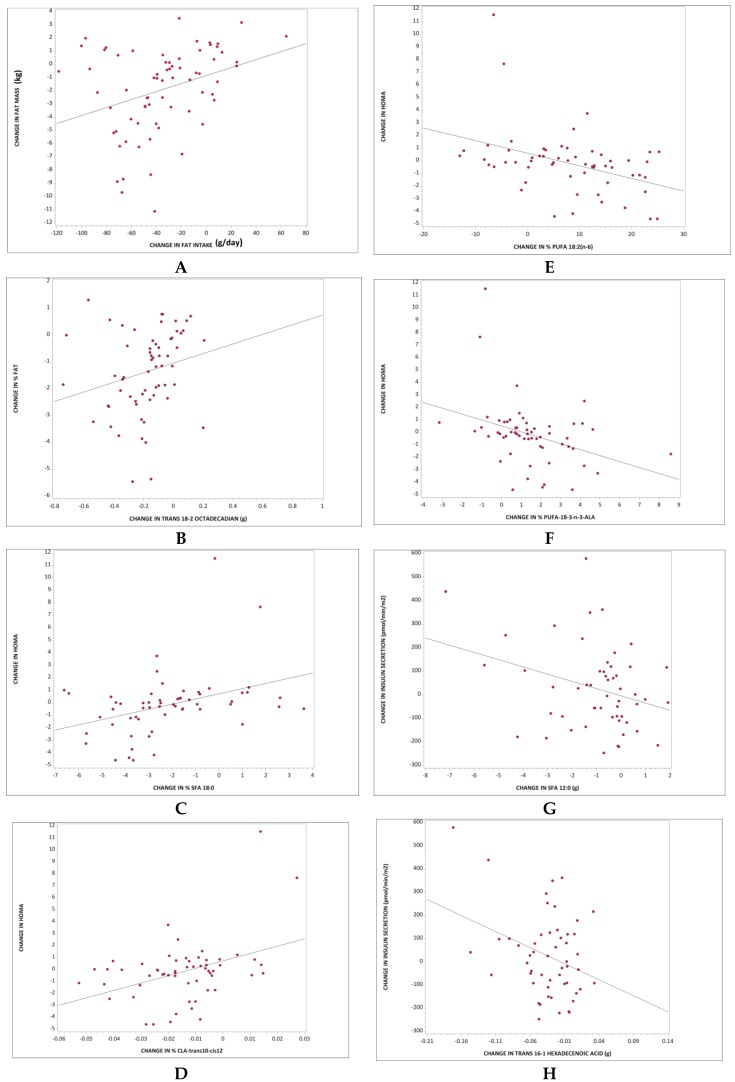
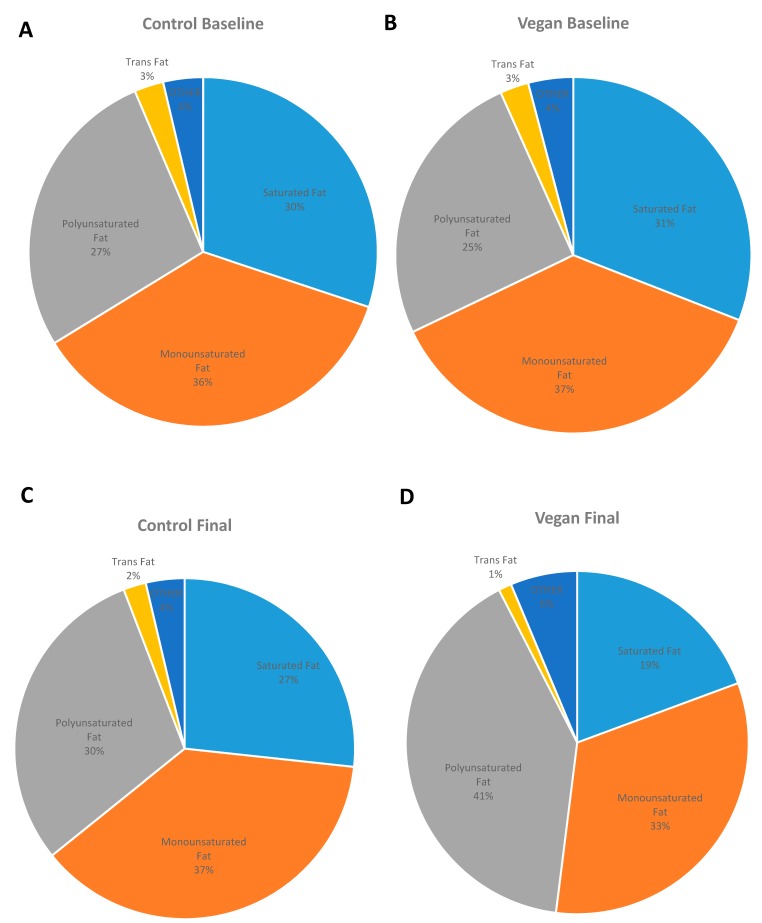
Macronutrient composition of the diet influences the development of obesity and insulin resistance. The aim of this study was to assess the role of dietary fat quantity and fatty acid composition in body composition, insulin resistance, and insulin secretion. An open parallel randomized trial design was used. Overweight participants ( = 75) were randomized to follow a low-fat vegan ( = 38) or control diet ( = 37) for 16 weeks. Dual X-ray absorptiometry was used to measure body composition. Insulin resistance was assessed with the Homeostasis Model Assessment (HOMA-IR) index. Insulin secretion was assessed after stimulation with a liquid breakfast (Boost Plus, Nestle, Vevey, Switzerland). Self-reported 3-day diet records were used to assess dietary intake. A linear regression model was used to test the relationship between fat intake and body composition, insulin resistance, and insulin secretion. Changes in fat intake expressed as percent of total energy consumed correlated positively with changes in fat mass ( = 0.52; < 0.001; and 0.347; = 0.006, respectively), even after adjustment for changes in body-mass index (BMI) and energy intake (0.33; = 0.01). Decreased intakes of C18:0 ( = 0.37, = 0.004) and CLA-trans-10-cis12 ( = 0.40, = 0.002), but increased intake of C18:2 ( = -0.40, = 0.002) and C18:3 ( = -0.36, = 0.006), were associated with a decrease in HOMA-IR, independent on changes in BMI and energy intake. The main fatty acids associated with changes in fasting insulin secretion were C12:0 ( = -0.31, = 0.03), and TRANS 16:1 ( = -0.33, = 0.02), both independent on changes in BMI and energy intake. Our findings demonstrate that, in the context of a low-fat vegan diet, decreased intake of saturated and trans fats and increased relative content of polyunsaturated fatty acids, particularly linoleic and α-linolenic acids, are associated with decreased fat mass and insulin resistance, and enhanced insulin secretion.
饮食中的宏量营养素组成会影响肥胖和胰岛素抵抗的发展。本研究旨在评估膳食脂肪量和脂肪酸组成对身体成分、胰岛素抵抗和胰岛素分泌的作用。采用开放平行随机试验设计。超重参与者(n=75)被随机分配到低脂纯素组(n=38)或对照组(n=37),进行 16 周的饮食干预。双能 X 线吸收法用于测量身体成分。用稳态模型评估法(HOMA-IR)指数评估胰岛素抵抗。用液体早餐(雀巢公司的 Boost Plus)刺激后评估胰岛素分泌。使用自我报告的 3 天饮食记录评估膳食摄入量。线性回归模型用于检验脂肪摄入量与身体成分、胰岛素抵抗和胰岛素分泌之间的关系。以总能量消耗的百分比表示的脂肪摄入量变化与脂肪量的变化呈正相关(r=0.52;p<0.001;r=0.347;p=0.006),即使在校正了体重指数(BMI)和能量摄入的变化后(r=0.33;p=0.01)。C18:0 的摄入量减少(r=0.37;p=0.004)和 CLA 反式 10-顺式 12(r=0.40;p=0.002),C18:2(r=-0.40;p=0.002)和 C18:3(r=-0.36;p=0.006)的摄入量增加,与 HOMA-IR 的降低相关,而与 BMI 和能量摄入的变化无关。与空腹胰岛素分泌变化相关的主要脂肪酸是 C12:0(r=-0.31;p=0.03)和 TRANS 16:1(r=-0.33;p=0.02),两者均与 BMI 和能量摄入的变化无关。我们的研究结果表明,在低脂纯素饮食的背景下,饱和脂肪和反式脂肪的摄入量减少,多不饱和脂肪酸,特别是亚油酸和α-亚麻酸的相对含量增加,与脂肪量减少和胰岛素抵抗降低以及胰岛素分泌增强有关。