Wright N, Wilson L, Smith M, Duncan B, McHugh P
Royal New Zealand College of General Practitioners, Gisborne, New Zealand.
Two Zesty Bananas Limited, Wellington, New Zealand.
Nutr Diabetes. 2017 Mar 20;7(3):e256. doi: 10.1038/nutd.2017.3.
BACKGROUND/OBJECTIVE: There is little randomised evidence using a whole food plant-based (WFPB) diet as intervention for elevated body mass index (BMI) or dyslipidaemia. We investigated the effectiveness of a community-based dietary programme. Primary end points: BMI and cholesterol at 6 months (subsequently extended).
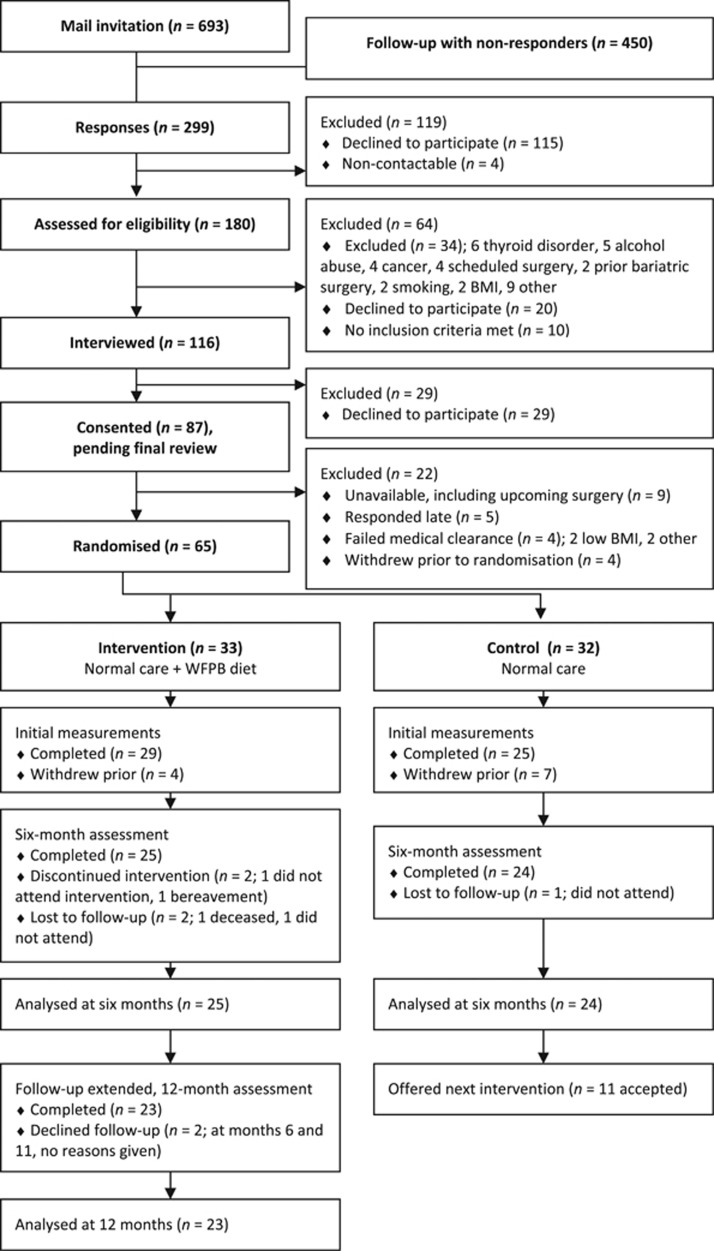
Ages 35-70, from one general practice in Gisborne, New Zealand. Diagnosed with obesity or overweight and at least one of type 2 diabetes, ischaemic heart disease, hypertension or hypercholesterolaemia. Of 65 subjects randomised (control n=32, intervention n=33), 49 (75.4%) completed the study to 6 months. Twenty-three (70%) intervention participants were followed up at 12 months.
All participants received normal care. Intervention participants attended facilitated meetings twice-weekly for 12 weeks, and followed a non-energy-restricted WFPB diet with vitamin B supplementation.
At 6 months, mean BMI reduction was greater with the WFPB diet compared with normal care (4.4 vs 0.4, difference: 3.9 kg m (95% confidence interval (CI)±1), P<0.0001). Mean cholesterol reduction was greater with the WFPB diet, but the difference was not significant compared with normal care (0.71 vs 0.26, difference: 0.45 mmol l (95% CI±0.54), P=0.1), unless dropouts were excluded (difference: 0.56 mmol l (95% CI±0.54), P=0.05). Twelve-month mean reductions for the WFPB diet group were 4.2 (±0.8) kg m BMI points and 0.55 (±0.54, P=0.05) mmol l total cholesterol. No serious harms were reported.
This programme led to significant improvements in BMI, cholesterol and other risk factors. To the best of our knowledge, this research has achieved greater weight loss at 6 and 12 months than any other trial that does not limit energy intake or mandate regular exercise.
背景/目的:几乎没有随机对照证据表明采用全食物植物性(WFPB)饮食干预可降低体重指数(BMI)或改善血脂异常。我们调查了一项基于社区的饮食计划的效果。主要终点:6个月时的BMI和胆固醇水平(随后延长)。
年龄在35 - 70岁之间,来自新西兰吉斯伯恩的一家普通诊所。被诊断为肥胖或超重,且患有2型糖尿病、缺血性心脏病、高血压或高胆固醇血症中的至少一种。在65名随机分组的受试者中(对照组n = 32,干预组n = 33),49名(75.4%)完成了6个月的研究。23名(70%)干预组参与者接受了12个月的随访。
所有参与者均接受常规护理。干预组参与者每周参加两次为期12周的辅助会议,并遵循非能量限制的WFPB饮食,同时补充维生素B。
在6个月时,与常规护理相比,WFPB饮食组的平均BMI降低幅度更大(4.4对0.4,差值:3.9 kg/m²(95%置信区间(CI)±1),P < 0.0001)。WFPB饮食组的平均胆固醇降低幅度更大,但与常规护理相比差异不显著(0.71对0.26,差值:0.45 mmol/L(95% CI±0.54),P = 0.1),除非排除失访者(差值:0.56 mmol/L(95% CI±0.54),P = 0.05)。WFPB饮食组12个月时的平均BMI降低值为4.2(±0.8)kg/m²,总胆固醇降低值为0.55(±0.54,P = 0.05)mmol/L。未报告严重不良事件。
该计划使BMI、胆固醇及其他风险因素得到显著改善。据我们所知,本研究在6个月和12个月时实现的体重减轻幅度大于任何其他不限制能量摄入或未强制规定定期运动的试验。