Division of Epidemiology and Community Health, School of Public Health, University of Minnesota, Minneapolis, Minnesota, USA.
Department of Biostatistics, Columbia University Mailman School of Public Health, New York, New York, USA.
Obesity (Silver Spring). 2018 Sep;26(9):1467-1473. doi: 10.1002/oby.22273.
Prospective associations between obesity in adolescence and adult socioeconomic outcomes, and potential mediators, were examined in a contemporary cohort.
Longitudinal data collected in 1998 to 1999 (Project EAT-I) and 2015 to 2016 (EAT-IV) were analyzed for 1,796 participants who provided data at both time points. Adolescents (mean age = 14.8 years) self-reported demographic and psychosocial variables (EAT-I) and follow-up outcomes (EAT-IV). Body weight and height were directly measured. Bachelor's degree or more education, income ≥ US $50,000, and partnered status at follow-up were examined by baseline obesity (>95th BMI percentile) using logistic regression. Self-esteem, depression, and weight-related teasing were examined as mediators using multivariate probit regressions. All analyses were adjusted for race, baseline age, and parent socioeconomic status.
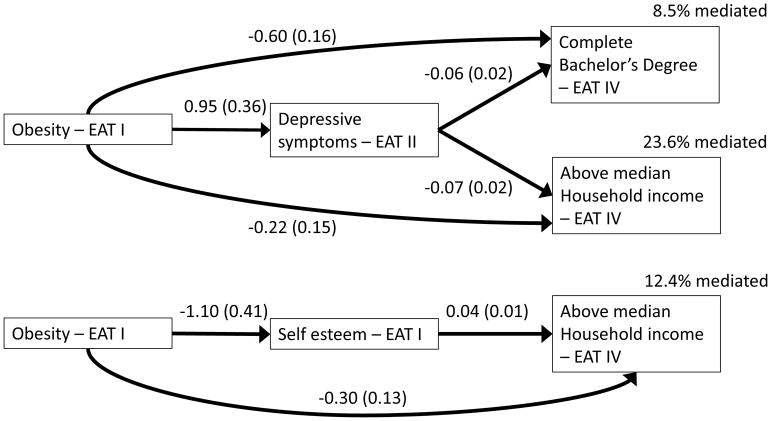
Girls with obesity were significantly less likely to have achieved a bachelor's degree (OR 0.32, 95% CI [0.18, 0.58]; P < 0.001), earn ≥ $50,000 annually (OR 0.57, 95% CI [0.33, 0.99]; P < 0.04), or be partnered (OR 0.45, 95% CI [0.27, 0.75]; P < 0.002) in adulthood. No associations were observed among boys. Among girls, depression mediated 8.5% and 23.6% of the association between adolescent obesity and adult education and income, respectively.
Adolescent girls with obesity have lower educational attainment and income and are less likely to be partnered in later adulthood. Depression may partly mediate the associations.
在当代队列中,研究了青少年肥胖与成人社会经济结局之间的前瞻性关联,以及潜在的中介因素。
对 1998 年至 1999 年(EAT-I 项目)和 2015 年至 2016 年(EAT-IV 项目)收集的纵向数据进行了分析,共纳入了 1796 名在两个时间点均提供数据的参与者。青少年(平均年龄=14.8 岁)自我报告人口统计学和心理社会变量(EAT-I)和随访结局(EAT-IV)。体重和身高通过直接测量获得。采用逻辑回归,根据基线肥胖(>95th BMI 百分位数)检查基线时拥有学士学位或更高学历、收入≥50,000 美元和在随访时处于伴侣关系的情况。采用多变量概率回归,检查自尊、抑郁和与体重相关的嘲笑作为中介因素。所有分析均调整了种族、基线年龄和父母的社会经济地位。
肥胖女孩获得学士学位的可能性显著降低(OR 0.32,95%CI [0.18, 0.58];P<0.001),年收入≥50,000 美元的可能性降低(OR 0.57,95%CI [0.33, 0.99];P<0.04),或处于伴侣关系的可能性降低(OR 0.45,95%CI [0.27, 0.75];P<0.002)。男孩中未观察到相关性。在女孩中,抑郁分别部分解释了青少年肥胖与成年教育和收入之间 8.5%和 23.6%的关联。
肥胖的青少年女孩在成年后受教育程度和收入较低,且不太可能处于伴侣关系。抑郁可能部分解释了这些关联。