Department of Ophthalmology, University Medical Center Mainz, Mainz, Germany.
Department of Urology, Klinikum Worms, Worms, Germany.
PLoS One. 2018 Sep 18;13(9):e0204008. doi: 10.1371/journal.pone.0204008. eCollection 2018.
There is some controversy whether or not saccades change with age. This cross-sectional study aims to clarify the characteristics of reflexive saccades at various ages to establish a normative cohort in a standardized set-up. Second objective is to investigate the feasibility of saccadometry in daily ophthalmological practice.
One hundred healthy participants aged between 6 and 76 years underwent an ophthalmologic examination and saccadometry, using an infrared video-oculography device, sampling at 220 Hz. The reflexive saccades were evoked in four directions and three target displacements each (5°/15°/30° horizontally and of 5°/10°/20° vertically). Saccadic peak velocity, gain (amplitude/target displacement) and latency were measured.
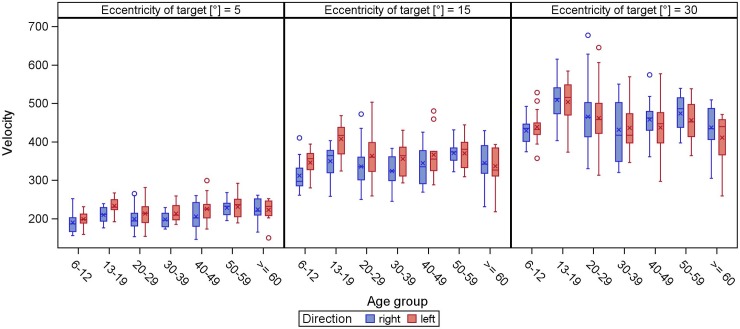
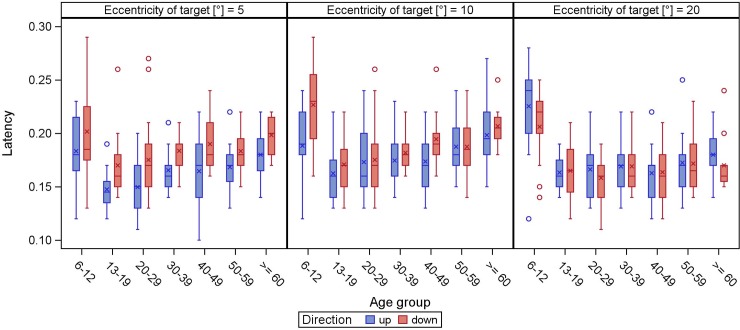
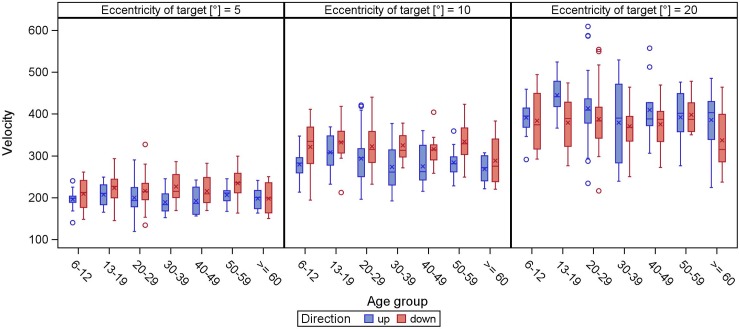
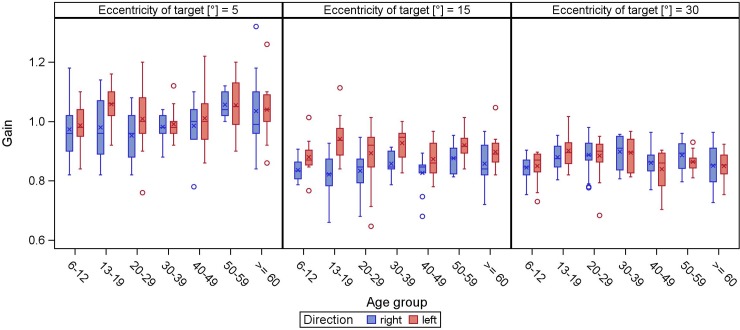
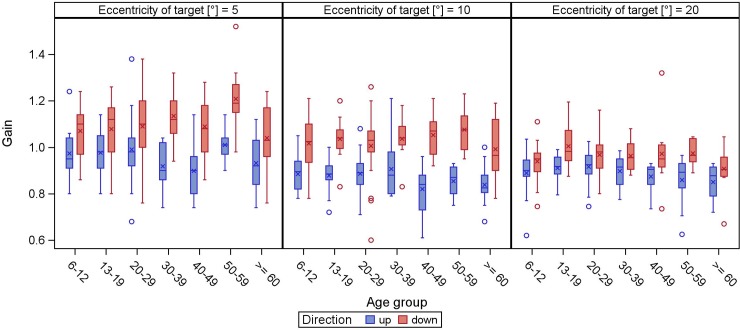
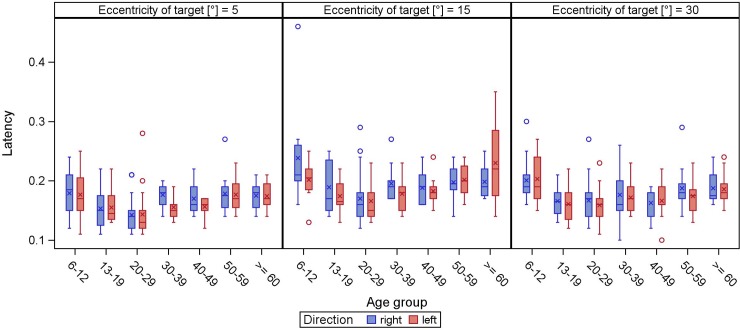
Mean peak velocity of saccades was 213°/s (± 29°/s), 352°/s (± 50°/s) and 455°/s (± 67°/s) to a target position 5°, 15°and 30° horizontally, respectively, and 208°/s (± 36°/s), 303°/s (± 50°/s) and 391°/s (± 71°/s) to a target position 5°, 10° and 20° vertically. The association between peak velocity and eccentricity proved to be present at any age in all four directions. We found no relevant effect of age on peak velocity, gain and latency in a fitted linear mixed model. However, latency becomes shorter during childhood and adolescence, while in adulthood it is relatively stable with a slight trend to increase in the elderly. Saccades are more precise when the target displacement is small. Isometric saccades are most common, followed by hypometric ones. All children and elderly were able to perform good quality saccadometry in a recording time of approximately 10 minutes.
The presented data may serve as normative control for further studies using such a video-oculography device for saccadometry. The means of peak velocity and the gain can be used independently from age respecting the target displacement. Latency is susceptible to age.
眼球跳动是否随年龄变化存在一定争议。本横断面研究旨在明确各年龄段反射性眼球跳动的特征,在标准化设置下建立一个正常参考群体。第二个目的是研究在日常眼科实践中眼球跳动测量的可行性。
100 名年龄在 6 至 76 岁之间的健康参与者接受了眼科检查和眼球跳动测量,使用红外视频眼动描记法设备,以 220Hz 的频率进行采样。以 5°/15°/30°的水平方向和 5°/10°/20°的垂直方向,各方向和各目标位移(5°/15°/30°水平方向和 5°/10°/20°垂直方向)下引出 4 次反射性眼球跳动。测量眼球跳动的峰值速度、增益(幅度/目标位移)和潜伏期。
目标在水平方向上位于 5°、15°和 30°时,眼球跳动的平均峰值速度分别为 213°/s(± 29°/s)、352°/s(± 50°/s)和 455°/s(± 67°/s),目标在垂直方向上位于 5°、10°和 20°时,眼球跳动的平均峰值速度分别为 208°/s(± 36°/s)、303°/s(± 50°/s)和 391°/s(± 71°/s)。在任何方向和任何年龄,峰值速度与偏心率之间都存在关联。我们发现,在拟合的线性混合模型中,年龄对峰值速度、增益和潜伏期均无显著影响。然而,潜伏期在儿童和青少年时期会变短,而成人时期则相对稳定,在老年人中稍有增加的趋势。当目标位移较小时,眼球跳动会更精确。等距眼球跳动最为常见,其次是低于正常的眼球跳动。所有儿童和老年人都能够在大约 10 分钟的记录时间内完成高质量的眼球跳动测量。
本研究结果可作为进一步使用该视频眼动描记法设备进行眼球跳动测量的研究的正常对照数据。在不考虑目标位移的情况下,峰值速度和增益的均值可独立于年龄使用。潜伏期易受年龄影响。