Sterling Madeline R, Silva Ariel F, Robbins Laura, Dargar Savira K, Schapira Marilyn M, Safford Monika M
Division of General Internal Medicine, Department of Medicine, Weill Cornell Medical College, New York City, New York, USA.
Education and Academic Affairs, Hospital for Special Surgery, New York City, New York, USA.
BMJ Open. 2018 Sep 19;8(9):e023073. doi: 10.1136/bmjopen-2018-023073.
To examine the perspectives of adults with heart failure (HF) about numerical concepts integral to HF self-care.
This qualitative study took place at an urban academic primary care practice.
Thirty men and women aged 47-89 years with a history of HF were recruited to participate. Eligibility criteria included: a history of HF (≥1 year), seen at the clinic within the last year, and a HF hospitalisation within the last 6 months. Non-English speakers and those with severe cognitive impairment were excluded.
In-depth semistructured interviews were conducted. Participants were interviewed about numeracy across three domains of HF self-care: (1) monitoring weight,(2) maintaining a diet low in salt and (3) monitoring blood pressure. Interviews were audio-taped, transcribed verbatim and analysed using grounded theory and word cloud techniques.
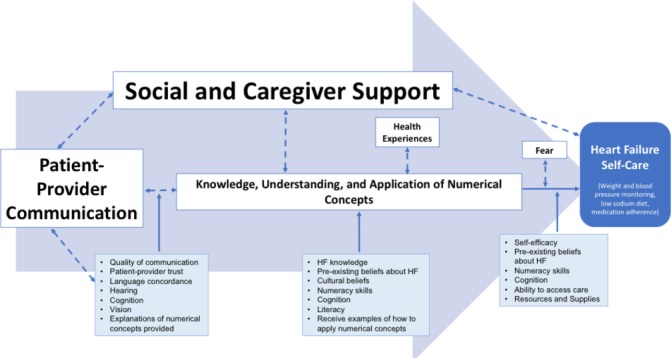
Five key themes reflecting participants' attitudes towards numerical concepts pertaining to weight, diet and blood pressure were identified: (1) Communication between healthcare providers and patients is a complex, multistage process; (2) Patients possess a wide range of knowledge and understanding; (3) Social and caregiver support is critical for the application of numerical concepts; (4) Prior health experiences shape outlook towards numerical concepts and instructions and (5) Fear serves as a barrier and a facilitator to carrying out HF self-care tasks that involve numbers. The findings informed a theoretical framework of health numeracy in HF.
Effective communication of numerical concepts which pertain to HF self-care is highly variable. Many patients with HF lack basic understanding and numeracy skills required for adequate self-care. As such, patients rely on caregivers who may lack HF training. HF-specific training of caregivers and research that seeks to elucidate the intricacies of the patient-caregiver relationship in the context of health numeracy and HF self-care are warranted.
探讨心力衰竭(HF)成人患者对HF自我护理中重要数字概念的看法。
这项定性研究在城市学术初级保健机构开展。
招募了30名年龄在47 - 89岁、有HF病史的男性和女性参与研究。纳入标准包括:HF病史(≥1年)、过去一年内曾在该诊所就诊、过去6个月内有过HF住院治疗。排除非英语使用者和有严重认知障碍者。
进行深入的半结构式访谈。就HF自我护理的三个领域中的数字能力对参与者进行访谈:(1)体重监测,(2)维持低盐饮食,(3)血压监测。访谈进行录音,逐字转录,并采用扎根理论和词云技术进行分析。
确定了反映参与者对与体重、饮食和血压相关数字概念态度的五个关键主题:(1)医疗服务提供者与患者之间的沟通是一个复杂的多阶段过程;(2)患者拥有广泛的知识和理解;(3)社会和照护者支持对于数字概念的应用至关重要;(4)既往健康经历塑造了对数字概念和指示的看法;(5)恐惧既是执行涉及数字的HF自我护理任务的障碍,也是促进因素。这些发现为HF健康数字素养的理论框架提供了依据。
与HF自我护理相关的数字概念的有效沟通差异很大。许多HF患者缺乏充分自我护理所需的基本理解和数字能力。因此,患者依赖可能缺乏HF培训的照护者。有必要对照护者进行HF专项培训,并开展研究以阐明健康数字素养和HF自我护理背景下患者 - 照护者关系的复杂性。