Biomolecular Mass Spectrometry and Proteomics, Bijvoet Center for Biomolecular Research, University of Utrecht, Utrecht, The Netherlands; Netherlands Proteomics Center, University of Utrecht, Utrecht, The Netherlands.
Department of Chemical Biology & Drug Discovery, Utrecht Institute for Pharmaceutical Sciences, University of Utrecht, Utrecht, The Netherlands.
Mol Cell Proteomics. 2018 Dec;17(12):2496-2507. doi: 10.1074/mcp.RA118.000880. Epub 2018 Sep 19.
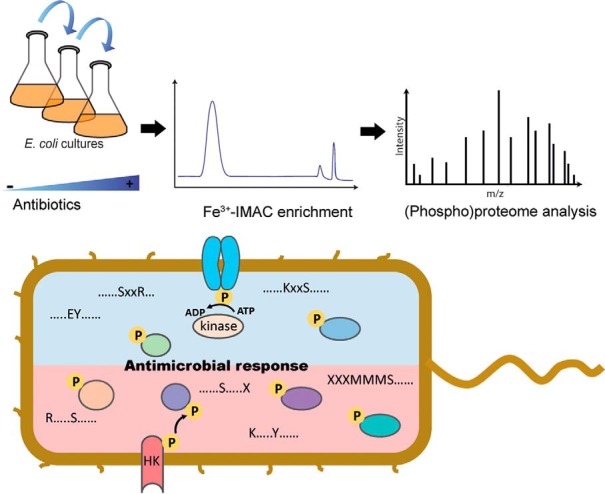
The rapid emergence of antimicrobial resistance is a major threat to human health. Antibiotics modulate a wide range of biological processes in bacteria and as such, the study of bacterial cellular signaling could aid the development of urgently needed new antibiotic agents. Due to the advances in bacterial phosphoproteomics, such a systemwide analysis of bacterial signaling in response to antibiotics has recently become feasible. Here we present a dynamic view of differential protein phosphorylation upon antibiotic treatment and antibiotic resistance. Most strikingly, differential phosphorylation was observed on highly conserved residues of resistance regulating transcription factors, implying a previously unanticipated role of phosphorylation mediated regulation. Using the comprehensive phosphoproteomics data presented here as a resource, future research can now focus on deciphering the precise signaling mechanisms contributing to resistance, eventually leading to alternative strategies to combat antimicrobial resistance.
抗生素耐药性的迅速出现是对人类健康的主要威胁。抗生素调节细菌中广泛的生物过程,因此,对细菌细胞信号转导的研究可能有助于开发急需的新型抗生素药物。由于细菌磷酸蛋白质组学的进步,最近已经可以对抗生素作用下的细菌信号转导进行系统的分析。在这里,我们展示了抗生素治疗和抗生素耐药性时差异蛋白磷酸化的动态视图。最引人注目的是,在调节耐药性的转录因子的高度保守残基上观察到差异磷酸化,这暗示了磷酸化介导的调节的以前未预料到的作用。使用这里呈现的全面磷酸蛋白质组学数据作为资源,未来的研究现在可以集中于破译导致耐药性的精确信号转导机制,最终导致对抗抗菌药物耐药性的替代策略。