Bontemps-Gallo Sébastien, Gaviard Charlotte, Richards Crystal L, Kentache Takfarinas, Raffel Sandra J, Lawrence Kevin A, Schindler Joseph C, Lovelace Joseph, Dulebohn Daniel P, Cluss Robert G, Hardouin Julie, Gherardini Frank C
Laboratory of Bacteriology, Rocky Mountain Laboratories, National Institute of Allergy and Infectious Diseases, National Institutes of Health, Hamilton, MT, United States.
CNRS UMR 6270 Polymères, Biopolymères, Surfaces Laboratory, Université de Rouen, Mont-Saint-Aignan, France.
Front Microbiol. 2018 Aug 31;9:2036. doi: 10.3389/fmicb.2018.02036. eCollection 2018.
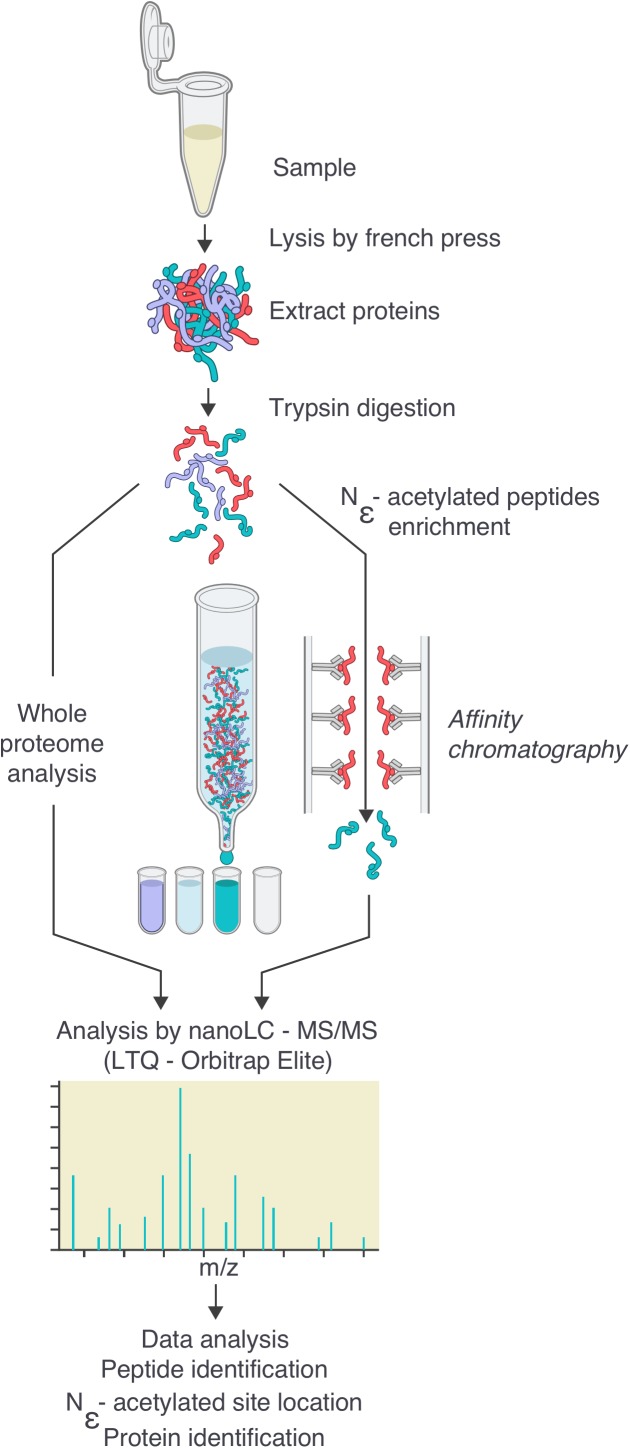
The post-translational modification of proteins has been shown to be extremely important in prokaryotes. Using a highly sensitive mass spectrometry-based proteomics approach, we have characterized the acetylome of . As previously reported for other bacteria, a relatively low number (5%) of the potential genome-encoded proteins of were acetylated. Of these, the vast majority were involved in central metabolism and cellular information processing (transcription, translation, etc.). Interestingly, these critical cell functions were targeted during both ML (mid-log) and S (stationary) phases of growth. However, acetylation of target proteins in ML phase was limited to single lysine residues while these same proteins were acetylated at multiple sites during S phase. To determine the acetyl donor in , we used mutants that targeted the sole acetate metabolic/anabolic pathway in (lipid I synthesis). strains B31-A3, B31-A3 Δ (acetyl-P and acetyl-CoA) and B31-A3 Δ (acetyl-P and acetyl-CoA) were grown to S phase and the acetylation profiles were analyzed. While only two proteins were acetylated in the Δ mutant, 140 proteins were acetylated in the Δ mutant suggesting that acetyl-P was the primary acetyl donor in . Using specific enzymatic assays, we were able to demonstrate that hyperacetylation of proteins in S phase appeared to play a role in decreasing the enzymatic activity of at least two glycolytic proteins. Currently, we hypothesize that acetylation is used to modulate enzyme activities during different stages of growth. This strategy would allow the bacteria to post-translationally stimulate the activity of key glycolytic enzymes by deacetylation rather than expending excessive energy synthesizing new proteins. This would be an appealing, low-energy strategy for a bacterium with limited metabolic capabilities. Future work focuses on identifying potential protein deacetylase(s) to complete our understanding of this important biological process.
蛋白质的翻译后修饰在原核生物中已被证明极为重要。我们采用基于高灵敏度质谱的蛋白质组学方法,对[具体物种]的乙酰化蛋白质组进行了表征。正如先前针对其他细菌所报道的那样,[具体物种]潜在基因组编码蛋白质中相对较少数量(5%)的蛋白质发生了乙酰化。其中,绝大多数参与中心代谢和细胞信息处理(转录、翻译等)。有趣的是,这些关键的细胞功能在对数中期(ML)和稳定期(S)生长阶段均受到靶向作用。然而,ML期靶蛋白的乙酰化仅限于单个赖氨酸残基,而这些相同的蛋白质在S期则在多个位点发生乙酰化。为了确定[具体物种]中的乙酰供体,我们使用了靶向[具体物种]唯一的乙酸代谢/合成途径(脂质I合成)的突变体。将菌株B31 - A3、B31 - A3 Δ(乙酰磷酸和乙酰辅酶A)和B31 - A3 Δ(乙酰磷酸和乙酰辅酶A)培养至S期,并分析其乙酰化谱。虽然在Δ突变体中只有两种蛋白质发生了乙酰化,但在Δ突变体中有140种蛋白质发生了乙酰化,这表明乙酰磷酸是[具体物种]中的主要乙酰供体。通过特定的酶促测定,我们能够证明S期蛋白质的过度乙酰化似乎在降低至少两种糖酵解蛋白的酶活性中发挥作用。目前,我们推测乙酰化用于在生长的不同阶段调节酶活性。这种策略将使细菌能够通过去乙酰化而不是消耗过多能量合成新蛋白质来翻译后刺激关键糖酵解酶的活性。对于代谢能力有限的细菌来说,这将是一种有吸引力的低能量策略。未来的工作重点是鉴定潜在的蛋白质脱乙酰酶,以完善我们对这一重要生物学过程的理解。