Pérez-Cataluña Alba, Salas-Massó Nuria, Diéguez Ana L, Balboa Sabela, Lema Alberto, Romalde Jesús L, Figueras Maria J
Departament de Ciències Mèdiques Bàsiques, Facultat de Medicina, Institut d'Investigació Sanitària Pere Virgili, Universitat Rovira i Virgili, Reus, Spain.
Departamento de Microbiología y Parasitología, CIBUS-Facultad de Biología, Universidade de Santiago de Compostela, Santiago de Compostela, Spain.
Front Microbiol. 2018 Sep 4;9:2077. doi: 10.3389/fmicb.2018.02077. eCollection 2018.
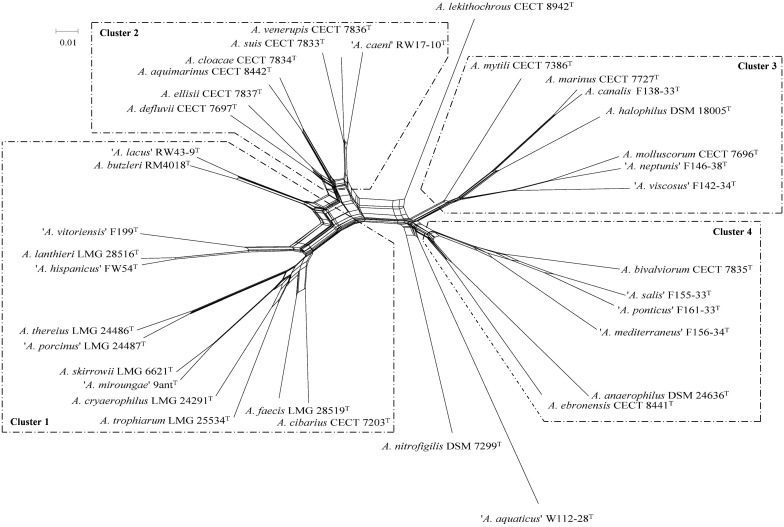
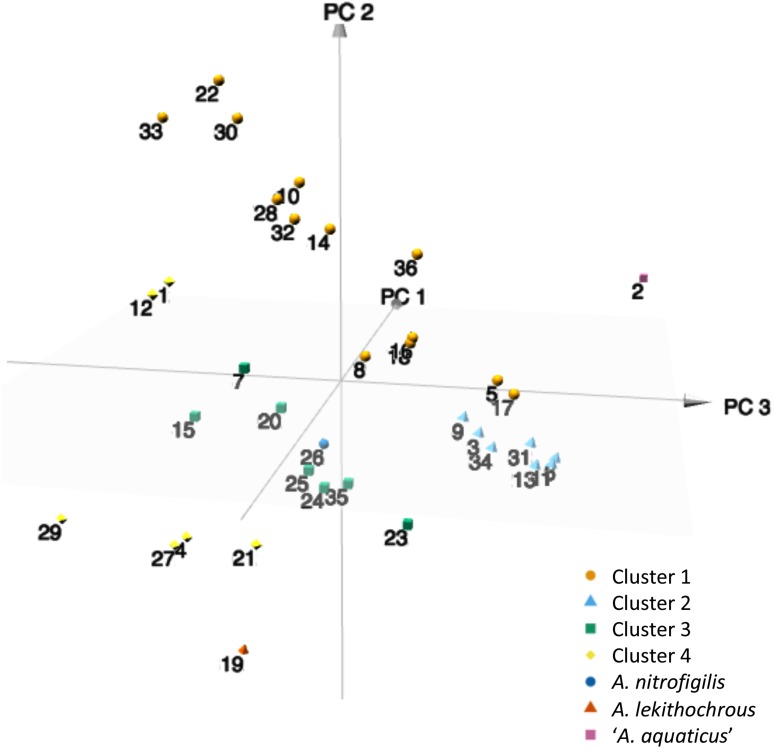
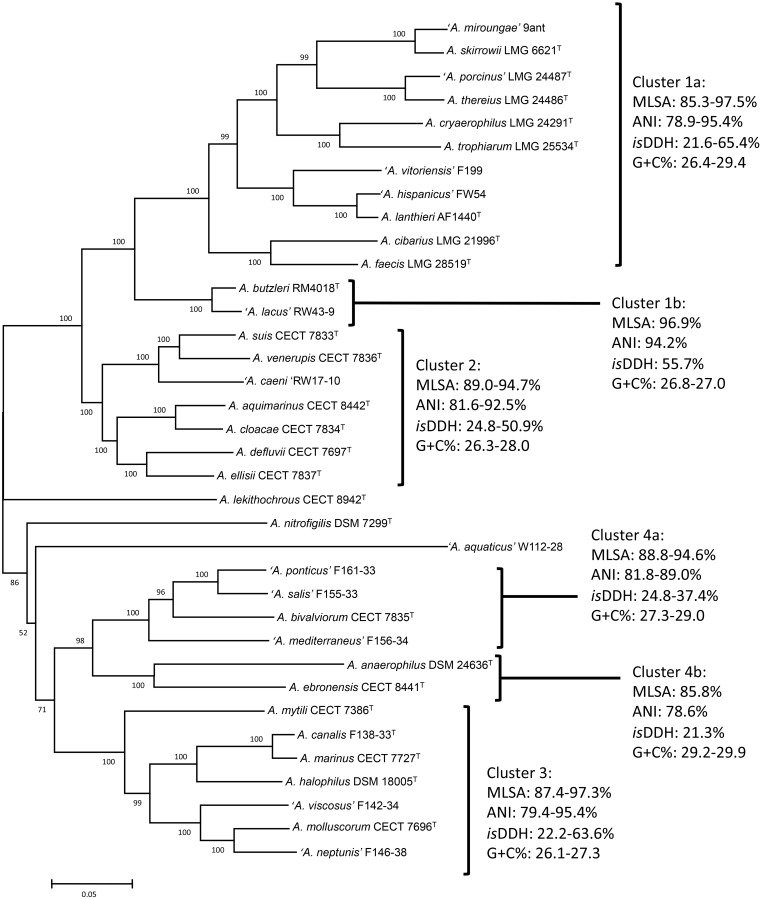
Since the description of the genus in 1991, a total of 27 species have been described, although some species have shown 16S rRNA similarities below 95%, which is the cut-off that usually separates species that belong to different genera. The objective of the present study was to reassess the taxonomy of the genus using information derived from the core genome (286 genes), a Multilocus Sequence Analysis (MLSA) with 13 housekeeping genes, as well as different genomic indexes like Average Nucleotide Identity (ANI), DNA-DNA hybridization (DDH), Average Amino-acid Identity (AAI), Percentage of Conserved Proteins (POCPs), and Relative Synonymous Codon Usage (RSCU). The study included a total of 39 strains that represent all the 27 species included in the genus together with 13 strains that are potentially new species, and the analysis of 57 genomes. The different phylogenetic analyses showed that the species grouped into four clusters. In addition, and the candidatus species '' appeared, as did , the type species of the genus, in separate branches. Furthermore, the genomic indices ANI and DDH not only confirmed that all the species were well-defined, but also the coherence of the clusters. The AAI and POCP values showed intra-cluster ranges above the respective cut-off values of 60% and 50% described for species belonging to the same genus. Phenotypic analysis showed that certain test combinations could allow the differentiation of the four clusters and the three orphan species established by the phylogenetic and genomic analyses. The origin of the strains showed that each of the clusters embraced species recovered from a common or related environment. The results obtained enable the division of the current genus in at least seven different genera, for which the names , gen. nov., gen. nov., gen. nov., gen. nov., gen. nov., and Candidate ' gen. nov. are proposed.
自1991年该属被描述以来,总共已描述了27个物种,尽管一些物种的16S rRNA相似性低于95%,而95%是通常用于区分属于不同属的物种的临界值。本研究的目的是利用来自核心基因组(286个基因)的信息、13个管家基因的多位点序列分析(MLSA)以及不同的基因组指标,如平均核苷酸同一性(ANI)、DNA-DNA杂交(DDH)、平均氨基酸同一性(AAI)、保守蛋白百分比(POCPs)和相对同义密码子使用情况(RSCU),重新评估该属的分类学。该研究共纳入了39株代表该属所有27个物种的菌株以及13株可能的新物种菌株,并对57个基因组进行了分析。不同的系统发育分析表明,该属物种分为四个簇。此外, 和候选物种“ ”出现了,该属的模式种 也出现在不同的分支中。此外,基因组指标ANI和DDH不仅证实了所有物种都有明确的定义,还证实了簇的一致性。AAI和POCP值显示簇内范围高于为同一属的物种描述的各自临界值60%和50%。表型分析表明,某些测试组合可以区分四个簇以及通过系统发育和基因组分析确定的三个孤立物种。菌株的来源表明,每个簇都包含从共同或相关环境中分离出的物种。所获得的结果使得当前的 属至少可以分为七个不同的属,为此提出了 属、 属新名、 属新名、 属新名、 属新名、 属新名和候选 属新名。