Institute for Agro-Environmental Sciences, National Agriculture and Food Research Organization (NARO), Tsukuba, Ibaraki, Japan.
Graduate School of Life and Environmental Sciences, University of Tsukuba, Tsukuba, Ibaraki, Japan.
PLoS One. 2018 Sep 20;13(9):e0203809. doi: 10.1371/journal.pone.0203809. eCollection 2018.
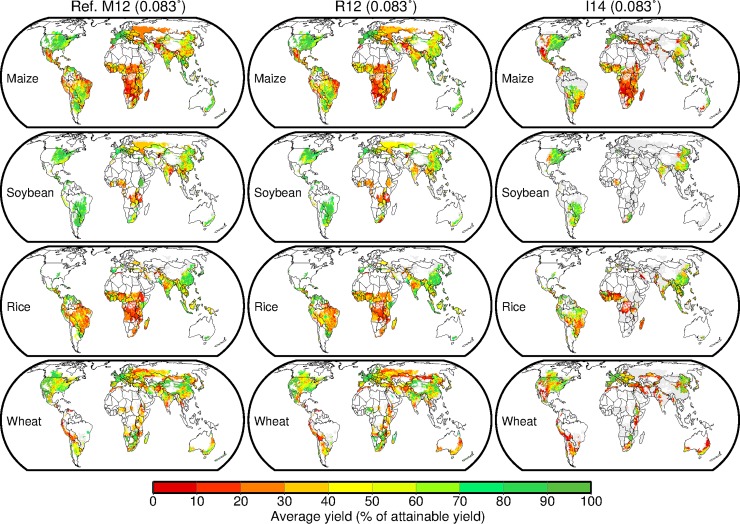
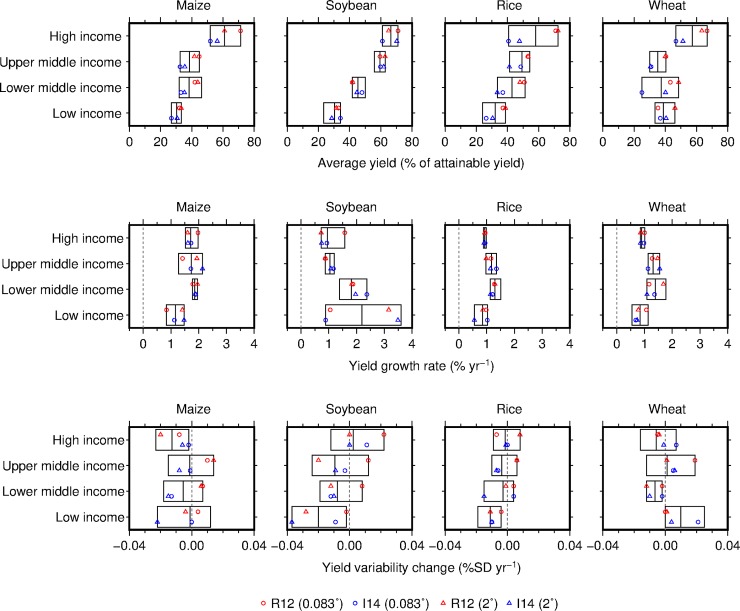
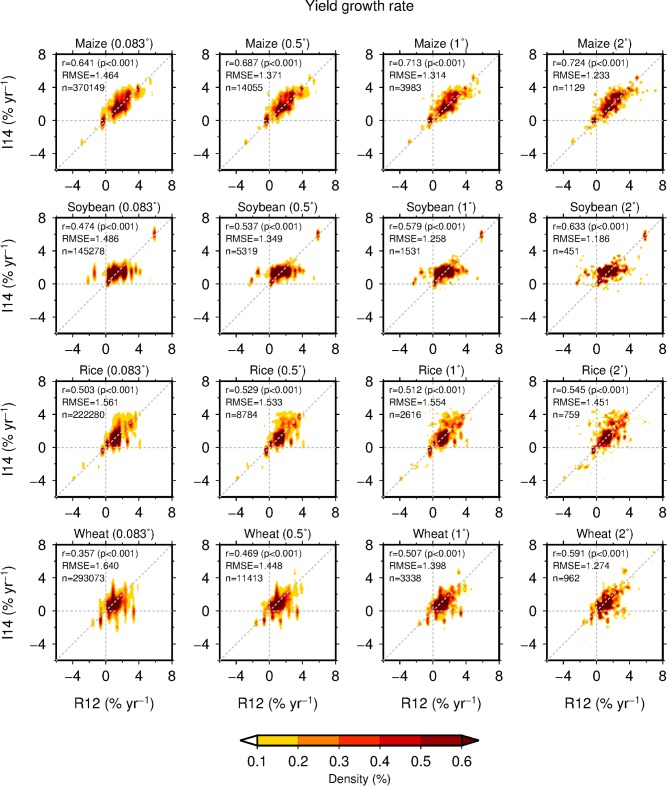
Global agriculture is under pressure to meet increasing demand for food and agricultural products. There are several global assessments of crop yields, but we know little about the uncertainties of their key findings, as the assessments are driven by the single best yield dataset available when each assessment was conducted. Recently, two different spatially explicit, global, historical yield datasets, one based on agricultural census and the other largely based on satellite remote sensing, became available. Using these datasets, we compare the similarities and differences in global yield gaps, trend patterns, growth rates and changes in year-to-year variability. We analyzed maize, rice, wheat and soybean for the period of 1981 to 2008 at four resolutions (0.083°, 0.5°, 1.0° and 2.0°). Although estimates varied by dataset and resolution, the global mean annual growth rates of 1.7-1.8%, 1.5-1.7%, 1.1-1.3% and 1.4-1.6% for maize, rice, wheat and soybean, respectively, are not on track to double crop production by 2050. Potential production increases that can be attributed to closing yield gaps estimated from the satellite-based dataset are almost twice those estimated from the census-based dataset. Detected yield variability changes in rice and wheat are sensitive to the choice of dataset and resolution, but they are relatively robust for maize and soybean. Estimates of yield gaps and variability changes are more uncertain than those of yield trend patterns and growth rates. These tendencies are consistent across crops. Efforts to reduce uncertainties are required to gain a better understanding of historical change and crop production potential to better inform agricultural policies and investments.
全球农业正面临着满足日益增长的粮食和农产品需求的压力。有几项全球作物产量评估,但我们对其关键发现的不确定性知之甚少,因为每项评估都是根据评估时可用的最佳单产数据集进行的。最近,两个不同的、具有空间明确性的、全球性的、历史性的产量数据集,一个基于农业普查,另一个主要基于卫星遥感,已经可用。我们使用这些数据集比较了全球产量差距、趋势模式、增长率和年际变化的可变性的异同。我们分析了 1981 年至 2008 年期间的玉米、水稻、小麦和大豆,分辨率为 0.083°、0.5°、1.0°和 2.0°。尽管估计值因数据集和分辨率而异,但玉米、水稻、小麦和大豆的全球年平均增长率分别为 1.7-1.8%、1.5-1.7%、1.1-1.3%和 1.4-1.6%,均无法实现到 2050 年作物产量翻番的目标。可以归因于从基于卫星的数据集估计的缩小产量差距的潜在产量增长几乎是从基于普查的数据集估计的两倍。从水稻和小麦中检测到的产量可变性变化对数据集和分辨率的选择敏感,但对于玉米和大豆来说,它们相对稳健。产量差距和可变性变化的估计比产量趋势模式和增长率的估计更不确定。这些趋势在各种作物中是一致的。需要努力减少不确定性,以更好地了解历史变化和作物生产潜力,从而更好地为农业政策和投资提供信息。