College of Medicine and Health Sciences and Referral Hospital, Dilla University, Dilla, Ethiopia.
Maternal and Child Well Being Unit, African Population and Health Research Center, Nairobi, Kenya.
Nutr Diabetes. 2018 Sep 20;8(1):52. doi: 10.1038/s41387-018-0060-y.
Poor maternal nutrition during pregnancy is a leading modifiable risk factor associated with risks of adverse pregnancy outcomes (APO). Nevertheless, there is paucity of evidence if consumption of some food groups is associated with lower risk of APO, particularly in low-income settings. We aimed to determine whether consumption of some food groups is associated with lower risk of APOs such as: preterm birth (PTB), low-birth weight (LBW), and stillbirth in rural Central Ethiopia.
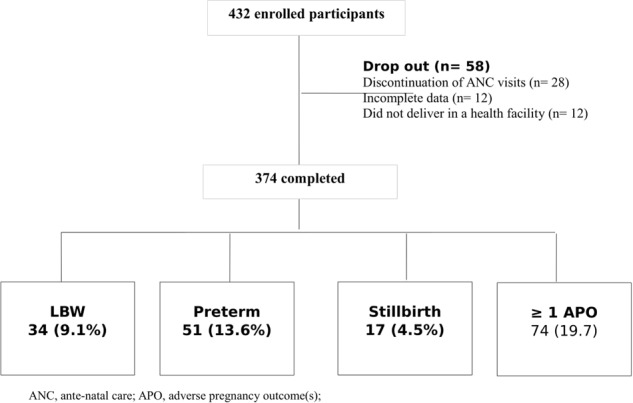
A multi-center (8 health centers) prospective cohort study, enrolling 432 pregnant women during their initial antenatal care visit, was employed. All mothers were then followed monthly (for a total of four visits) from enrollment to delivery. Midwives in respective health centers assessed dietary diversity using the Women's individual dietary diversity score and evaluated birth outcomes following standard procedures. Logistic regression models were run to predict association of food groups with the APO.
Out of the 374 pregnant women who completed the study, one in five [74 (19.8%)] experienced at least one of the APO: 34 (9.1%) gave birth to LBW babies, 51(13.6%) had PTB and 17 (4.5%) experienced stillbirth. Poor or inconsistent consumption (<¾ assessments) of dark green leafy vegetables (adjusted odds ratio (AOR) = 2.01; 95% confidence interval (CI): 1.04-3.87), dairy products (AOR = 2.64; 95% CI: 1.11-6.30), and fruits and vegetables (AOR = 2.92; 95% CI: 1.49-5.67) were independently associated with higher APO risks. Whereas, being nonanemic at term (AOR = 0.24; 95% CI: 0.12-0.48) was independently associated with lower APO risks.
Poor or inconsistent consumption of dairy, dark green leafy vegetables and fruits were associated with higher risk of APOs. While community-based trials and mechanistic studies are needed to substantiate these findings, efforts to promote dietary diversity through increased consumption of fruits, vegetables and dairy may be beneficial in this and similar settings.
孕妇营养不良是与不良妊娠结局(APO)风险相关的主要可改变的危险因素之一。然而,在低收人群体中,某些食物组的摄入与较低的 APO 风险相关的证据仍然不足。我们旨在确定某些食物组的摄入是否与 APO 风险降低有关,例如:早产(PTB)、低出生体重(LBW)和死产。
采用多中心(8 个卫生中心)前瞻性队列研究,在初始产前保健就诊期间招募了 432 名孕妇。所有母亲随后从登记到分娩每月(共 4 次)进行随访。各卫生中心的助产士使用妇女个体饮食多样性评分评估饮食多样性,并按照标准程序评估出生结局。使用逻辑回归模型预测食物组与 APO 的关联。
在完成研究的 374 名孕妇中,有五分之一(74 名,19.8%)至少经历了一种 APO:34 名(9.1%)生下 LBW 婴儿,51 名(13.6%)早产,17 名(4.5%)发生死产。深色绿叶蔬菜(调整后的优势比(AOR)=2.01;95%置信区间(CI):1.04-3.87)、乳制品(AOR=2.64;95%CI:1.11-6.30)和水果和蔬菜(AOR=2.92;95%CI:1.49-5.67)的摄入量较差或不一致与较高的 APO 风险独立相关。相反,足月时不贫血(AOR=0.24;95%CI:0.12-0.48)与较低的 APO 风险独立相关。
乳制品、深色绿叶蔬菜和水果的摄入量较差或不一致与 APO 风险增加有关。虽然需要社区为基础的试验和机制研究来证实这些发现,但通过增加水果、蔬菜和乳制品的摄入来促进饮食多样性的努力可能在这种情况下和类似情况下是有益的。