Babin Loelia, Piganeau Marion, Renouf Benjamin, Lamribet Khadija, Thirant Cecile, Deriano Ludovic, Mercher Thomas, Giovannangeli Carine, Brunet Erika C
Laboratory "Genome Dynamics in the Immune System", Equipe Labellisée Ligue Contre le Cancer, INSERM UMR1163; Université Paris Descartes Sorbonne Paris Cité, Institut Imagine, Paris 75015, France; Museum National d'Histoire Naturelle, INSERM U1154, CNRS UMR7196, Sorbonne Université, Paris 75005, France.
Museum National d'Histoire Naturelle, INSERM U1154, CNRS UMR7196, Sorbonne Université, Paris 75005, France.
iScience. 2018 Jul 27;5:19-29. doi: 10.1016/j.isci.2018.06.007. Epub 2018 Jun 19.
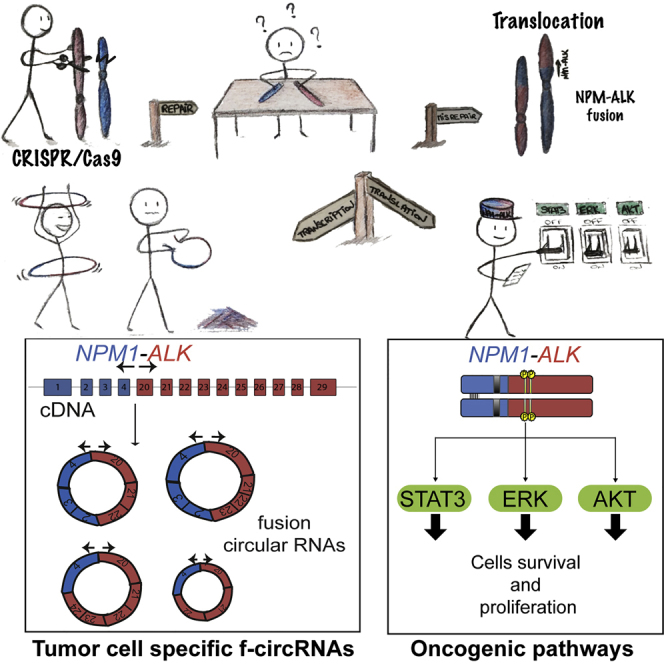
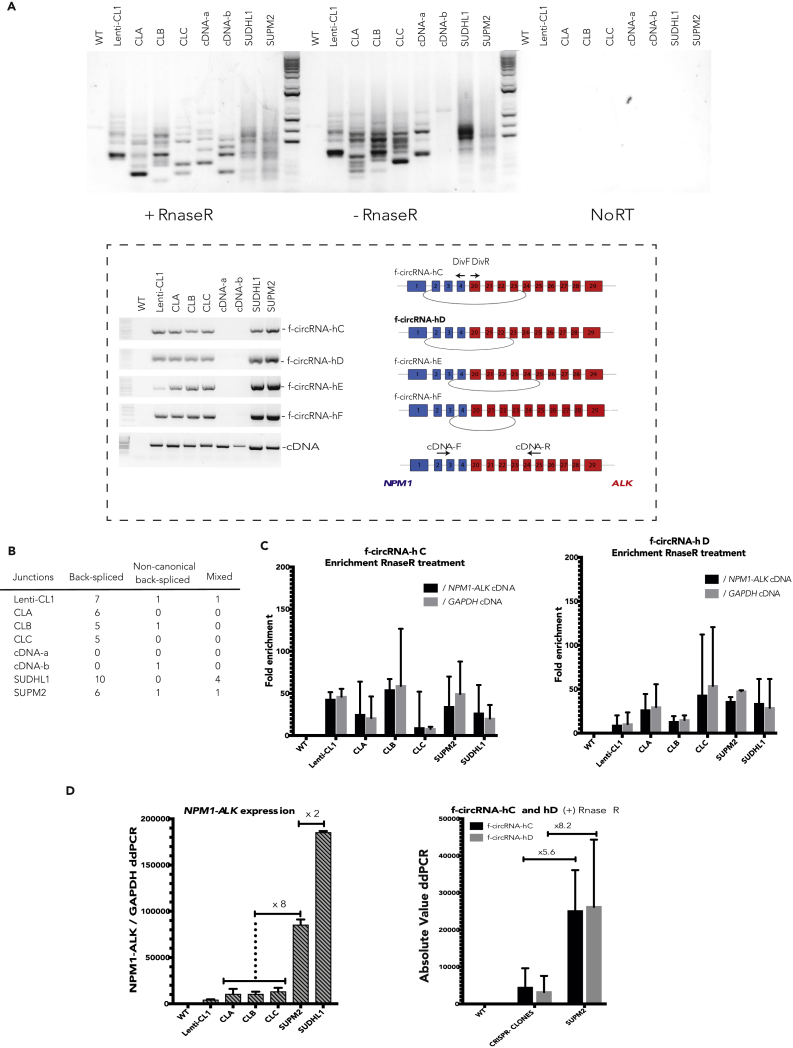
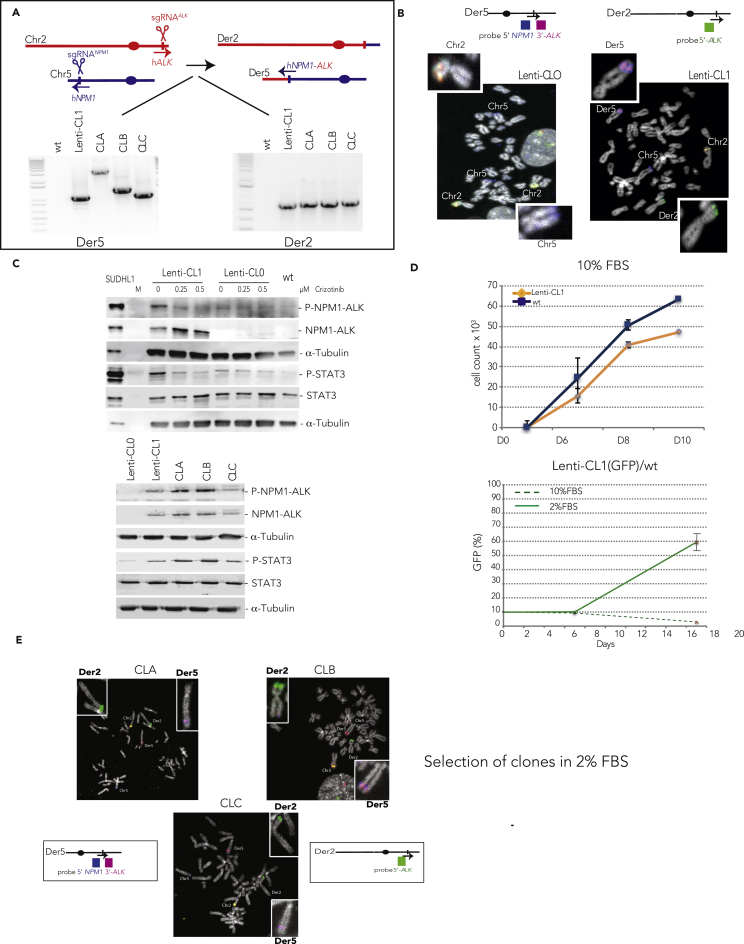
Circular RNAs constitute a unique class of RNAs whose precise functions remain to be elucidated. In particular, cancer-associated chromosomal translocations can give rise to fusion circular RNAs that play a role in leukemia progression. However, how and when fusion circular RNAs are formed and whether they are being selected in cancer cells remains unknown. Here, we used CRISPR/Cas9 to generate physiological translocation models of NPM1-ALK fusion gene. We showed that, in addition to generating fusion proteins and activating specific oncogenic pathways, chromosomal translocation induced by CRISPR/Cas9 led to the formation of de novo fusion circular RNAs. Specifically, we could recover different classes of circular RNAs composed of different circularization junctions, mainly back-spliced species. In addition, we identified fusion circular RNAs identical to those found in related patient tumor cells providing evidence that fusion circular RNAs arise early after chromosomal formation and are not just a consequence of the oncogenesis process.
环状RNA构成了一类独特的RNA,其确切功能仍有待阐明。特别是,与癌症相关的染色体易位可产生融合环状RNA,这些融合环状RNA在白血病进展中发挥作用。然而,融合环状RNA是如何以及何时形成的,以及它们是否在癌细胞中被选择,仍然未知。在这里,我们使用CRISPR/Cas9生成了NPM1-ALK融合基因的生理性易位模型。我们发现,除了产生融合蛋白并激活特定的致癌途径外,CRISPR/Cas9诱导的染色体易位还导致了从头融合环状RNA的形成。具体而言,我们能够回收由不同环化连接组成的不同类别的环状RNA,主要是反向剪接的种类。此外,我们鉴定出与相关患者肿瘤细胞中发现的融合环状RNA相同的融合环状RNA,这提供了证据表明融合环状RNA在染色体形成后早期出现,而不仅仅是肿瘤发生过程的结果。