Klingmann Ingrid, Heckenberg Andrea, Warner Kay, Haerry David, Hunter Amy, May Matthew, See Wolf
EUPATI, European Forum for Good Clinical Practice, Brussels, Belgium.
EUPATI, Ethics Committee, Medical University Vienna, Vienna, Austria.
Front Med (Lausanne). 2018 Sep 7;5:251. doi: 10.3389/fmed.2018.00251. eCollection 2018.
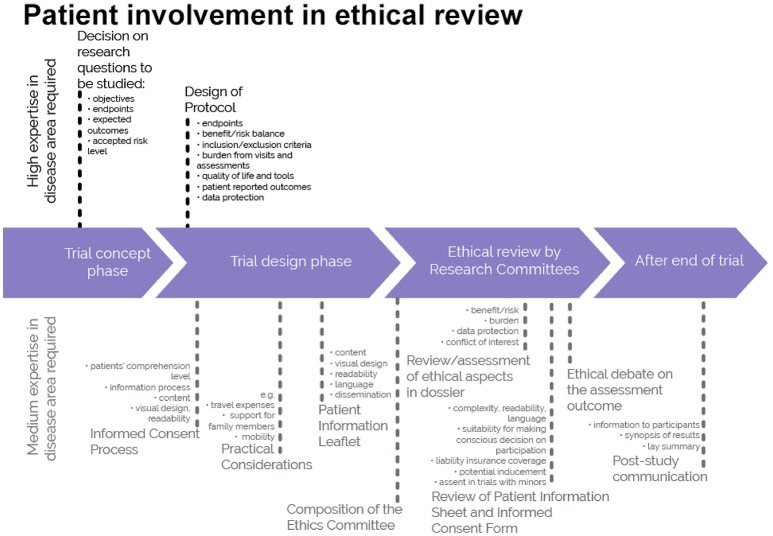
Involvement of patients in the research and development process (R&D) of new medicines-in all areas of indications-today is a widely accepted strategy in pharmaceutical industry to ensure relevance and suitability of the treatment under development. This may consist in, but is not limited to, patient input to achieve more patient-friendly protocol design, endpoint, and comparator selection as well as disease-adapted study conditions in a pre- or post-marketing clinical trial. Ethical aspects and especially the balance of benefit and risk in a clinical trial are frequently judged differently by clinical researchers, regulators, ethics committees, and patients due to their different focus. The final assessment of the ethical aspects of a planned clinical trial is provided by an independent ethics committee consisting of physicians and other experts in healthcare and clinical trial methodology as well as of lay persons. The participation of patients in ethics committees is a much-discussed concept, its suitability disputed in many countries, and only limited experience on best practices is available. In order to be effective and yield the best results for all stakeholders, integration of patients into the medicines development process needs to be structured and governed by clear, mutually agreed rules and modes of operation. Communication and collaboration processes need to be systematically implemented to establish transparency, trust and respect between those developing new medicines and their users, respectively between those involved in design and approval of clinical trials and participants. In particular agreement on the ethical aspects of a clinical trial and/or its overall ethical acceptability is a prerequisite before the start of a clinical trial. Existing codes of practice for patient involvement with various stakeholders do not comprehensively cover the full scope of R&D, with the exception of more general statements on interaction. Overarching guidance on meaningful and ethical interaction is missing. One specific aim of the European Patients' Academy on Therapeutic Innovation (EUPATI) was to close this gap through the development of guidance documents for ethics committees, pharmaceutical industry-led medicines R&D, regulatory authorities, and health technology assessment (HTA). This EUPATI "Guidance for patient involvement in ethical review of clinical trials" gives practical recommendations for ground rules and lists options for conditions and practices for involving patients in the work of ethics committees to enable trustful and constructive collaboration whatever the national (legal) framework for patient involvement in ethics committees might be. The guidance sets the collaboration of patients in ethics committees in the broader context of relevance and opportunities for patient input on ethics in the overall medicines R&D and specifically the overall clinical trial process from concept development to trial result reporting in lay summaries. In addition to a presentation of the full text of the Guidance, this article aims at providing additional background information on the development process of the Guidance, as well as insight into the current debate on this topic.
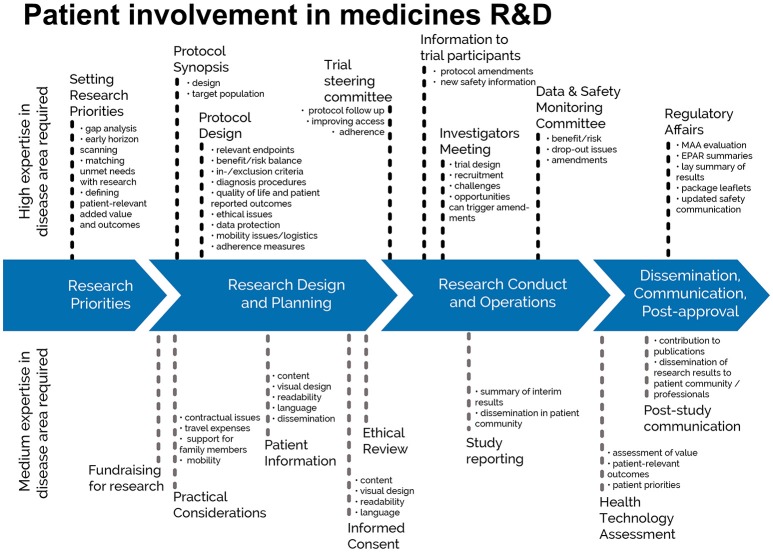
让患者参与新药研发过程(涵盖所有适应症领域)如今已成为制药行业广泛认可的策略,以确保正在研发的治疗方法具有相关性和适用性。这可能包括但不限于患者提供意见,以实现更有利于患者的方案设计、终点指标和对照选择,以及在上市前或上市后临床试验中根据疾病调整研究条件。由于关注重点不同,临床研究人员、监管机构、伦理委员会和患者对伦理问题,尤其是临床试验中的利益与风险平衡,往往有不同的判断。对一项计划中的临床试验伦理问题的最终评估由一个独立的伦理委员会进行,该委员会由医生、医疗保健和临床试验方法方面的其他专家以及非专业人士组成。患者参与伦理委员会是一个备受讨论的概念,在许多国家对其适用性存在争议,且关于最佳实践的经验有限。为了有效并为所有利益相关者带来最佳结果,需要以明确、双方认可的规则和运作模式来构建并管理患者融入药物研发过程的方式。需要系统地实施沟通与协作流程,以在新药研发人员与其使用者之间,以及参与临床试验设计和批准的人员与参与者之间建立透明度、信任和尊重。特别是在临床试验开始前,就临床试验的伦理问题和/或其整体伦理可接受性达成一致是前提条件。现有的关于患者与各利益相关者互动的实践准则除了一些关于互动的一般性陈述外,并未全面涵盖研发的所有方面。缺乏关于有意义且符合伦理的互动的总体指导。欧洲治疗创新患者学院(EUPATI)的一个具体目标是通过为伦理委员会、制药行业主导的药物研发、监管机构和卫生技术评估(HTA)制定指导文件来填补这一空白。这份EUPATI“患者参与临床试验伦理审查的指导意见”针对基本规则给出了实用建议,并列出了让患者参与伦理委员会工作的条件和做法选项,以便无论患者参与伦理委员会的国家(法律)框架如何,都能实现信任且建设性的合作。该指导意见将患者在伦理委员会中的合作置于更广泛的背景下,即在整个药物研发过程中患者对伦理问题发表意见的相关性和机会,特别是从概念开发到以通俗易懂的总结形式报告试验结果的整个临床试验过程中。除了展示该指导意见的全文外,本文旨在提供关于该指导意见制定过程的更多背景信息,以及对当前关于这一主题的辩论的见解。