Slimani Maamer, Paravlic Armin, Granacher Urs
Centre National de la Medecine et des Sciences Des Sports, Tunis, Tunisia.
Scientific Research Center Koper, Institute for Kinesiology Research, Koper, Slovenia.
Front Physiol. 2018 Aug 22;9:1155. doi: 10.3389/fphys.2018.01155. eCollection 2018.
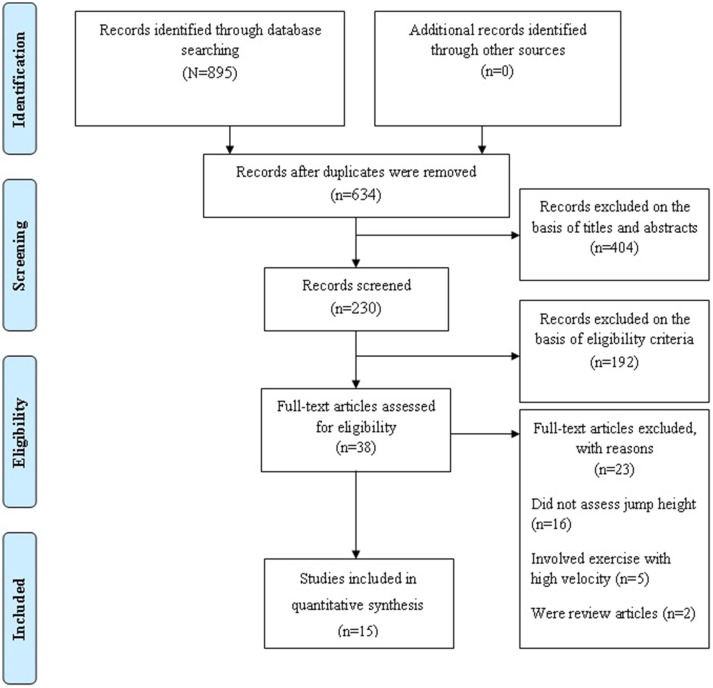
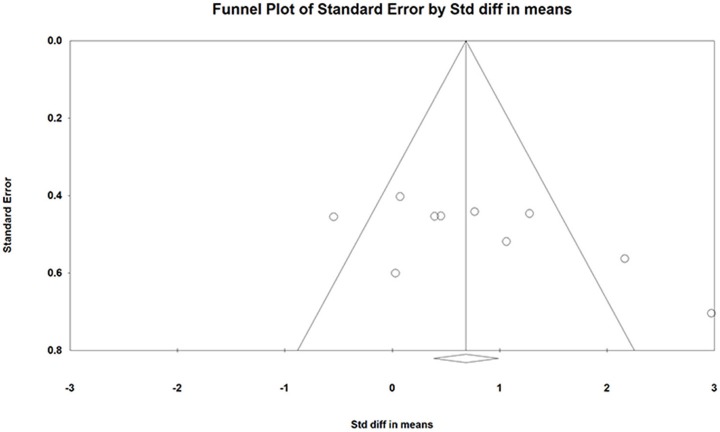
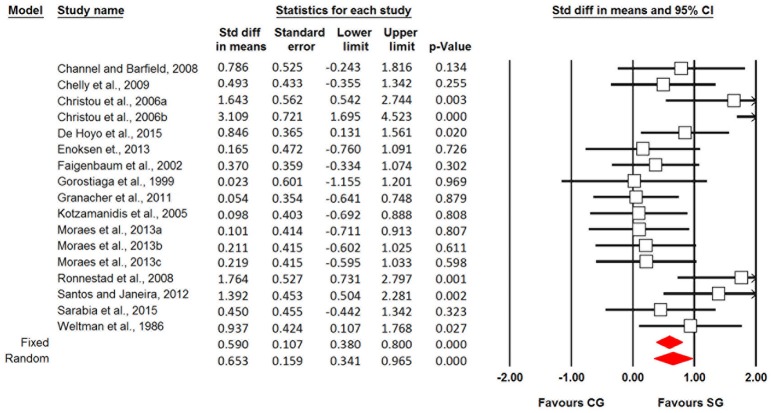
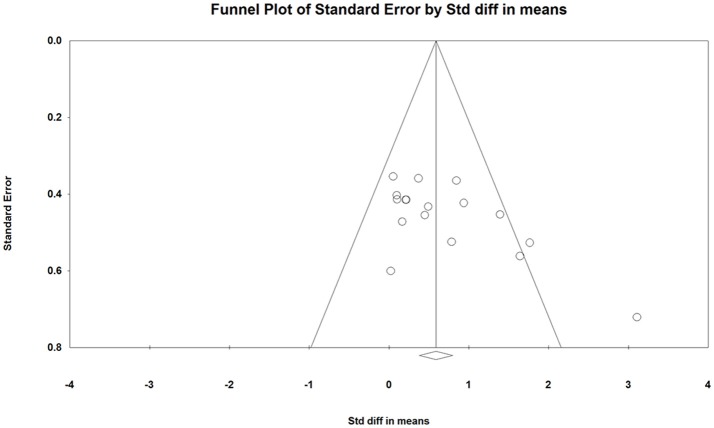
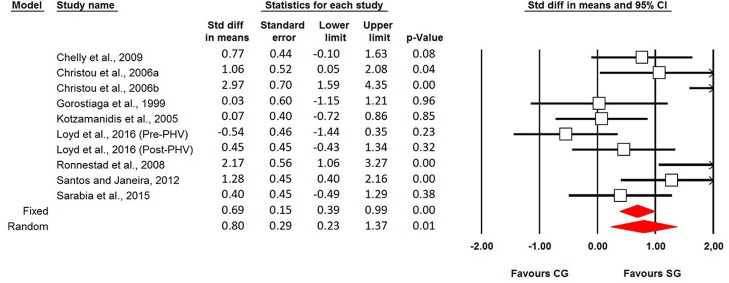
It is well-documented that strength training (ST) improves measures of muscle strength in young athletes. Less is known on transfer effects of ST on proxies of muscle power and the underlying dose-response relationships. The objectives of this meta-analysis were to quantify the effects of ST on lower limb muscle power in young athletes and to provide dose-response relationships for ST modalities such as frequency, intensity, and volume. A systematic literature search of electronic databases identified 895 records. Studies were eligible for inclusion if (i) healthy trained children (girls aged 6-11 y, boys aged 6-13 y) or adolescents (girls aged 12-18 y, boys aged 14-18 y) were examined, (ii) ST was compared with an active control, and (iii) at least one proxy of muscle power [squat jump (SJ) and countermovement jump height (CMJ)] was reported. Weighted mean standardized mean differences (SMDwm) between subjects were calculated. Based on the findings from 15 statistically aggregated studies, ST produced significant but small effects on CMJ height (SMDwm = 0.65; 95% CI 0.34-0.96) and moderate effects on SJ height (SMDwm = 0.80; 95% CI 0.23-1.37). The sub-analyses revealed that the moderating variable expertise level (CMJ height: = 0.06; SJ height: N/A) did not significantly influence ST-related effects on proxies of muscle power. "Age" and "sex" moderated ST effects on SJ ( = 0.005) and CMJ height ( = 0.03), respectively. With regard to the dose-response relationships, findings from the meta-regression showed that none of the included training modalities predicted ST effects on CMJ height. For SJ height, the meta-regression indicated that the training modality "training duration" significantly predicted the observed gains ( = 0.02), with longer training durations (>8 weeks) showing larger improvements. This meta-analysis clearly proved the general effectiveness of ST on lower-limb muscle power in young athletes, irrespective of the moderating variables. Dose-response analyses revealed that longer training durations (>8 weeks) are more effective to improve SJ height. No such training modalities were found for CMJ height. Thus, there appear to be other training modalities besides the ones that were included in our analyses that may have an effect on SJ and particularly CMJ height. ST monitoring through rating of perceived exertion, movement velocity or force-velocity profile could be promising monitoring tools for lower-limb muscle power development in young athletes.
有充分的文献记载,力量训练(ST)可改善年轻运动员的肌肉力量指标。关于ST对肌肉力量指标的转移效应以及潜在的剂量反应关系,人们了解较少。本荟萃分析的目的是量化ST对年轻运动员下肢肌肉力量的影响,并提供诸如频率、强度和训练量等ST方式的剂量反应关系。对电子数据库进行的系统文献检索共识别出895条记录。符合纳入标准的研究需满足以下条件:(i)研究对象为健康的受过训练的儿童(6至11岁女孩,6至13岁男孩)或青少年(12至18岁女孩,14至18岁男孩);(ii)将ST与积极对照组进行比较;(iii)报告了至少一项肌肉力量指标[深蹲跳(SJ)和反向移动跳高度(CMJ)]。计算了受试者之间的加权平均标准化均值差(SMDwm)。基于15项统计汇总研究的结果,ST对CMJ高度产生了显著但较小的影响(SMDwm = 0.65;95%可信区间0.34 - 0.96),对SJ高度产生了中等影响(SMDwm = 0.80;95%可信区间0.23 - 1.37)。亚组分析显示,调节变量专业水平(CMJ高度: = 0.06;SJ高度:无数据)对ST对肌肉力量指标的相关影响没有显著影响。“年龄”和“性别”分别调节了ST对SJ( = 0.005)和CMJ高度( = 0.03)的影响。关于剂量反应关系,荟萃回归的结果表明,纳入的训练方式均未预测到ST对CMJ高度的影响。对于SJ高度,荟萃回归表明训练方式“训练时长”显著预测了观察到的增益( = 0.02),训练时长较长(>8周)显示出更大的改善。本荟萃分析清楚地证明了ST对年轻运动员下肢肌肉力量的总体有效性,与调节变量无关。剂量反应分析表明,较长的训练时长(>8周)对提高SJ高度更有效。未发现对CMJ高度有此类训练方式。因此,除了我们分析中所包含的训练方式外,似乎还有其他训练方式可能会对SJ,特别是CMJ高度产生影响。通过感知运动用力程度、运动速度或力 - 速度曲线对ST进行监测,可能是监测年轻运动员下肢肌肉力量发展的有前景的工具。