Department of Epidemiology, Lazio Regional Health Service, Via Cristoforo Colombo 112, 00142, Rome, Italy.
Cristo Re Hospital, Via delle Calasanziane, 25, 00167, Rome, Italy.
BMC Pregnancy Childbirth. 2018 Sep 24;18(1):383. doi: 10.1186/s12884-018-2018-4.
The rates of caesarean section (CS) are increasing globally. CS rates are one of the most frequently used indicators of health care quality. Vaginal Birth After Caesarean (VBAC) could be considered a reasonable and safe option for most women with a previous CS. Despite this fact, in some European countries, many women who had a previous CS will have a routine CS subsequently and VBAC rates are extremely variable across countries. VBAC use is inversely related to caesarean use. The objective of the present study was to analyze VBAC rates with respect to caesarean rates and the variations among areas of residence, hospitals and hospital ownership types in Italy.
This study was based on information from the Hospital Information System (HIS). We collected data from all deliveries in Italy from January 1, 2010 to December 31, 2014 and we considered only deliveries with a previous caesarean section. Applying multivariate logistic regression analysis, the adjusted proportions of VBAC for each Local Health Units (LHU), each hospital and by hospital ownership types were calculated. Cross-classified logistic multilevel models were performed to analyze within geographic, hospitals and hospital ownership types variations.
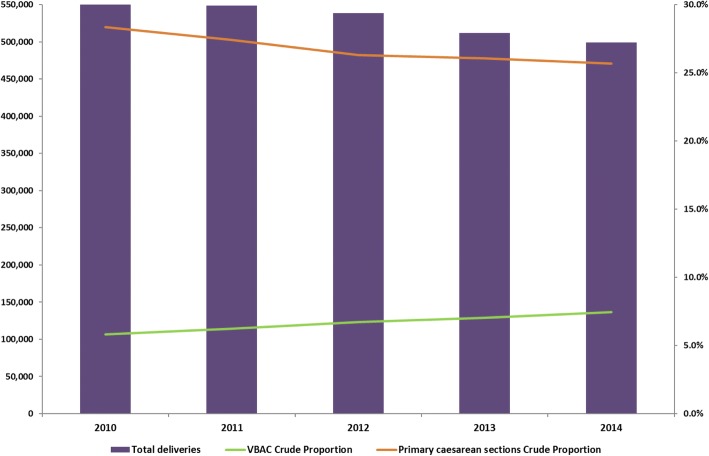
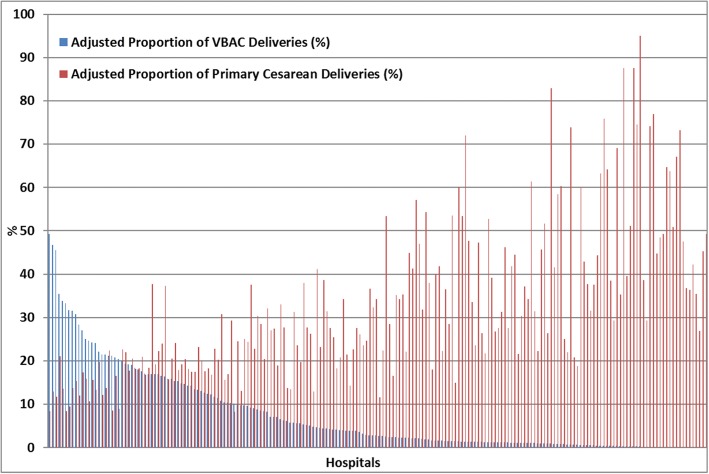
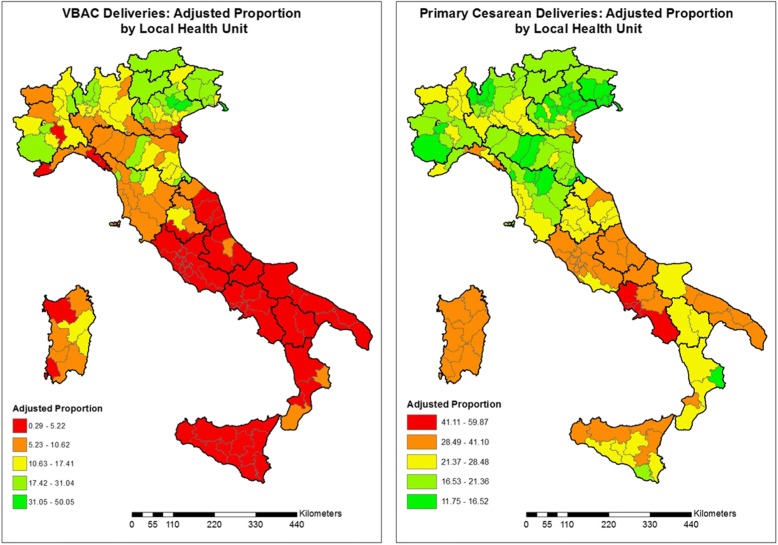
We studied a total of 77,850 deliveries with a previous caesarean section in Italy between January 1, 2010 and December 31, 2014. The proportion of VBAC in Italy slightly increased in the last few years, from 5.8% in 2010 to 7.5% in 2014. Proportions of VBAC ranged from 0.29 to 50.05% in Italian LHUs. The LHUs with lower proportions of VBAC deliveries were characterized by higher values for primary caesarean deliveries. Private hospitals showed the lowest mean of crude VBAC proportions but the highest variation among hospitals, ranging from 0 to 47.1%.
Hospital rates of caesarean section for women with at least one previous caesarean section vary widely, and only some of the variation can be explained by case-mix and hospital-level factors, suggesting that additional factors influence practices. Identifying disparities in VBAC may have important implications for health services planning and targeted efforts to reduce overall rates of caesarean deliveries.
全球剖宫产率不断上升。剖宫产率是衡量医疗保健质量的最常用指标之一。对于有过剖宫产史的大多数女性来说,阴道分娩后剖宫产(VBAC)可以被认为是一种合理且安全的选择。尽管如此,在一些欧洲国家,许多有过剖宫产史的女性随后会例行剖宫产,而 VBAC 率在各国之间差异极大。VBAC 的使用与剖宫产的使用呈反比。本研究的目的是分析意大利 VBAC 率与剖宫产率的关系,以及不同地区、医院和医院所有制类型之间的差异。
本研究基于医院信息系统(HIS)的数据。我们收集了 2010 年 1 月 1 日至 2014 年 12 月 31 日期间意大利所有分娩的数据,仅考虑有过剖宫产史的分娩。通过多变量逻辑回归分析,计算了每个地方卫生单位(LHU)、每家医院和医院所有制类型的 VBAC 调整比例。采用交叉分类逻辑多层模型分析地理、医院和医院所有制类型的变化。
我们研究了 2010 年 1 月 1 日至 2014 年 12 月 31 日期间意大利共有 77850 例有过剖宫产史的分娩。近年来,意大利 VBAC 的比例略有上升,从 2010 年的 5.8%上升到 2014 年的 7.5%。意大利 LHU 之间 VBAC 比例从 0.29%到 50.05%不等。VBAC 分娩比例较低的 LHU 特征是初次剖宫产分娩率较高。私立医院的 VBAC 比例平均值最低,但医院之间的差异最大,从 0 到 47.1%不等。
对于至少有一次剖宫产史的女性,医院剖宫产率差异很大,只有部分差异可以用病例组合和医院水平因素来解释,这表明还有其他因素影响实践。确定 VBAC 的差异可能对卫生服务规划和有针对性地降低剖宫产率具有重要意义。