School of Medicine and Public Health, University of Newcastle, Callaghan, NSW, 2308, Australia.
Hunter New England Population Health, Locked Bag 10, Wallsend, NSW, 2287, Australia.
BMC Med. 2018 Sep 25;16(1):167. doi: 10.1186/s12916-018-1151-2.
Chronic diseases and musculoskeletal conditions have a significant global burden and frequently co-occur. Musculoskeletal conditions may contribute to the development of chronic disease; however, this has not been systematically synthesised. We aimed to investigate whether the most common musculoskeletal conditions, namely neck or back pain or osteoarthritis of the knee or hip, contribute to the development of chronic disease.
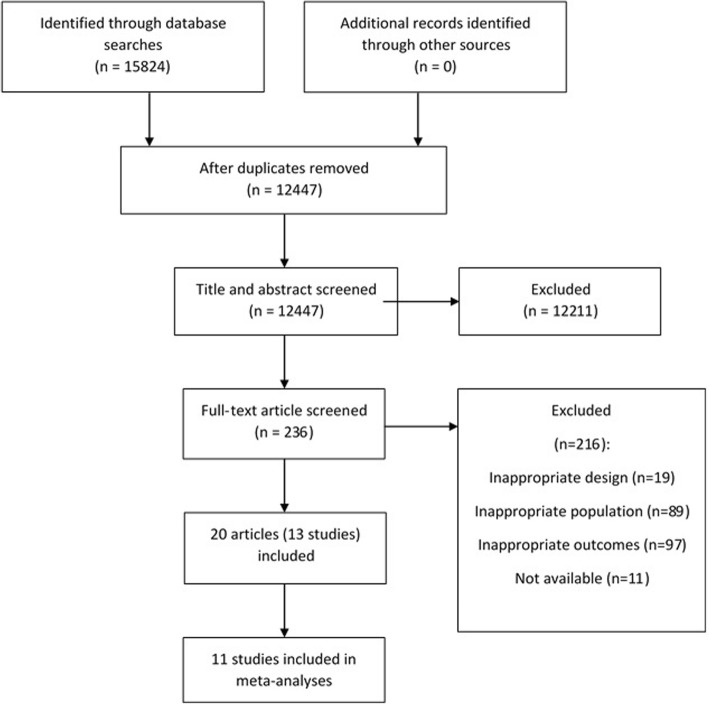
We searched CINAHL, Embase, Medline, Medline in Process, PsycINFO, Scopus and Web of Science to February 8, 2018, for cohort studies reporting adjusted estimates of the association between baseline musculoskeletal conditions (neck or back pain or osteoarthritis of the knee or hip) and subsequent diagnosis of a chronic disease (cardiovascular disease, cancer, diabetes, chronic respiratory disease or obesity). Two independent reviewers performed data extraction and assessed study quality. Adjusted hazard ratios were pooled using the generic inverse variance method in random effect models, regardless of the type of musculoskeletal condition or chronic disease.
CRD42016039519.
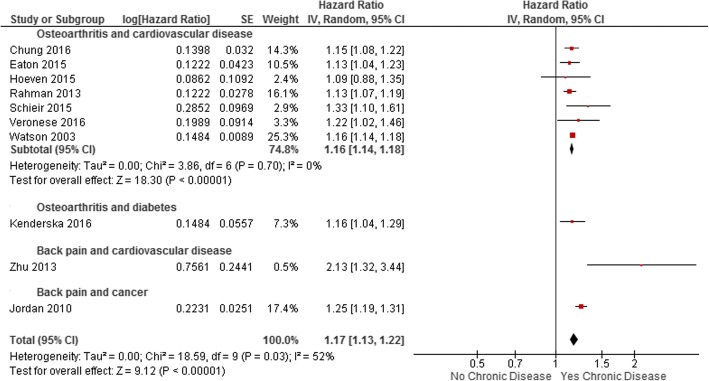
There were 13 cohort studies following 3,086,612 people. In the primary meta-analysis of adjusted estimates, osteoarthritis (n = 8 studies) and back pain (n = 2) were the exposures and cardiovascular disease (n = 8), cancer (n = 1) and diabetes (n = 1) were the outcomes. Pooled adjusted estimates from these 10 studies showed that people with a musculoskeletal condition have a 17% increase in the rate of developing a chronic disease compared to people without (hazard ratio 1.17, 95% confidence interval 1.13-1.22; I 52%, total n = 2,686,113 people).
This meta-analysis found that musculoskeletal conditions may increase the risk of chronic disease. In particular, osteoarthritis appears to increase the risk of developing cardiovascular disease. Prevention and early treatment of musculoskeletal conditions and targeting associated chronic disease risk factors in people with long standing musculoskeletal conditions may play a role in preventing other chronic diseases. However, a greater understanding about why musculoskeletal conditions may increase the risk of chronic disease is needed.
慢性疾病和肌肉骨骼疾病在全球范围内负担沉重,且常同时发生。肌肉骨骼疾病可能导致慢性疾病的发生;然而,目前尚未对此进行系统的综合研究。我们旨在研究最常见的肌肉骨骼疾病,即颈痛、背痛或膝关节或髋关节骨关节炎,是否会导致慢性疾病的发生。
我们检索了 CINAHL、Embase、Medline、Medline in Process、PsycINFO、Scopus 和 Web of Science,截至 2018 年 2 月 8 日,以寻找报告基线肌肉骨骼疾病(颈痛、背痛或膝关节或髋关节骨关节炎)与随后诊断为慢性疾病(心血管疾病、癌症、糖尿病、慢性呼吸道疾病或肥胖症)之间关联的调整后估计值的队列研究。两名独立审查员进行了数据提取和研究质量评估。使用随机效应模型中的通用倒数方差法汇总调整后的风险比,无论肌肉骨骼疾病或慢性疾病的类型如何。
CRD42016039519。
有 13 项队列研究纳入了 3086612 人。在调整后的估计值的主要荟萃分析中,骨关节炎(n=8 项研究)和背痛(n=2 项研究)为暴露因素,心血管疾病(n=8 项研究)、癌症(n=1 项研究)和糖尿病(n=1 项研究)为结局。来自这 10 项研究的汇总调整后估计值表明,与无肌肉骨骼疾病的人相比,患有肌肉骨骼疾病的人患慢性疾病的比率增加了 17%(风险比 1.17,95%置信区间 1.13-1.22;I 52%,总 n=2686113 人)。
本荟萃分析发现,肌肉骨骼疾病可能会增加患慢性疾病的风险。特别是,骨关节炎似乎会增加患心血管疾病的风险。预防和早期治疗肌肉骨骼疾病,并针对患有长期肌肉骨骼疾病的人相关的慢性疾病风险因素进行治疗,可能在预防其他慢性疾病方面发挥作用。然而,我们需要更深入地了解为什么肌肉骨骼疾病可能会增加患慢性疾病的风险。