Geriatric Research Education and Clinical Center, William S. Middleton Memorial Veterans Hospital, Madison, WI, 53705, USA.
Wisconsin Alzheimer's Disease Research Center, University of Wisconsin School of Medicine and Public Health, Madison, WI, 53792, USA.
Alzheimers Res Ther. 2018 Sep 24;10(1):97. doi: 10.1186/s13195-018-0429-0.
Age is the cardinal risk factor for Alzheimer's disease (AD), and white matter hyperintensities (WMH), which are more prevalent with increasing age, may contribute to AD. Higher cardiorespiratory fitness (CRF) has been shown to be associated with cognitive health and decreased burden of AD-related brain alterations in older adults. Accordingly, the aim of this study was to determine whether CRF attenuates age-related accumulation of WMH in middle-aged adults at risk for AD.
One hundred and seven cognitively unimpaired, late-middle-aged adults from the Wisconsin Registry for Alzheimer's Prevention underwent 3 T magnetic resonance imaging and performed graded maximal treadmill exercise testing from which we calculated the oxygen uptake efficiency slope (OUES) as our measure of CRF. Total WMH were quantified using the Lesion Segmentation Tool and scaled to intracranial volume. Linear regression adjusted for APOE4 carriage, family history, body mass index, systolic blood pressure, and sex was used to examine relationships between age, WMH, and CRF.
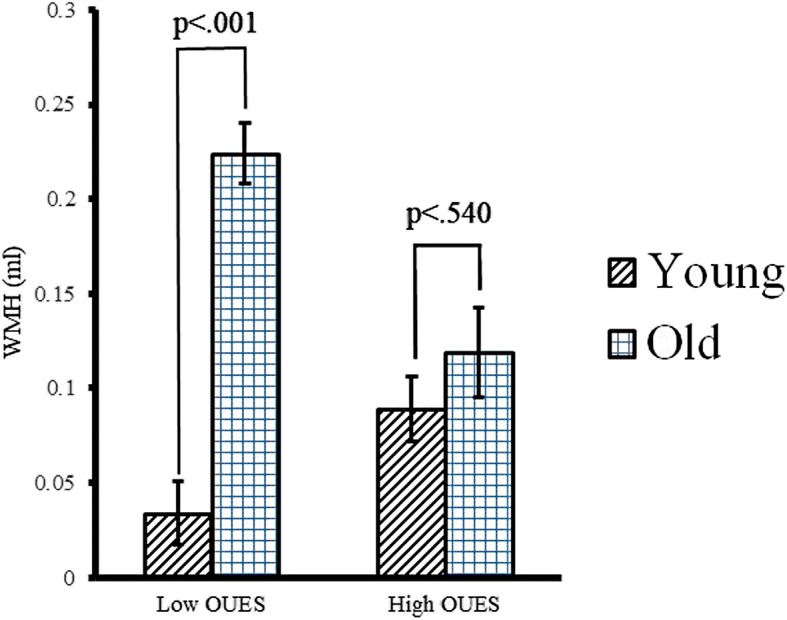
As expected, there was a significant association between age and WMH (p < .001). Importantly, there was a significant interaction between age and OUES on WMH (p = .015). Simple main effects analyses revealed that the effect of age on WMH remained significant in the Low OUES group (p < .001) but not in the High OUES group (p = .540), indicating that higher CRF attenuates the deleterious age association with WMH.
Higher CRF tempers the adverse effect of age on WMH. This suggests a potential pathway through which increased aerobic fitness facilitates healthy brain aging, especially among individuals at risk for AD.
年龄是阿尔茨海默病(AD)的主要危险因素,而随年龄增长而更为普遍的脑白质高信号(WMH)可能导致 AD。较高的心肺适能(CRF)已被证明与认知健康有关,并可降低老年人群 AD 相关脑改变的负担。因此,本研究旨在确定 CRF 是否可减弱中年 AD 高危人群中与年龄相关的 WMH 累积。
107 名认知正常、中老年的威斯康星州阿尔茨海默病预防登记处参与者接受了 3T 磁共振成像,并进行了分级最大跑步机运动测试,我们从中计算出耗氧量效率斜率(OUES)作为 CRF 的测量值。使用病变分割工具对总 WMH 进行量化,并按颅内体积进行缩放。线性回归调整 APOE4 携带情况、家族史、体重指数、收缩压和性别,以检验年龄、WMH 和 CRF 之间的关系。
正如预期的那样,年龄与 WMH 之间存在显著相关性(p < .001)。重要的是,年龄与 OUES 对 WMH 的交互作用具有统计学意义(p = .015)。简单主要效应分析显示,在低 OUES 组中,年龄对 WMH 的影响仍然显著(p < .001),但在高 OUES 组中则不显著(p = .540),这表明较高的 CRF 可减轻 WMH 与年龄的不良关联。
较高的 CRF 缓和了年龄对 WMH 的不利影响。这表明,增加有氧运动能力可能通过促进健康的大脑衰老,尤其是在 AD 高危人群中,为这一关联提供了潜在的途径。