School of Sciences, Beijing University of Posts and Telecommunications, Beijing, China.
Center for Systems and Control, College of Engineering, Peking University, Beijing, China.
PLoS Comput Biol. 2018 Sep 25;14(9):e1006035. doi: 10.1371/journal.pcbi.1006035. eCollection 2018 Sep.
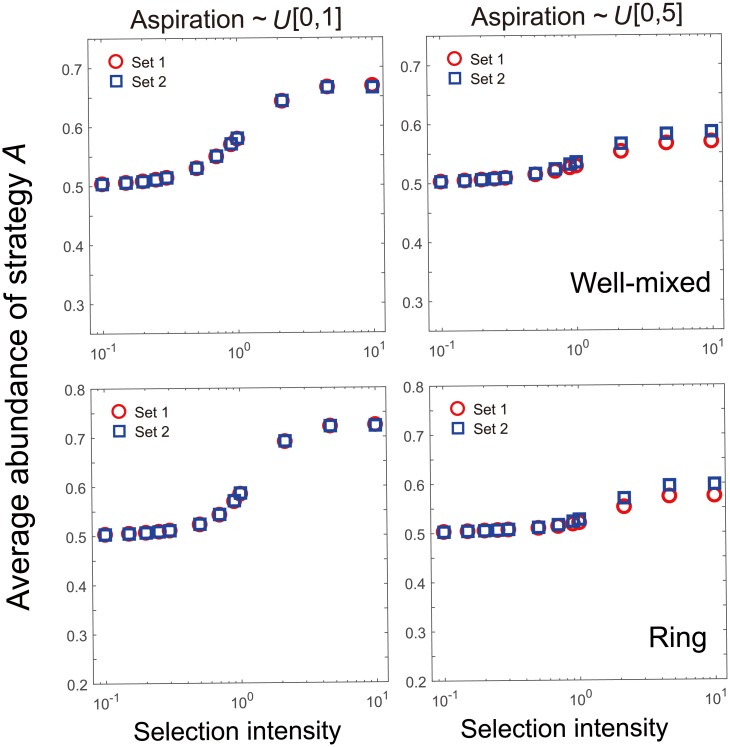
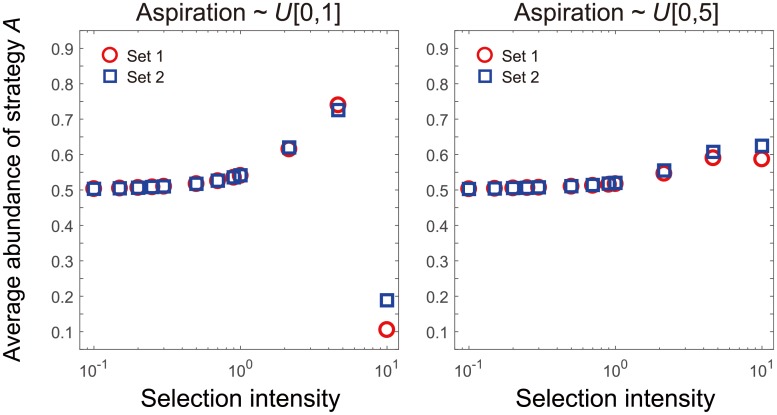
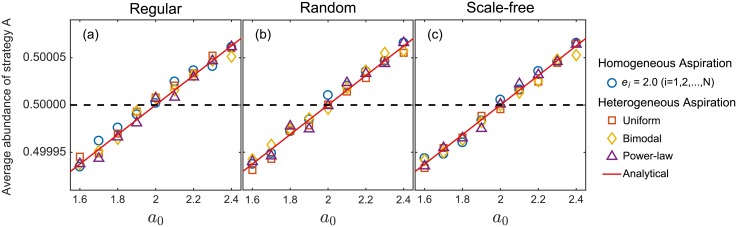
Cooperation is key for the evolution of biological systems ranging from bacteria communities to human societies. Evolutionary processes can dramatically alter the cooperation level. Evolutionary processes are typically of two classes: comparison based and self-evaluation based. The fate of cooperation is extremely sensitive to the details of comparison based processes. For self-evaluation processes, however, it is still unclear whether the sensitivity remains. We concentrate on a class of self-evaluation processes based on aspiration, where all the individuals adjust behaviors based on their own aspirations. We prove that the evolutionary outcome with heterogeneous aspirations is the same as that of the homogeneous one for regular networks under weak selection limit. Simulation results further suggest that it is also valid for general networks across various distributions of personalised aspirations. Our result clearly indicates that self-evaluation processes are robust in contrast with comparison based rules. In addition, our result greatly simplifies the calculation of the aspiration dynamics, which is computationally expensive.
合作是从细菌群落到人类社会等各种生物系统进化的关键。进化过程可以极大地改变合作水平。进化过程通常分为两类:基于比较的和基于自我评估的。合作的命运对基于比较的过程的细节极其敏感。然而,对于自我评估过程,其敏感性是否仍然存在尚不清楚。我们专注于一类基于愿望的自我评估过程,其中所有个体都根据自己的愿望调整行为。我们证明,在弱选择极限下,对于规则网络,具有异质愿望的进化结果与同质愿望的进化结果相同。模拟结果进一步表明,对于具有各种个性化愿望分布的一般网络,该结果也是有效的。我们的结果清楚地表明,与基于比较的规则相比,自我评估过程具有更强的稳健性。此外,我们的结果大大简化了愿望动态的计算,这在计算上是很昂贵的。