Center for Metabolic and Vascular Biology, Arizona State University, Scottsdale, AZ 85259, United States of America.
College of Medicine, Mayo Clinic Arizona, Scottsdale, AZ 85259, United States of America.
Metabolism. 2018 Dec;89:18-26. doi: 10.1016/j.metabol.2018.09.006. Epub 2018 Sep 22.
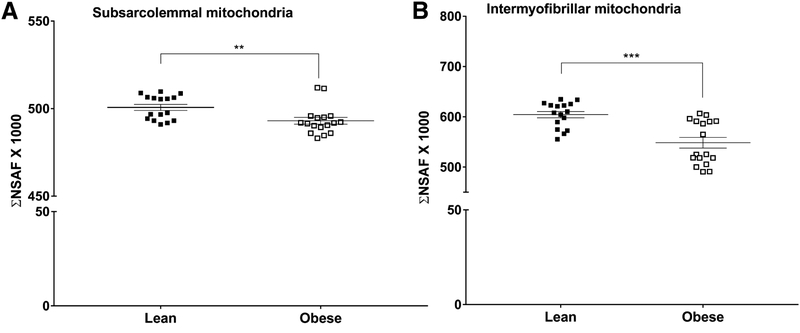
Skeletal muscle mitochondrial content and function appear to be altered in obesity. Mitochondria in muscle are found in well-defined regions within cells, and they are arranged in a way that form distinct subpopulations of subsarcolemmal (SS) and intermyofibrillar (IMF) mitochondria. We sought to investigate differences in the proteomes of SS and IMF mitochondria between lean subjects and subjects with obesity.
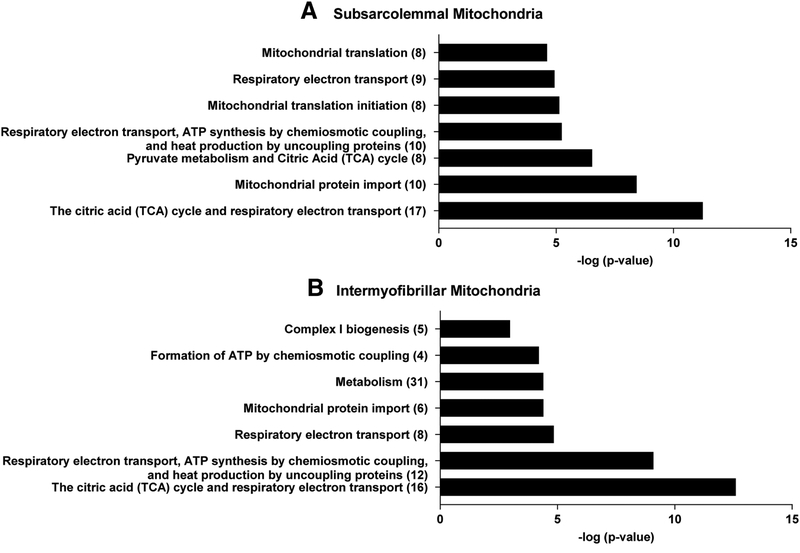
We performed comparative proteomic analyses on SS and IMF mitochondria isolated from muscle samples obtained from lean subjects and subjects with obesity. Mitochondria were isolated using differential centrifugation, and proteins were subjected to label-free quantitative tandem mass spectrometry analyses. Collected data were evaluated for abundance of mitochondrial proteins using spectral counting. The Reactome pathway database was used to determine metabolic pathways that are altered in obesity.
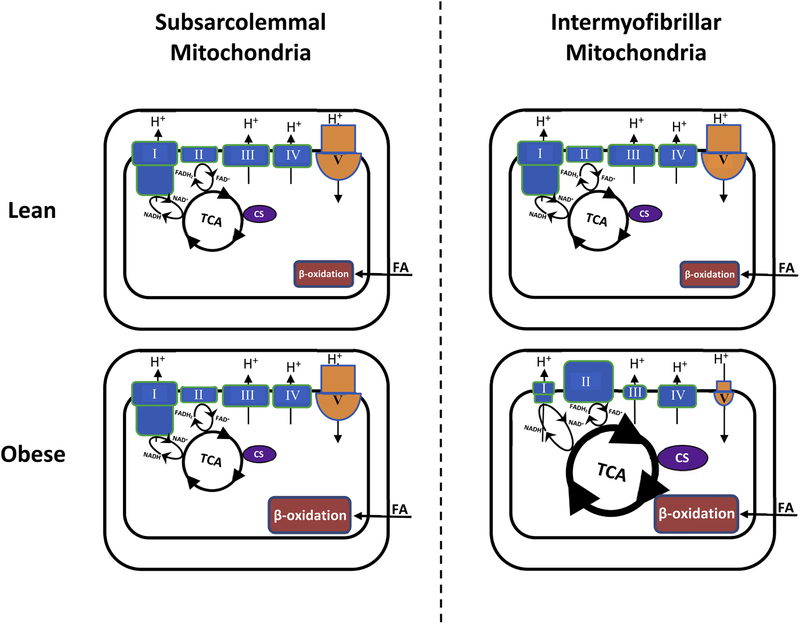
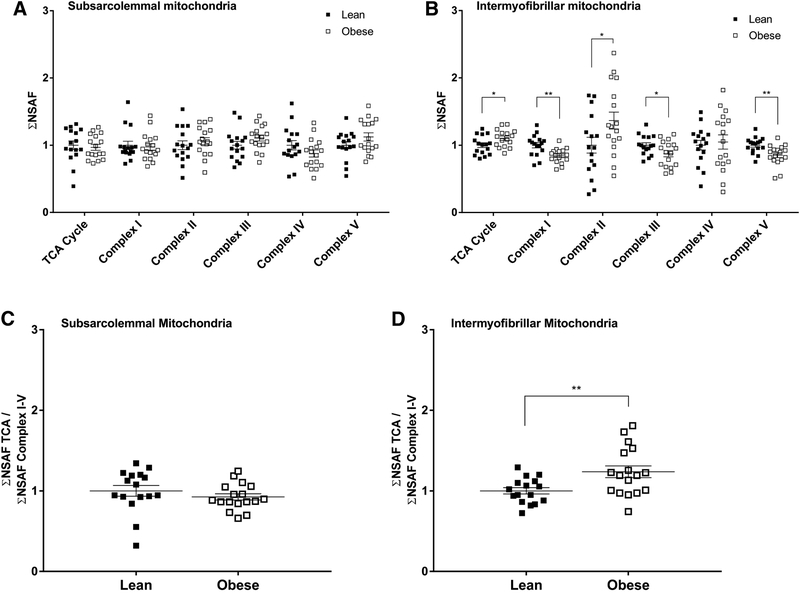
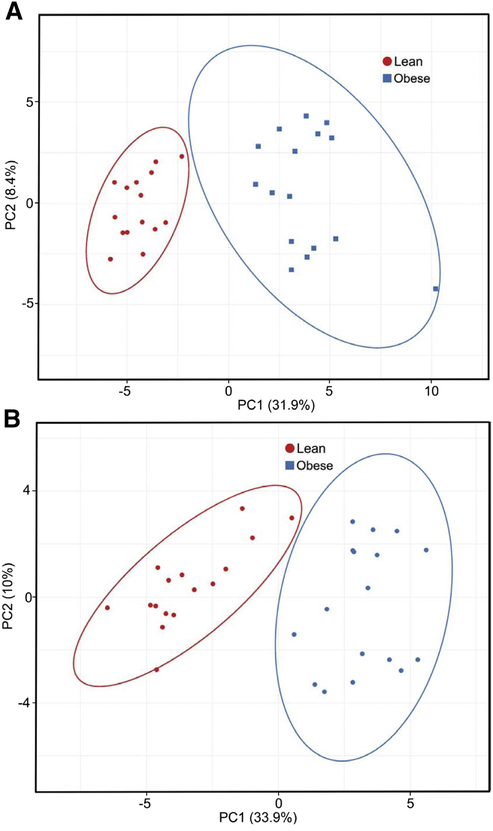
Among proteins, 73 and 41 proteins showed different (mostly lower) expression in subjects with obesity in the SS and IMF mitochondria, respectively (false discovery rate-adjusted P ≤ 0.05). We specifically found an increase in proteins forming the tricarboxylic acid cycle and electron transport chain (ETC) complex II, but a decrease in proteins forming protein complexes I and III of the ETC and adenosine triphosphate (ATP) synthase in subjects with obesity in the IMF, but not SS, mitochondria. Obesity was associated with differential effects on metabolic pathways linked to protein translation in the SS mitochondria and ATP formation in the IMF mitochondria.
Obesity alters the expression of mitochondrial proteins regulating key metabolic processes in skeletal muscle, and these effects are distinct to mitochondrial subpopulations located in different regions of the muscle fibers.
ClinicalTrials.gov (NCT01824173).
肥胖会改变骨骼肌中线粒体的含量和功能。肌肉中的线粒体存在于细胞内的特定区域,它们的排列方式形成了独特的亚群,包括位于肌小节下的(SS)和肌纤维间的(IMF)线粒体。我们试图研究瘦素体和肥胖体之间 SS 和 IMF 线粒体的蛋白质组差异。
我们对来自瘦素体和肥胖体的肌肉样本中分离的 SS 和 IMF 线粒体进行了比较蛋白质组学分析。使用差速离心法分离线粒体,并用无标记定量串联质谱分析蛋白质。使用光谱计数法评估线粒体蛋白的丰度。使用 Reactome 途径数据库确定肥胖改变的代谢途径。
在蛋白质中,73 种和 41 种蛋白质在 SS 和 IMF 线粒体中分别表现出不同(大多数较低)的表达(假发现率调整后的 P 值均≤0.05)。我们特别发现,在 IMF 线粒体中,形成三羧酸循环和电子传递链(ETC)复合物 II 的蛋白质增加,但形成 ETC 复合物 I 和 III 以及三磷酸腺苷(ATP)合酶的蛋白质减少;而在 SS 线粒体中,肥胖与代谢途径的差异效应相关,这些代谢途径与蛋白质翻译有关。
肥胖改变了调节骨骼肌关键代谢过程的线粒体蛋白的表达,这些影响与位于肌肉纤维不同区域的线粒体亚群有关。
ClinicalTrials.gov(NCT01824173)。