Carlsson Isabelle, Breding Karin, Larsson P-G
Skaraborg Hospital Skövde, Lövängsvägen, Skövde, Sweden.
Department of Obstetrics and Gynecology, Skaraborg Hospital Skövde, Skövde, Sweden.
BMC Womens Health. 2018 Sep 25;18(1):158. doi: 10.1186/s12905-018-0645-6.
Induced abortion is one of the most common gynecological procedures in Sweden, but there is still little knowledge about the adverse effects. The aims of this study are to provide an overview of complications of medical and surgical abortions and to evaluate the impact of bacterial screening to prevent postabortal infections.
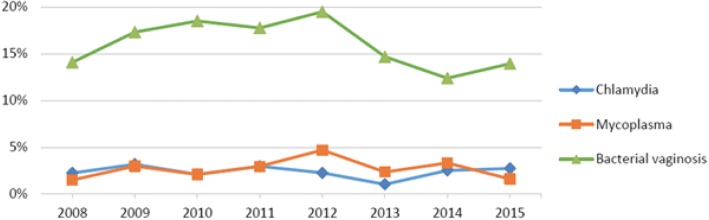
All women who underwent induced abortion at Skaraborg Hospital between 2008 and 2015 are included in the study. Bacterial screening for chlamydia, gonorrhea, mycoplasma, and bacterial vaginosis was performed prior to the abortions. Abortion complications, categorized as bleeding, infection, or incomplete abortion were assessed in women who came in contact with the gynecological clinic within 30 days after the procedure.
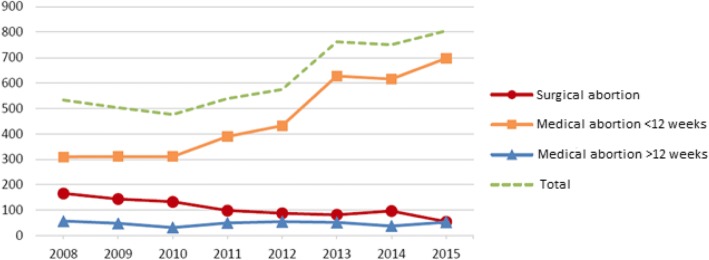
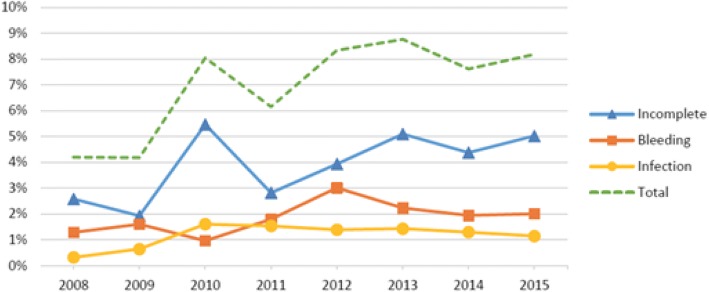
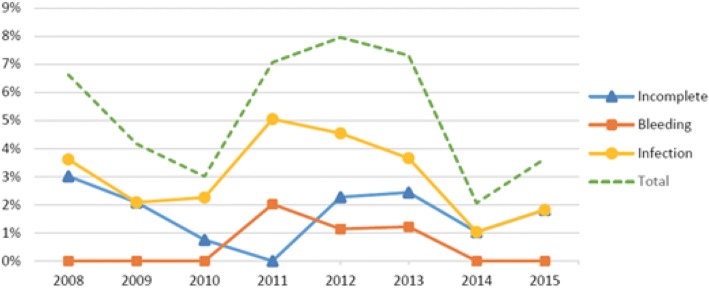
A total of 4945 induced abortions were performed during the study period. Nearly all, 4945 (99.7%) were eligible for inclusion in the study. Medical abortions < 12 weeks were the most common procedure (74.7%), followed by surgical abortions (17.5%), and medical abortion > 12 weeks (7.8%). Complications were registered in 333 (6.7%) of all abortions. Among medical abortions < 12 weeks, the complication frequency increased significantly, from 4.2% in 2008 to 8.2% in 2015 (RR 1.49, 95% 1.04-2.15). An incomplete abortion was the most common complication related to medical abortions < 12 weeks. Of all women who tested positive for one or several bacteria at the screening and therefore received antibiotics, 1.4% developed a postabortal infection. Among those who tested negative at the screening, 1.7% developed infectious complications.
The share of complications related to medical abortions < 12 weeks increased significantly during 2008-2015 without any evident cause. Women who tested positive for one or several bacteria upon screening and received antibiotics experienced almost an equal proportion of postabortal infections compared to women who tested negative upon screening. The screening process seems to fulfill its purpose of reducing the risk of infectious complications.
人工流产是瑞典最常见的妇科手术之一,但对其不良影响仍知之甚少。本研究的目的是概述药物流产和手术流产的并发症,并评估细菌筛查对预防流产后感染的影响。
纳入2008年至2015年在斯卡罗堡医院接受人工流产的所有女性。在流产前对衣原体、淋病、支原体和细菌性阴道病进行细菌筛查。对术后30天内与妇科门诊接触的女性评估流产并发症,分为出血、感染或流产不全。
研究期间共进行了4945例人工流产。几乎所有4945例(99.7%)符合纳入研究的条件。妊娠12周以内的药物流产是最常见的手术(74.7%),其次是手术流产(17.5%),以及妊娠12周以上的药物流产(7.8%)。所有流产中有333例(6.7%)记录了并发症。在妊娠12周以内的药物流产中,并发症发生率显著增加,从2008年的4.2%增至2015年的8.2%(相对危险度1.49,95%可信区间1.04 - 2.15)。流产不全是与妊娠12周以内药物流产相关的最常见并发症。在筛查中一种或几种细菌检测呈阳性并因此接受抗生素治疗的所有女性中,1.4%发生了流产后感染。在筛查中检测呈阴性的女性中,1.7%发生了感染性并发症。
2008 - 2015年期间,与妊娠12周以内药物流产相关的并发症比例显著增加,且无明显原因。筛查中一种或几种细菌检测呈阳性并接受抗生素治疗的女性与筛查中检测呈阴性的女性发生流产后感染的比例几乎相同。筛查过程似乎实现了降低感染性并发症风险的目的。