Kentrop Jiska, Smid Claire R, Achterberg E J M, van IJzendoorn Marinus H, Bakermans-Kranenburg Marian J, Joëls Marian, van der Veen Rixt
Department of Translational Neuroscience, Brain Center Rudolf Magnus, University Medical Center Utrecht, Utrecht University, Utrecht, Netherlands.
Department of Animals in Science and Society, Division of Behavioral Neuroscience, Faculty of Veterinary Medicine, Utrecht University, Utrecht, Netherlands.
Front Behav Neurosci. 2018 Sep 11;12:193. doi: 10.3389/fnbeh.2018.00193. eCollection 2018.
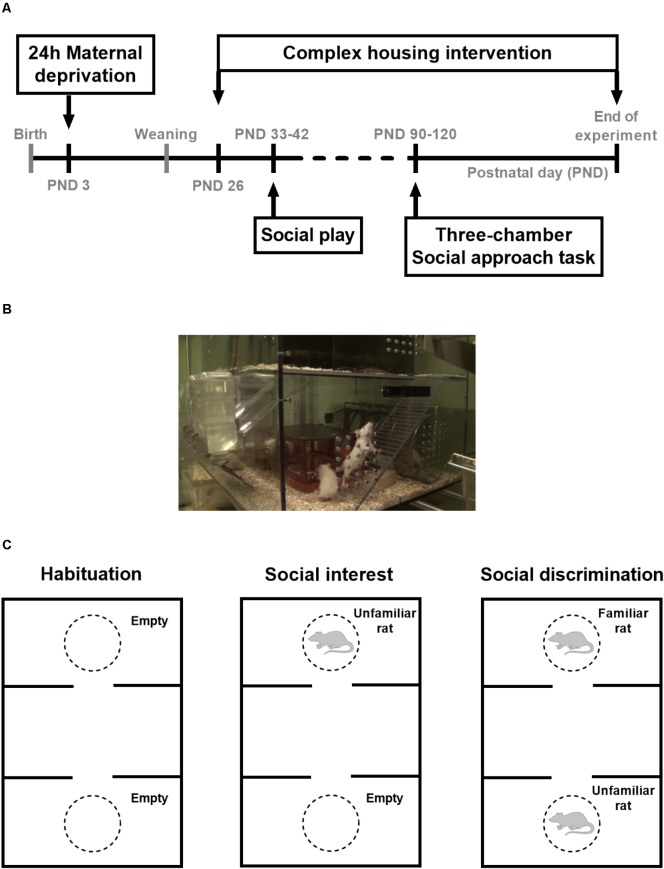
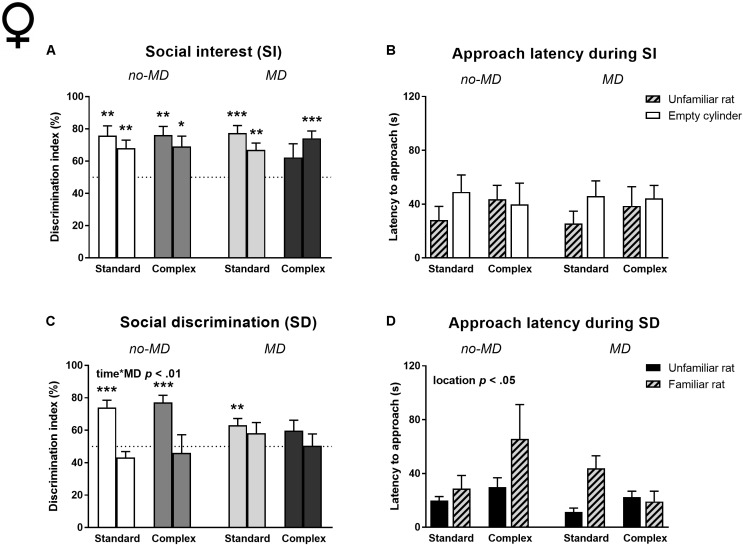
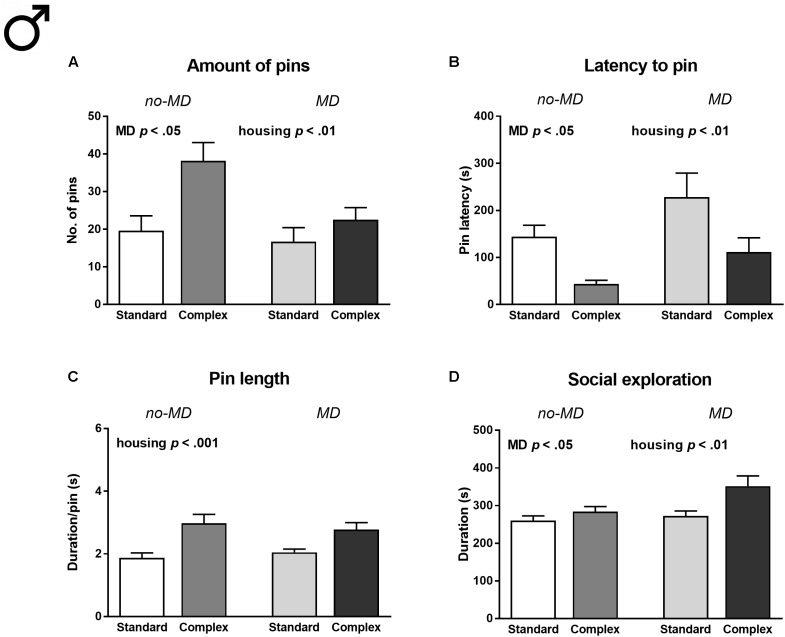
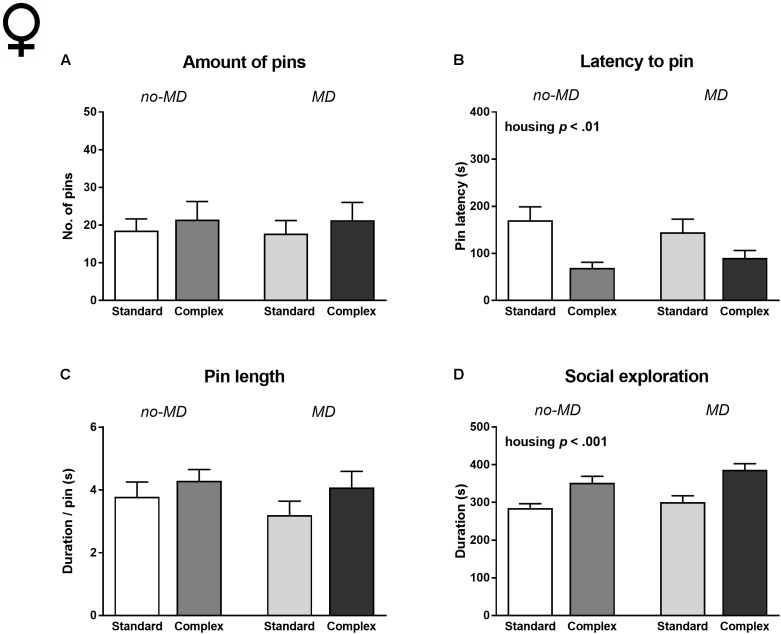
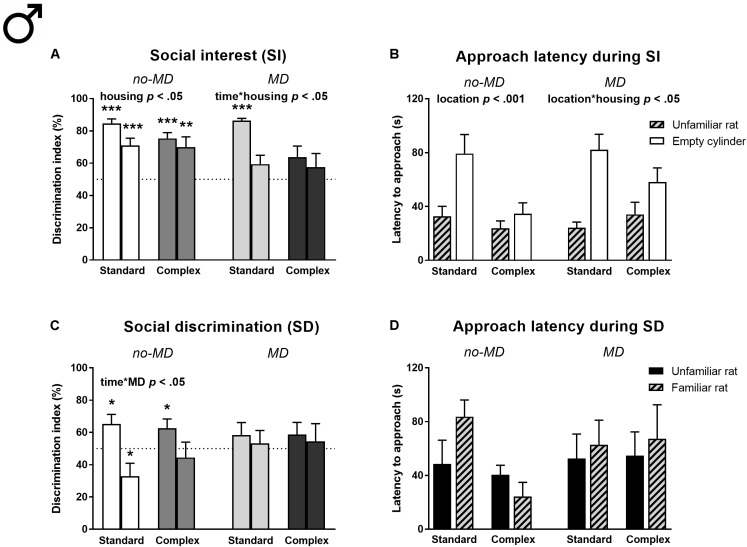
Early life context and stressful experiences are known to increase the risk of developing psychiatric disorders later in life, including disorders with deficits in the social domain. Our study aimed to investigate the influence of early life environment on social behavior in a well-controlled animal model. To this end we tested the effects of maternal deprivation (MD) on rat social play behavior in adolescence and social interaction in adulthood. Additionally, we provided a stimulating environment during adolescence (complex housing) as a potential intervention to diminish the effects of early life stress. Male and female Wistar rats were deprived from their mother for 24 h on postnatal day 3 (PND 3) or were left undisturbed. Complex housing started 5 days after weaning and consisted of housing 10 same-sex conspecifics in large, two-floor Marlau cages until the end of the study. Social play behavior in adolescence was tested under different conditions (3 h vs. 24 h social isolation prior to testing). Maternally deprived males - but not females - showed a longer latency to play and a decreased total amount of social play behavior, after a 24 h isolation period. In adulthood, social discrimination was impaired in deprived male and female rats in the three-chamber social approach task. Complex housing did not moderate the effects of MD, but in itself induced a strong behavioral phenotype. Both complex housed males and females hardly displayed any play behavior after a 3 h isolation period. However, after 24 h of isolation, these animals showed shorter latencies to engage in social play behavior. Only complex housed males truly showed more social play behavior here, while showing less social interest in adulthood. We conclude that MD has mild negative effects on social behavior in adolescence and adulthood, which are not counteracted by complex housing. Complex housing induces a specific phenotype associated with rapid habituation; a lack of social play after short isolation periods, while increasing play behavior after a prolonged period of isolation in adolescence, and less social interest, paired with intact social discrimination in adulthood. In both early life settings, males seem to be more influenced by the early life environment compared to females.
众所周知,早期生活环境和应激经历会增加日后患精神疾病的风险,包括社交领域存在缺陷的疾病。我们的研究旨在通过一个严格控制的动物模型来探究早期生活环境对社交行为的影响。为此,我们测试了母婴分离(MD)对大鼠青春期社交玩耍行为和成年期社交互动的影响。此外,我们在青春期提供了一个刺激性环境(复杂饲养环境),作为一种潜在干预措施,以减轻早期生活应激的影响。雄性和雌性Wistar大鼠在出生后第3天(PND 3)被与其母亲分离24小时,或不受干扰。复杂饲养环境在断奶后5天开始,包括将10只同性同种个体饲养在大型双层Marlau笼中,直至研究结束。青春期的社交玩耍行为在不同条件下进行测试(测试前3小时与24小时社交隔离)。经过24小时隔离期后,母婴分离的雄性大鼠——而非雌性大鼠——表现出玩耍潜伏期延长和社交玩耍行为总量减少。在成年期,在三室社交趋近任务中,母婴分离的雄性和雌性大鼠的社交辨别能力受损。复杂饲养环境并未缓和母婴分离的影响,但它本身会诱发一种强烈的行为表型。经过3小时隔离期后,无论是处于复杂饲养环境中的雄性大鼠还是雌性大鼠,几乎都不表现出任何玩耍行为。然而,经过24小时隔离后,这些动物参与社交玩耍行为的潜伏期缩短。只有处于复杂饲养环境中的雄性大鼠在此处真正表现出更多的社交玩耍行为,而在成年期表现出较少的社交兴趣。我们得出结论,母婴分离对青春期和成年期的社交行为有轻微负面影响,复杂饲养环境无法抵消这些影响。复杂饲养环境诱发了一种与快速习惯化相关的特定表型;在短时间隔离后缺乏社交玩耍行为,而在青春期长时间隔离后增加玩耍行为,以及社交兴趣减少,同时在成年期保持完整的社交辨别能力。在这两种早期生活环境中,与雌性相比,雄性似乎更容易受到早期生活环境的影响。