Xu Yuan-Yuan, Feng Zheng-Quan, Xie Yuan-Jun, Zhang Jin, Peng Shu-Hao, Yu Yong-Ju, Li Min
Department of Military Psychology, Army Medical University, Chongqing, China.
The Fifth Department of Daping Hospital & Surgery Institute, Army Medical University, Chongqing, China.
Front Psychiatry. 2018 Sep 11;9:432. doi: 10.3389/fpsyt.2018.00432. eCollection 2018.
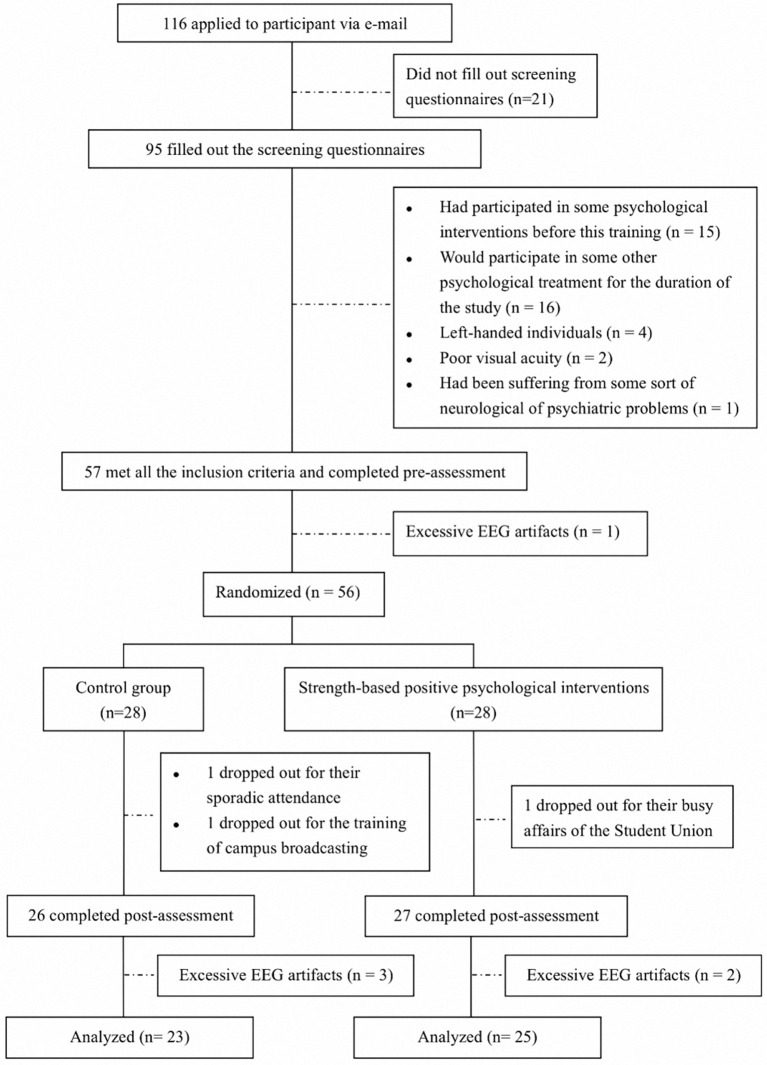
Subjective well-being (SWB) refers to traits concerned with happiness, fulfillment and enrichment and is a substantial predictor of a flourishing life. Interest in the promotion of well-being has blossomed in recent years, and it is widely reported that positive psychological interventions (PPIs) can effectively improve SWB. However, to date, the neural correlates of PPIs remain elusive. Since previous research has suggested that emotion regulation might be the theoretical foundation for potential working mechanisms, here we used electroencephalography (EEG) techniques to identify whether the intentional increase of subjective well-being through PPIs was associated with greater tonic left frontal activation. Fifty-five students met the inclusion criteria and were allocated to a randomized controlled trial that was single blinded. The intervention group received PPIs once a week for 10 weeks ( = 28). Meanwhile, students in a placebo control group (CG, = 27) were asked to write down early memories every day for 10 weeks and were invited to share voluntarily at the weekly meeting. Measures of subjective well-being, depression and anxiety were assessed at pre-test and post-test. Forty-eight students completed the post-test, and the collected data were analyzed across time (PPIs, = 25; CG, = 23). It was found that students undergoing the 10-week PPIs reported larger improvement in SWB, and greater relief in self-rated depression and anxiety from pre-intervention to post-intervention than did those in the control group. As expected, in conjunction with the promotion of subjective well-being and the amelioration of emotional distress from pre- to post-treatment in the intervention group, a significantly increased coefficient of frontal alpha EEG asymmetry was found. In summary, these findings suggest that adaptive emotion regulation, which is characteristic of greater tonic left frontal activation, reflects the efficiency of PPIs and highlights the frontal alpha EEG asymmetry as a neural substrate linking PPIs and mental health.
ChiCTR-ROC-17012636.
主观幸福感(SWB)指的是与幸福、满足和充实相关的特质,是美好生活的重要预测指标。近年来,人们对促进幸福感的兴趣日益浓厚,并且有广泛报道称积极心理干预(PPI)能够有效改善主观幸福感。然而,迄今为止,积极心理干预的神经关联仍不明确。由于先前的研究表明情绪调节可能是潜在作用机制的理论基础,因此我们在此使用脑电图(EEG)技术来确定通过积极心理干预有意提高主观幸福感是否与更强的静息左额叶激活有关。55名学生符合纳入标准,并被分配到一项单盲随机对照试验中。干预组每周接受一次积极心理干预,共10周(n = 28)。与此同时,安慰剂对照组(CG,n = 27)的学生被要求连续10周每天写下早期记忆,并被邀请在每周会议上自愿分享。在干预前和干预后评估主观幸福感、抑郁和焦虑指标。48名学生完成了干预后测试,并对收集到的数据进行了跨时间分析(积极心理干预组,n = 25;对照组,n = 23)。结果发现,接受10周积极心理干预的学生在主观幸福感方面的改善更大,并且与对照组相比,从干预前到干预后自评抑郁和焦虑的缓解程度更高。正如预期的那样,随着干预组从治疗前到治疗后主观幸福感的提升和情绪困扰情况的改善,发现额叶α波脑电图不对称系数显著增加。总之,这些发现表明,以更强的静息左额叶激活为特征的适应性情绪调节反映了积极心理干预的效果,并突出了额叶α波脑电图不对称作为连接积极心理干预和心理健康的神经基础。
ChiCTR-ROC-17012636。