Bayne Tim, Carter Olivia
School of Philosophical, Historical and International Studies, 20 Chancellors Walk, Monash University, VIC, Australia.
School of Psychological Sciences, University of Melbourne, Parkville, VIC, Australia.
Neurosci Conscious. 2018 Sep 19;2018(1):niy008. doi: 10.1093/nc/niy008. eCollection 2018.
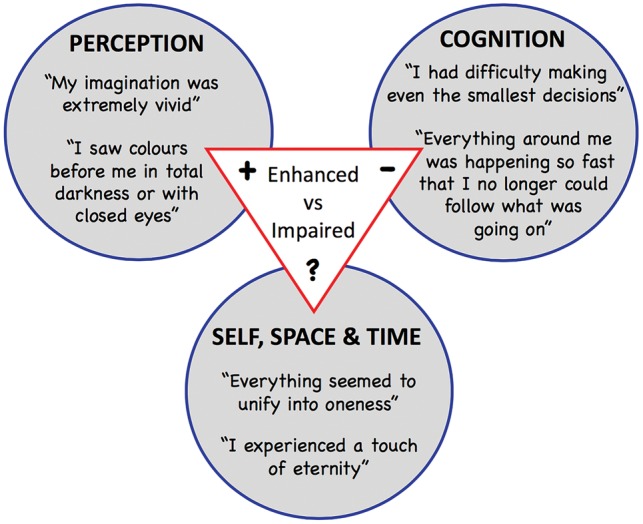
It has often been suggested in the popular and academic literature that the psychedelic state qualifies as a higher state of consciousness relative to the state of normal waking awareness. This article subjects this proposal to critical scrutiny, focusing on the question of what it would mean for a state of consciousness to be 'higher'. We begin by considering the contrast between conscious contents and conscious global states. We then review the changes in conscious global state associated with psychedelic drug use, focusing on the effects of two serotonergic hallucinogens: psilocybin and lysergic acid diethylamide. Limiting our review to findings obtained from lab-based experiments and reported in peer-reviewed journals, we prioritize the more common and reliably induced effects obtained through subjective questionnaires and psychophysical measures. The findings are grouped into three broad categories (sensory perception, cognitive function, and experiences of unity) and demonstrate that although certain aspects of consciousness are improved or enhanced in the psychedelic state, many of the functional capacities that are associated with consciousness are seriously compromised. Psychedelic-induced states of consciousness are indeed remarkable in many ways, but it is inappropriate to regard them as 'higher' states of consciousness. The fact that psychedelics affect different aspects of consciousness in fundamentally different ways provides evidence against the unidimensional (or 'level-based') view of consciousness, and instead provides strong support for a multidimensional conception of conscious states. The final section of the article considers the implications of this analysis for two prominent theories of consciousness: the Global Workspace Theory and Integrated Information Theory.
在大众和学术文献中,人们常认为迷幻状态相对于正常清醒意识状态而言,可被视作一种更高层次的意识状态。本文对这一观点进行批判性审视,重点关注意识状态“更高”意味着什么这一问题。我们首先思考意识内容与整体意识状态之间的差异。接着,我们回顾与使用迷幻药物相关的整体意识状态变化,重点关注两种血清素能致幻剂的效果:裸盖菇素和麦角酸二乙酰胺。我们将综述限定于基于实验室实验并发表在同行评审期刊上的研究结果,优先考虑通过主观问卷和心理物理学测量获得的更常见且可靠的诱导效应。研究结果分为三大类(感官知觉、认知功能和统一体验),表明尽管在迷幻状态下意识的某些方面有所改善或增强,但许多与意识相关的功能能力却受到严重损害。迷幻剂诱导的意识状态在许多方面确实引人注目,但将它们视为“更高层次”的意识状态是不合适的。迷幻剂以根本不同的方式影响意识的不同方面这一事实,为反对意识的单维(或“基于层次”)观点提供了证据,反而为意识状态的多维概念提供了有力支持。文章的最后一部分思考了这一分析对两种著名意识理论的影响:全局工作空间理论和整合信息理论。