Auerbach Jonathan, Howey Richard, Jiang Lai, Justice Anne, Li Liming, Oualkacha Karim, Sayols-Baixeras Sergi, Aslibekyan Stella W
Department of Statistics, Columbia University, 1255 Amsterdam Ave, New York, NY, 10027, USA.
Institute of Genetic Medicine, Newcastle University, Central Parkway, Newcastle-upon-Tyne, NE1 3BZ, UK.
BMC Genet. 2018 Sep 17;19(Suppl 1):74. doi: 10.1186/s12863-018-0645-4.
Increasingly available multilayered omics data on large populations has opened exciting analytic opportunities and posed unique challenges to robust estimation of causal effects in the setting of complex disease phenotypes. The GAW20 Causal Modeling Working Group has applied complementary approaches (eg, Mendelian randomization, structural equations modeling, Bayesian networks) to discover novel causal effects of genomic and epigenomic variation on lipid phenotypes, as well as to validate prior findings from observational studies.
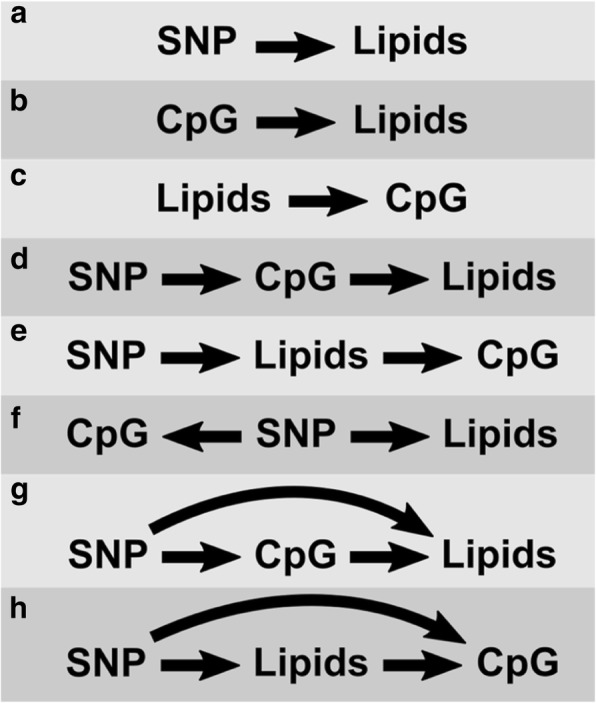
Two Mendelian randomization studies have applied novel approaches to instrumental variable selection in methylation data, identifying bidirectional causal effects of CPT1A and triglycerides, as well as of RNMT and C6orf42, on high-density lipoprotein cholesterol response to fenofibrate. The CPT1A finding also emerged in a Bayesian network study. The Mendelian randomization studies have implemented both existing and novel steps to account for pleiotropic effects, which were independently detected in the GAW20 data via a structural equation modeling approach. Two studies estimated indirect effects of genomic variation (via DNA methylation and/or correlated phenotypes) on lipid outcomes of interest. Finally, a novel weighted R measure was proposed to complement other causal inference efforts by controlling for the influence of outlying observations.
The GAW20 contributions illustrate the diversity of possible approaches to causal inference in the multi-omic context, highlighting the promises and assumptions of each method and the benefits of integrating both across methods and across omics layers for the most robust and comprehensive insights into disease processes.
关于大量人群的多层组学数据越来越多,这为因果效应的稳健估计带来了令人兴奋的分析机会,并在复杂疾病表型背景下提出了独特挑战。GAW20因果建模工作组应用了互补方法(例如,孟德尔随机化、结构方程建模、贝叶斯网络)来发现基因组和表观基因组变异对脂质表型的新因果效应,以及验证观察性研究的先前发现。
两项孟德尔随机化研究在甲基化数据中应用了新的工具变量选择方法,确定了CPT1A和甘油三酯以及RNMT和C6orf42对非诺贝特治疗高密度脂蛋白胆固醇反应的双向因果效应。CPT1A的研究结果也出现在一项贝叶斯网络研究中。孟德尔随机化研究实施了现有步骤和新步骤来解释多效性效应,这些效应通过结构方程建模方法在GAW20数据中被独立检测到。两项研究估计了基因组变异(通过DNA甲基化和/或相关表型)对感兴趣的脂质结果的间接效应。最后,提出了一种新的加权R测量方法,通过控制异常观测值的影响来补充其他因果推断方法。
GAW20的研究成果说明了在多组学背景下因果推断可能方法的多样性,突出了每种方法的前景和假设,以及跨方法和跨组学层整合的好处,以便对疾病过程获得最稳健和全面的见解。