Département de Biologie, Faculté des Sciences, Université de Sherbrooke, Sherbrooke, Quebec, Canada.
Département de Biologie, Faculté des Sciences, Université de Sherbrooke, Sherbrooke, Quebec, Canada
mSphere. 2018 Sep 26;3(5):e00473-18. doi: 10.1128/mSphere.00473-18.
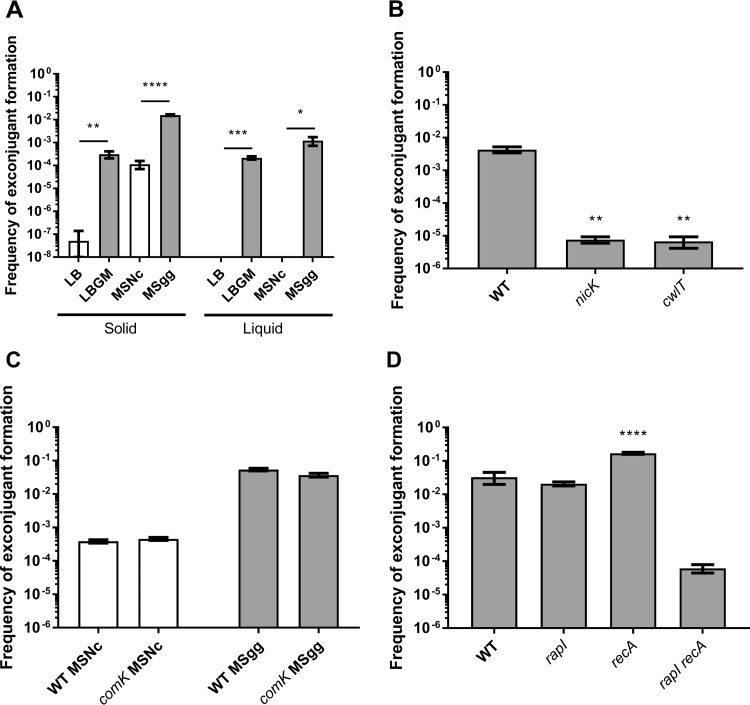
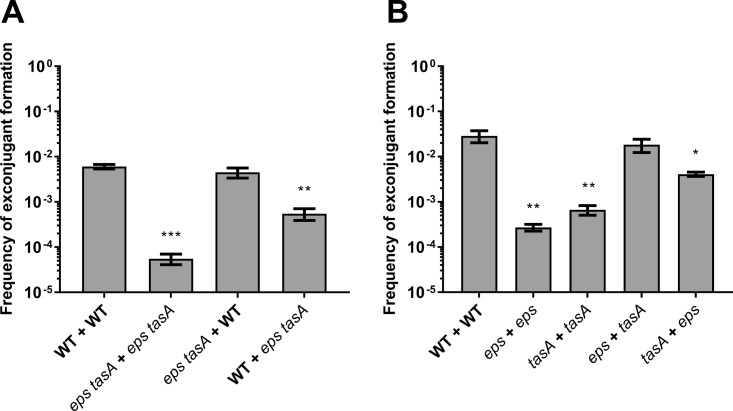
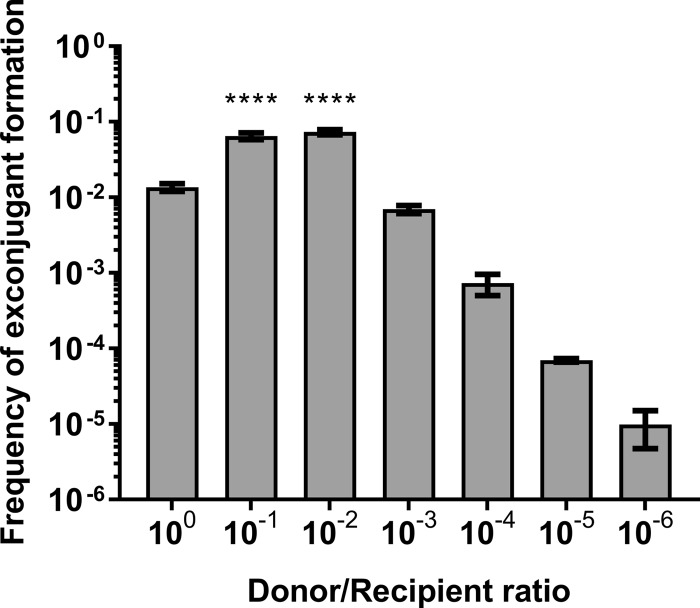
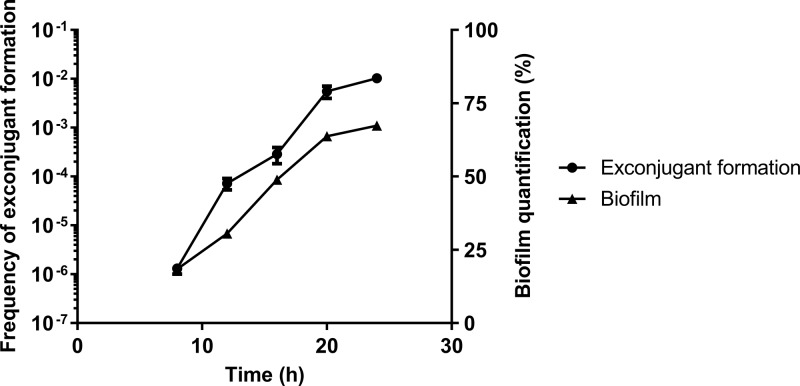
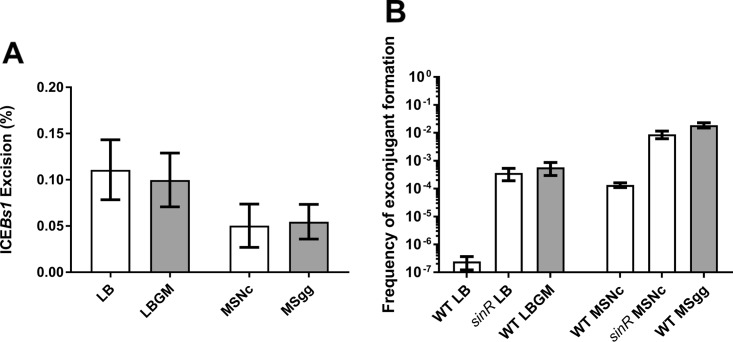
Horizontal gene transfer by integrative and conjugative elements (ICEs) is a very important mechanism for spreading antibiotic resistance in various bacterial species. In environmental and clinical settings, most bacteria form biofilms as a way to protect themselves against extracellular stress. However, much remains to be known about ICE transfer in biofilms. Using ICE from , we show that the natural conjugation efficiency of this ICE is greatly affected by the ability of the donor and recipient to form a biofilm. ICE transfer considerably increases in biofilm, even at low donor/recipient ratios. Also, while there is a clear temporal correlation between biofilm formation and ICE transfer, biofilms do not alter the level of ICE excision in donor cells. Conjugative transfer appears to be favored by the biophysical context of biofilms. Indeed, extracellular matrix production, particularly from the recipient cells, is essential for biofilms to promote ICE transfer. Our study provides basic new knowledge on the high rate of conjugative transfer of ICEs in biofilms, a widely preponderant bacterial lifestyle in the environment, which could have a major impact on our understanding of horizontal gene transfer in natural and clinical environments. Transfer of mobile genetic elements from one bacterium to another is the principal cause of the spread of antibiotic resistance. However, the dissemination of these elements in environmental contexts is poorly understood. In clinical and environmental settings, bacteria are often found living in multicellular communities encased in a matrix, a structure known as a biofilm. In this study, we examined how forming a biofilm influences the transmission of an integrative and conjugative element (ICE). Using the model Gram-positive bacterium , we observed that biofilm formation highly favors ICE transfer. This increase in conjugative transfer is due to the production of extracellular matrix, which creates an ideal biophysical context. Our study provides important insights into the role of the biofilm structure in driving conjugative transfer, which is of major importance since biofilm is a widely preponderant bacterial lifestyle for clinically relevant bacterial strains.
水平基因转移通过整合和共轭元件(ICEs)是在各种细菌物种中传播抗生素抗性的非常重要的机制。在环境和临床环境中,大多数细菌形成生物膜作为一种保护自己免受细胞外应激的方式。然而,关于 ICE 在生物膜中的转移仍然有很多未知之处。使用 中的 ICE,我们表明,这种 ICE 的自然共轭效率受到供体和受体形成生物膜的能力的极大影响。在生物膜中,ICE 转移大大增加,即使在供体/受体比例较低的情况下也是如此。此外,虽然生物膜形成和 ICE 转移之间存在明显的时间相关性,但生物膜不会改变供体细胞中 ICE 切除的水平。共轭转移似乎受到生物膜的生物物理环境的青睐。事实上,细胞外基质的产生,特别是来自受体细胞的产生,对于促进 ICE 转移的生物膜是必不可少的。我们的研究为环境中广泛存在的细菌生活方式生物膜中 ICE 高共轭转移率提供了基本的新知识,这可能对我们理解自然和临床环境中的水平基因转移产生重大影响。从一种细菌到另一种细菌转移移动遗传元件是抗生素抗性传播的主要原因。然而,这些元素在环境背景下的传播知之甚少。在临床和环境环境中,细菌通常被发现在基质中包裹的多细胞群落中生活,这种结构称为生物膜。在这项研究中,我们研究了形成生物膜如何影响整合和共轭元件(ICE)的传输。使用模型革兰氏阳性菌 ,我们观察到生物膜形成高度有利于 ICE 转移。这种共轭转移的增加是由于细胞外基质的产生,它创造了一个理想的生物物理环境。我们的研究提供了关于生物膜结构在驱动共轭转移中的作用的重要见解,这对于具有重要意义,因为生物膜是与临床相关的细菌菌株的广泛存在的细菌生活方式。