Selvam Balaji, Mittal Shriyaa, Shukla Diwakar
Department of Chemical and Biomolecular Engineering, Center for Biophysics and Quantitative Biology, and Department of Plant Biology, University of Illinois at Urbana-Champaign, Urbana, Illinois, United States.
ACS Cent Sci. 2018 Sep 26;4(9):1146-1154. doi: 10.1021/acscentsci.8b00330. Epub 2018 Aug 28.
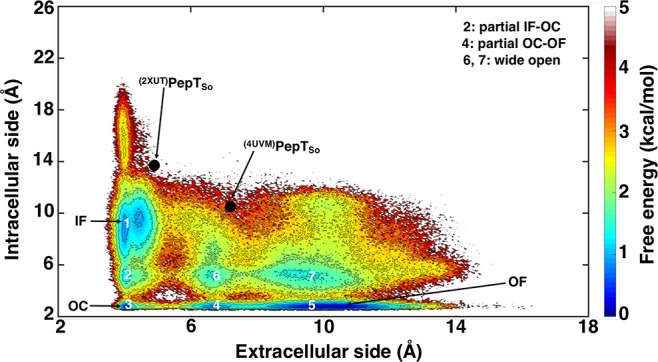
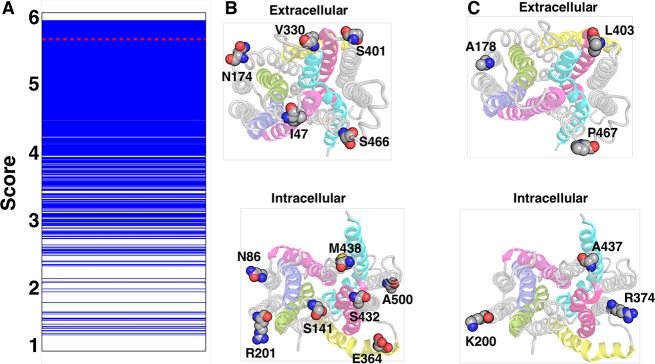
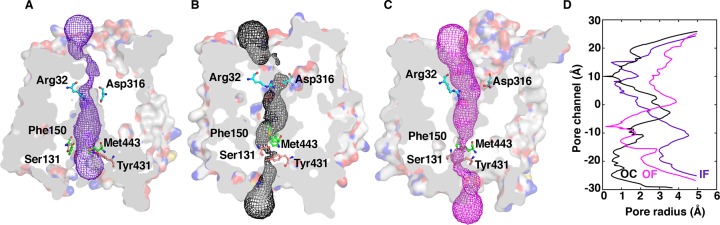
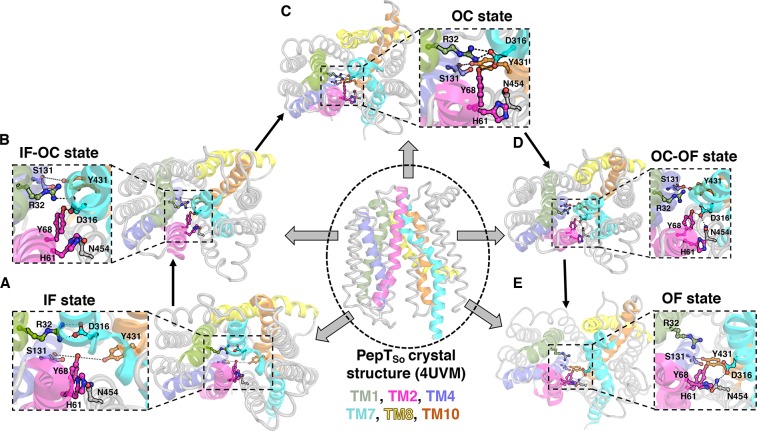
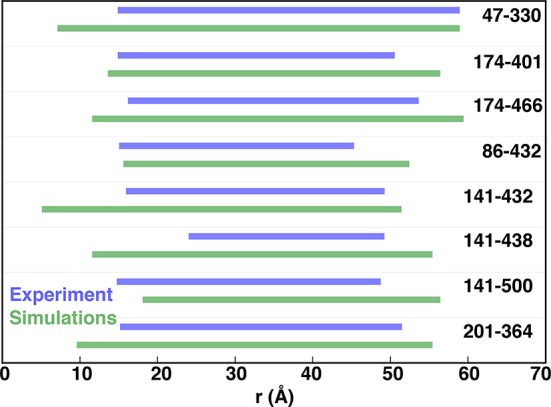
PepT is a proton-coupled bacterial symporter, from the major facilitator superfamily (MFS), which transports di-/tripeptide molecules. The recently obtained crystal structure of PepT provides an unprecedented opportunity to gain an understanding of functional insights of the substrate transport mechanism. Binding of the proton and peptide molecule induces conformational changes into occluded (OC) and outward-facing (OF) states, which we are able to characterize using molecular dynamics (MD) simulations. The structural knowledge of the OC and OF state is important to fully understand the major energy barrier associated with the transport cycle. In order to gain functional insight into the interstate dynamics, we performed extensive all atom MD simulations. The Markov state model was constructed to identify the free energy barriers between the states, and kinetic information on intermediate pathways was obtained using the transition pathway theory (TPT). TPT shows that the OF state is obtained by the movement of TM1 and TM7 at the extracellular side approximately 12-16 Å away from each other, and the inward movement of TM4 and TM10 at the intracellular halves to 3-4 Å characterizes the OC state. Helix distance distributions obtained from MD simulations were compared with experimental double electron-electron resonance spectroscopy and were found to be in excellent agreement with previous studies. We also predicted the optimal positions for placement of methane thiosulfonate spin label probes to capture the slowest protein dynamics. Our finding sheds light on the conformational cycle of this key membrane transporter and the functional relationships between the multiple intermediate states.
肽转运蛋白(PepT)是一种质子偶联的细菌同向转运体,属于主要易化子超家族(MFS),负责转运二肽/三肽分子。最近获得的PepT晶体结构为深入了解底物转运机制的功能见解提供了前所未有的机会。质子和肽分子的结合会诱导构象变化,形成封闭(OC)状态和外向(OF)状态,我们能够通过分子动力学(MD)模拟对其进行表征。OC和OF状态的结构知识对于全面理解与转运循环相关的主要能量屏障至关重要。为了深入了解不同状态之间的动力学,我们进行了广泛的全原子MD模拟。构建了马尔可夫状态模型以识别不同状态之间的自由能屏障,并使用过渡路径理论(TPT)获得了中间路径的动力学信息。TPT表明,OF状态是由细胞外侧的跨膜螺旋1(TM1)和跨膜螺旋7(TM7)彼此相距约12 - 16 Å移动形成的,而细胞内半部的TM4和TM10向内移动至3 - 4 Å则表征了OC状态。将MD模拟获得的螺旋距离分布与实验双电子-电子共振光谱进行比较,发现与先前的研究结果非常吻合。我们还预测了甲烷硫代磺酸盐自旋标记探针的最佳放置位置,以捕捉最慢的蛋白质动力学。我们的发现揭示了这种关键膜转运蛋白的构象循环以及多个中间状态之间的功能关系。